409A Valuation: Complete Guide to Section 409A
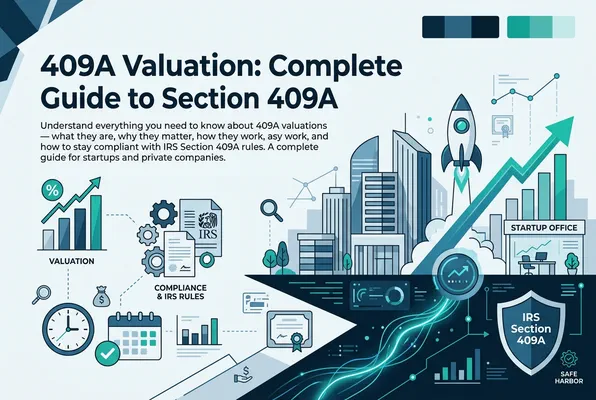

If you’re a founder planning to issue stock options to your team, understanding the 409A valuation process is not optional—it’s essential. Getting it right protects your employees from unexpected tax consequences, keeps your startup on the right side of IRS regulations, and signals to investors that you run a professional, compliance-focused operation. This guide covers everything you need to know about the 409A, from the basics of Section 409A of the Internal Revenue Code to choosing the right valuation provider.
What Is a 409A Valuation?
A 409A valuation is an independent appraisal of the fair market value (FMV) of a private company’s common stock. Because private companies aren’t publicly traded, there’s no open market to determine what a share is worth—so a formal valuation process is required.
The primary purpose of the 409A valuation is to establish the minimum strike price (also called the exercise price) at which employees can purchase stock options. Under IRS Section 409A, stock options must be granted at or above the FMV of common stock on the date of grant. If they’re not, the options may be reclassified as nonqualified deferred compensation, triggering significant adverse tax consequences for the recipient.
Background: Why Was Section 409A Enacted?
Section 409A of the Internal Revenue Code was enacted as part of the American Jobs Creation Act of 2004, taking effect on January 1, 2005. Its passage was largely driven by the Enron scandal, in which highly compensated executives accelerated the payment of tens of millions in deferred compensation just before the company filed for bankruptcy—leaving thousands of ordinary employees with nothing. Lawmakers and the IRS determined that clearer, stricter rules governing nonqualified deferred compensation were necessary to prevent such abuses from recurring.
Before Section 409A, the taxation of nonqualified deferred compensation was governed by a patchwork of common-law doctrines applied inconsistently. Section 409A replaced that ambiguity with a unified set of rules covering deferral elections, timing of distributions, and penalties for non-compliance.
How Section 409A Applies to Startups and Stock Options
Section 409A of the internal revenue code broadly applies to any arrangement that constitutes a “deferral of compensation”—meaning compensation earned in one taxable year that is payable in a later taxable year. The definition is intentionally wide and can capture employment agreements, severance arrangements, change-of-control agreements, and equity compensation plans.
For startups, the most common area of concern is stock options. Because stock options typically vest and become exercisable more than a year after the grant date, they could theoretically be treated as a form of deferred compensation. However, Section 409A specifically exempts stock options granted at fair market value from being classified as nonqualified deferred compensation—provided the exercise price equals FMV on the date of grant. This is precisely why getting a 409A valuation before issuing options is so critical.
Which Equity Arrangements Are Subject to Section 409A?
Not all equity arrangements automatically fall under Section 409A. Stock options and stock appreciation rights (SARs) are exempt from Section 409A rules if granted with an exercise price equal to the fair market value of the underlying stock at the time of grant and if the number of shares is fixed on the grant date. If either condition is violated, the arrangement becomes subject to Section 409A as nonqualified deferred compensation.
Nonqualified deferred compensation plans—including certain restricted stock unit (RSU) plans and phantom equity arrangements—are fully subject to Section 409A. These plans must comply with strict rules on deferral elections, permissible payment events (such as separation from service, death, disability, a fixed date, or a change in control), and acceleration restrictions.
When Do You Need a 409A Valuation?
A 409A valuation is required before issuing stock options to employees, directors, advisors, or contractors—any service provider who may be subject to U.S. income taxes. The valuation must be in place before options are granted, not after.
You’ll also need to update your 409A valuation in the following circumstances:
- After a new financing round, whether it’s a priced equity round, a SAFE, or a convertible note with meaningful conversion dynamics
- After receiving a credible acquisition offer or term sheet
- After a material change in financial projections, either positive (rapid revenue growth) or negative (significant customer loss)
- After a major strategic milestone, such as a regulatory clearance, a significant new partnership, or a major product launch
- At least every 12 months, regardless of whether a material event has occurred
The IRS deems a 409A valuation valid for 12 months from its effective date, or until a material event occurs—whichever comes first. Issuing options against a stale or unsupported valuation is one of the most common and costly compliance mistakes early-stage companies make.
The 409A Valuation Process: How It Works
The 409A valuation process typically unfolds in four stages:
- Document gathering: You’ll provide the appraiser with key materials, including your articles of incorporation, cap table, financial statements or projections, and any recent term sheets or financing documents. SAFE notes and priced round details are especially relevant, as they directly influence how the valuation provider models your company’s equity value.
- Management call: The valuation analyst conducts a call with the founding team to understand the business, its competitive position, growth trajectory, and any risks or opportunities not captured in the financial data.
- Analysis and draft report: The provider applies one or more valuation methodologies to estimate the FMV of your common stock and produces a draft report for your review.
- Review and finalization: You review the draft for factual accuracy, provide any corrections, and the provider issues a final valuation opinion.
For straightforward early-stage companies, the entire 409A valuation process typically takes one to two weeks once all required documents have been submitted.
Common 409A Valuation Methodologies
Valuation providers use three primary methodologies when performing a 409A valuation. The approach selected depends on the company’s stage, industry, and capital structure.
Market Approach
The market approach estimates value by referencing comparable publicly traded companies or recent comparable transactions. For venture-backed startups that have recently raised a financing round, valuation providers often apply the OPM backsolve method—working backward from the price paid in the financing round to determine the implied value of common stock, accounting for the different rights of preferred versus common shareholders.
Income Approach
The income approach calculates company value based on projected future cash flows, discounted back to present value using an appropriate discount rate. This method is best suited to more mature companies with a predictable revenue stream and positive cash flows. It is less commonly used for early-stage companies that are still pre-revenue.
Asset Approach
The asset approach—sometimes called the cost approach—values the company based on the fair market value of its net assets. This method is typically applied to very early-stage companies with little to no revenue or to holding companies with primarily tangible assets.
In practice, most 409A valuations use a combination of approaches, weighting each based on its relevance to the company’s circumstances.
409A Safe Harbor: Protecting Your Company and Your Employees
One of the most important concepts in the 409A valuation world is safe harbor. A safe harbor valuation is one where the IRS must presume the valuation is reasonable—and to challenge it, the IRS must prove the valuation was “grossly unreasonable.” This shifts the burden of proof from the company to the IRS, providing significant legal protection.
There are three ways to achieve safe harbor status under IRS Section 409A:
- Independent appraisal: Obtaining a 409A valuation from a qualified, independent third-party provider. This is by far the most common approach used by startups.
- Binding formula: Using a consistently applied repurchase formula that meets IRS requirements.
- Illiquid startup presumption: For companies less than 10 years old with no publicly traded equity, a valuation may be performed by a qualified individual within the organization—though this method carries more risk and is rarely used.
To qualify for the independent appraisal safe harbor, the valuation provider must have at least five years of relevant experience in business valuation, financial accounting, investment banking, private equity, secured lending, or comparable fields.
Penalties for Non-Compliance with Section 409A
If stock options are granted with an exercise price below the fair market value of the common stock—whether due to an outdated 409A valuation, an unsupported valuation, or no valuation at all—the consequences under Section 409A fall squarely on the employee:
- All compensation deferred under the nonqualified deferred compensation plan for the current and all preceding taxable years becomes immediately includible in gross income for the taxable year
- Accrued interest on the additional taxable amount, calculated at the underpayment rate plus 1 percentage point, from the time the compensation first deferred
- An additional 20% penalty tax on all deferred compensation required to be included in gross income
These penalties are in addition to any regular income taxes owed and can be devastating to employees who may have had no idea they were at risk. Beyond individual tax exposure, non-compliant option grants can delay IPOs and M&A exits, complicate financing rounds, and trigger IRS audits.
409A Valuation vs. Fundraising Valuation
One of the most persistent points of confusion for founders is the relationship between a 409A valuation and the valuation assigned during a fundraising round. These are not the same number, and they are not meant to be.
| 409A Valuation | Fundraising Valuation | |
|---|---|---|
| Purpose | Sets the FMV of common stock for option strike pricing | Determines the price investors pay for preferred stock |
| Stock type | Common stock | Preferred stock |
| Typical value | Lower, reflecting common stock's subordinate position | Higher, reflecting preferred rights and protections |
Preferred stock purchased by investors in a financing round comes with additional rights—liquidation preferences, anti-dilution protections, and veto rights—that make it more valuable than common stock on a per-share basis. A 409A valuation accounts for this difference, which is why the FMV of common stock is almost always lower than the implied price per share from a funding round. This is not a problem—it’s an accurate reflection of the different economics of each share class.
How to Choose a 409A Valuation Provider
Not all 409A valuation providers are equal. When choosing a provider, look for:
- Independence: The provider must be a qualified, independent third party with no financial stake in the outcome of the valuation.
- Relevant experience: At least five years of experience in business valuation, financial accounting, investment banking, or private equity—as required under IRS regulations.
- Audit defensibility: The provider should be willing to stand behind their report in the event of an IRS inquiry or due diligence review.
- Experience with companies at your stage: A provider who has valued thousands of early-stage companies will understand the nuances of your capital structure and industry dynamics far better than a generalist firm.
- Platform integration: If your cap table is managed digitally, look for a 409A valuation provider that integrates with your equity management system to reduce data entry errors and streamline the process.
The cost of a 409A valuation can range from approximately $1,500 to $5,000 for early-stage companies, and significantly more for later-stage businesses with complex capital structures. Some equity management platforms bundle 409A valuations into their subscription pricing, making compliance a predictable part of your operating budget.
Managing Equity and 409A Valuations with Incentrium
At Incentrium , we help startups and growth-stage companies manage their equity and 409A valuation obligations efficiently and accurately. Our platform is designed to simplify the entire 409A valuation process—from gathering the documents your valuation provider needs to tracking valuation history and option grant compliance over time.
Whether you’re getting your first 409A valuation before issuing options to early employees or refreshing an existing valuation after a new financing round, having the right tools and the right partners makes all the difference. Keeping your 409A valuation current is one of the most important things you can do to protect your team and build a company investors can trust.
FAQ
What is a 409A valuation and why do startups need one?
How long is a 409A valuation valid?
Who pays the penalties if a 409A valuation is non-compliant?
What is 409A safe harbor and how does a company qualify?
Written by
Dominik KonoldCEO & Founder
Dominik Konold is the CEO and founder of Finidy GmbH, specializing in share-based compensation and treasury accounting. With a background in audit and investment banking, he is a certified Professional Risk Manager (PRMIA) and lectures for the Association of Public Banks and the Academy of International Accounting.
Related Posts
409A Valuation Explained: FMV, Safe Harbor & Costs
A complete guide to the principles and basics of a 409A Valuation

Dry Income: Meaning, Tax Impact & Management Tips
This article explains what dry income is, why it occurs, how it affects business owners and investors, and which tax strategies can help manage tax liabilities and maintain financial stability.

Accelerated Vesting: How to Accelerate Your Vesting Schedule for Stock Options & Restricted Stock
This guide explains accelerated vesting, including single- and double-trigger acceleration, vesting schedules, equity grants, and what happens to employee equity during major corporate events.
Ready to simplify your equity programs?
See how Incentrium helps you manage share-based compensation with ease. Book a demo to learn more.
Book a Demo