Accelerated Vesting: How to Accelerate Your Vesting Schedule for Stock Options & Restricted Stock
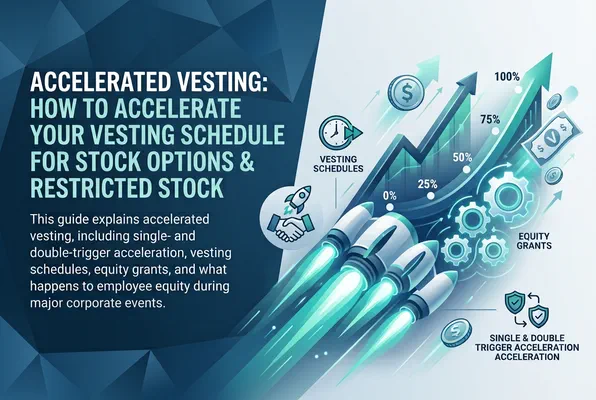

Stock options and restricted stock units (RSUs) are powerful tools companies use to attract and retain talent. But what happens when a company is acquired, an employee is let go, or a major corporate event shakes things up before the standard vesting period ends? This is where accelerated vesting comes into play, a mechanism that can significantly change the value and timing of an employee’s equity compensation.
Understanding accelerated vesting is essential whether you’re a startup founder structuring equity packages, an HR professional designing compensation plans, or an employee trying to understand your own stock option agreement. This guide breaks down everything you need to know.
What Is Accelerated Vesting?
Accelerated vesting refers to a contractual provision that speeds up the normal vesting schedule of stock options, restricted stock units, or other equity awards. Instead of waiting out the standard timeline, often a four-year vesting period with a one-year cliff, unvested shares become immediately vested when specific triggering events occur.
Typically, these events include:
- A merger or acquisition (change of control)
- Termination without cause
- Resignation for good reason (constructive termination)
- An initial public offering (IPO)
- Death or disability of the employee
Accelerated vesting is most commonly built into the equity incentive plans of startups and growth-stage companies, where unpredictable corporate transactions make standard vesting schedules potentially unfair to employees who might otherwise forfeit the equity they’ve earned.
How Vesting Schedules Determine When Employees Earn Equity
Not every equity grant follows the same timeline. While time-based vesting schedules are among the most common types of vesting schedules, companies may also use quarterly vesting acceleration or milestone-based vesting. Under a time-based structure, an employee earns additional vested shares simply by remaining with the company for a specified period. With milestone vesting, however, shares or options may become vested when specific business or performance goals are reached. These different approaches allow companies to design equity compensation around both employee retention and measurable results.
Why Companies Use Accelerated Vesting
For employers, offering accelerated vesting provisions serves several strategic purposes:
- Attracting top talent: Executives and key hires are more likely to accept offers with accelerated vesting clauses, since these reduce the risk of losing equity due to events outside their control.
- Retention during uncertainty: Knowing that equity accelerates in a merger scenario can reduce anxiety and turnover during due diligence and integration periods.
- Aligning incentives: It reassures employees that their contributions won’t be wiped out simply because ownership of the company changes hands.
- Competitive compensation packages: In competitive labor markets, especially within tech and venture-backed startups, accelerated vesting has become a standard feature of equity compensation negotiations.
Single Trigger vs. Double Trigger Accelerated Vesting
One of the most important distinctions to understand is between single trigger and double trigger accelerated vesting clauses. These structures determine exactly when and how acceleration is activated.
Single Trigger Acceleration
With single trigger acceleration, only one event is needed to accelerate vesting, most commonly a change of control, such as an acquisition or merger. The moment the triggering event occurs, all or a portion of unvested shares immediately vest, regardless of whether the employee’s job status changes.
Pros: Simple and predictable for employees, guarantees equity value regardless of post-acquisition employment status
Cons: Can be unattractive to acquiring companies, since it may cause a wave of departures immediately after closing, may reduce retention incentives for key employees post-acquisition
Double Trigger Acceleration
Double trigger acceleration requires two separate events to occur before vesting accelerates:
- A change of control (merger, acquisition, sale of the company)
- A qualifying termination event, typically involuntary termination without cause, or resignation for good reason, within a specified window after the change of control (often 12 months)
This structure has become the industry standard, especially in venture-backed startups, because it strikes a balance between protecting employees and preserving the acquirer’s ability to retain talent post-transaction.
Pros: Protects employees from being let go shortly after an acquisition without receiving their equity, more appealing to acquirers, since it encourages continuity of the workforce, seen as a fairer middle ground by investors and legal advisors
Cons: More complex to draft and administer, requires careful definition of “good reason” and “cause” to avoid disputes
How Accelerated Vesting Works in Practice
To understand the mechanics, consider a simplified example:
An employee receives 48,000 RSUs on a standard four-year vesting schedule with a one-year cliff. After 18 months, the company is acquired, and the employee is terminated without cause three months later as part of a company-wide restructuring.
- Without acceleration: The employee keeps only the shares vested up to the termination date, in this case, roughly 21 months’ worth of vesting, and forfeits the rest.
- With double trigger acceleration: Because both the change of control and the qualifying termination occurred within the specified window, all remaining unvested RSUs immediately vest, and the employee receives the full 48,000 shares.
This example illustrates why accelerated vesting clauses are often a critical point of negotiation, particularly for senior executives, founders transitioning into employee roles post-acquisition, and early employees who took on significant risk.
What Happens to Unvested Options When You Leave the Company?
Employees should understand what happens if they leave the company before their equity is fully vested. In many plans, unvested options and other unvested awards are forfeited when an employee leaves before vesting is complete. Vested shares may remain with the employee, although stock options can be subject to an exercise deadline after termination. The exact rules depend on the equity plan and the type of award, such as incentive stock options or non-qualified stock options. Reviewing these terms before deciding to leave can help employees understand what portion of their equity they can actually retain.
Accelerated Vesting in Different Scenarios
Mergers and Acquisitions
Accelerated vesting is most frequently discussed in the context of mergers and acquisitions. When a company is acquired, unvested equity can be handled in several ways: assumed by the acquirer, cashed out, cancelled, or accelerated. Negotiating accelerated vesting terms ahead of time protects employees from losing value if their roles are eliminated during post-merger integration.
IPOs
Some equity plans include accelerated vesting tied to a successful IPO, rewarding early employees who helped build the company toward a public offering. This is less common than M&A-related acceleration but still appears in select compensation structures.
Termination Scenarios
Beyond change-of-control events, some employment agreements include accelerated vesting for termination without cause even absent a merger, or for death and disability. These provisions are generally less common but can appear in executive-level contracts.
Founder Agreements
Founders often negotiate their own accelerated vesting terms separate from standard employee equity plans. Since founders typically have significant equity stakes, protecting that value during an acquisition or forced departure is a key part of structuring founder agreements and shareholder arrangements.
Founder Shares and Equity as Part of the Compensation Package
For founders and early employees, founder shares and employee stock can represent a significant part of the overall compensation package. These awards are often structured to encourage people to stay at the company and participate in its long-term growth. Acceleration provisions can become particularly important when ownership changes, because a founder or key employee may otherwise have substantial unvested equity at the time of a transaction. Whether the agreement provides single-trigger and double-trigger protection, milestone-based vesting or another form of acceleration, the specific terms determine how much equity an individual ultimately retains.
Legal and Tax Considerations
Accelerated vesting isn’t just a compensation mechanic, it carries real legal and tax implications that both companies and employees should understand.
- Section 280G and golden parachute rules: For public companies, accelerated vesting tied to a change of control can trigger “golden parachute” tax rules under IRS Section 280G, potentially resulting in excise taxes for the recipient and loss of tax deductions for the company.
- 409A compliance: Equity plans must be structured carefully to remain compliant with Section 409A, which governs deferred compensation and timing of payouts.
- Dilution impact: Accelerated vesting increases the number of shares outstanding at once, which can affect cap table calculations during an acquisition and influence negotiations around deal terms.
- Employment agreement clarity: Precise legal drafting is essential to define “cause,” “good reason,” and the exact trigger window, as ambiguity can lead to disputes during post-acquisition transitions.
Given these complexities, companies structuring equity compensation plans, and employees reviewing offer letters, should consult legal and financial advisors to ensure accelerated vesting provisions are both compliant and fair.
How to Negotiate Accelerated Vesting
For employees and executives, accelerated vesting clauses are often negotiable, particularly at senior levels or during funding rounds and acquisition discussions. Here are a few practical tips:
- Understand your current equity plan: Review your stock option or RSU agreement to see if any acceleration provisions already exist.
- Push for double trigger protection: This is generally seen as the fairer, more balanced structure and is more likely to be accepted by both companies and investors.
- Define key terms clearly: Ensure “change of control,” “cause,” and “good reason” are explicitly and favorably defined in your contract.
- Consider partial acceleration: Some agreements offer partial acceleration (e.g., 50% of unvested shares) rather than full acceleration, which can be a reasonable compromise during negotiations.
- Factor in timing windows: Confirm how long after a change of control the termination trigger remains active (commonly 12 months).
Accelerated Vesting and Startup Equity Strategy
For startups, building thoughtful accelerated vesting provisions into equity incentive plans is a strategic decision that affects fundraising, hiring, and M&A readiness. Investors often scrutinize these clauses during due diligence, since overly generous single trigger provisions across the entire employee base can make a company less attractive to potential acquirers.
A well-structured equity compensation strategy typically includes:
- Standard double trigger acceleration for most employees
- More generous or single trigger terms reserved for founders and C-level executives
- Clear documentation within the equity incentive plan and individual grant agreements
- Alignment with vesting schedules, cliff periods, and overall cap table management
Getting this balance right helps companies remain competitive in talent acquisition while maintaining flexibility and appeal during future transactions.
Final Thoughts
Accelerated vesting is a critical, often misunderstood component of modern equity compensation. Whether structured as single trigger or double trigger, these provisions directly impact how much value employees and founders retain during major corporate events like mergers, acquisitions, and terminations. For companies, getting the structure right means balancing talent retention, investor expectations, and M&A readiness. For employees, understanding, and when possible, negotiating, these terms can make a significant financial difference down the line.
As equity compensation continues to play a central role in competitive hiring, having a clear grasp of accelerated vesting mechanics is essential for anyone navigating today’s startup and corporate landscape.
FAQ
What is accelerated vesting?
What is the difference between single trigger and double trigger accelerated vesting?
How does accelerated vesting affect startup equity compensation?
Who typically negotiates accelerated vesting clauses?
Written by
Dominik KonoldCEO & Founder
Dominik Konold is the CEO and founder of Finidy GmbH, specializing in share-based compensation and treasury accounting. With a background in audit and investment banking, he is a certified Professional Risk Manager (PRMIA) and lectures for the Association of Public Banks and the Academy of International Accounting.
Related Posts
Equity Dilution: What Founders & Employees Need to Know
Learn how equity dilution works, why it occurs, how it affects founders, employees, and investors, and how to manage its impact on ownership and shareholder value.
Growth Shares: Everything Startups Need to Know in 2026
A comprehensive guide explaining how growth shares work, their benefits, tax implications, and how they compare with other employee equity incentive schemes.
Leaver Provisions in Equity Compensation Explained
This guide explains what leaver provisions are, how good leaver and bad leaver clauses work, and how companies can design fair, legally robust equity rules that protect both the business and its employees.
Ready to simplify your equity programs?
See how Incentrium helps you manage share-based compensation with ease. Book a demo to learn more.
Book a Demo