Advisory Shares: Complete Guide for Startup Founders

Bringing the right people into your startup’s orbit can make or break your trajectory. But experienced operators, seasoned executives, and well-connected industry veterans rarely come for free — and most early-stage companies cannot afford to pay consulting rates. That is where advisory shares come in.
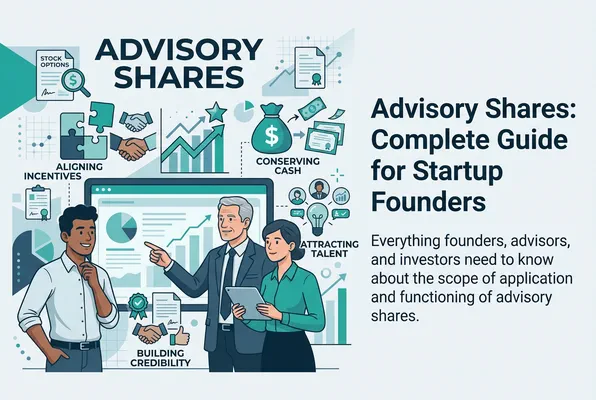
Advisory shares are one of the most practical and widely used tools in the startup world. They allow founders to attract high-caliber advisors, align incentives, and conserve cash — all at the same time. Yet despite being so common, many founders and advisors alike have questions about how they actually work, what types exist, and how to structure them fairly.
This guide covers everything you need to know.
What Are Advisory Shares?
Advisory shares often referred to as advisor shares are a form of equity compensation given to company advisors in lieu of cash fees. Rather than paying an advisor an hourly or monthly rate, a startup offers them a stake in the company’s future success. If the startup grows and achieves a successful exit — through acquisition or IPO — those advisory shares become genuinely valuable.
It is worth noting that advisory shares are not a distinct legal category of stock. The term is a startup industry convention used to describe any equity given to advisors for their services. Advisory shares are a type of equity compensation that can take different legal forms, which we will cover below.
A common misconception is that advisory shares represent a special class of shares. In reality, advisory shares are a form of equity compensation using the same instruments — stock options, restricted stock or regular shares — that companies issue to employees and founders. The label simply indicates who the recipient is and why the equity is being granted.
Why Do Startups Grant Advisory Shares?
Startups grant advisory shares for several interconnected reasons. Understanding the logic helps both founders and advisors negotiate better.
Conserving Cash
For an early-stage startup company, every dollar in the bank matters. Paying a senior industry expert $10,000 a month in consulting fees is simply not viable for most pre-seed or seed-stage companies. Offering equity instead allows the startup to access expertise without burning through its cash runway.
Aligning Incentives
When an advisor holds equity, their financial success is tied directly to the company’s success. This alignment of incentives means advisors are genuinely motivated to provide their best strategic insights, open up their networks, and go beyond surface-level advice. An advisor who stands to benefit from the company growing will show up differently than one who is simply billing hours.
Attracting Top Talent
Advisory shares can help startups punch above their weight. A well-structured equity offer can attract former founders, C-suite executives, and respected investors who would never consider a traditional part-time role. These are people whose names on a pitch deck can lend immediate credibility to a young company.
Building Credibility
Having a recognizable name on your advisory board signals to investors and customers that serious people believe in your company. That reputational boost can be worth far more than the equity granted.
How Do Advisory Shares Work?
Understanding how advisory shares work requires looking at three key elements: the type of equity granted, the vesting schedule, and the legal agreement that governs everything.
Types of Advisory Shares
There are two primary types of advisory shares that startups issue.
Non-Qualified Stock Options (NSOs)
The most common form of advisory share is the non-qualified stock option. An NSO gives the advisor the right — but not the obligation — to buy a set number of shares at a predetermined strike price, usually equal to the fair market value at the time of grant (established via a 409A valuation). NSOs are required for non-employees and are subject to ordinary income tax upon exercise.
Advisors receive NSOs rather than incentive stock options (ISOs), which are reserved exclusively for employees. This is an important distinction: advisory shares as NSOs carry different — and generally less favorable — tax treatment than employee stock options granted as ISOs.
Restricted Stock Awards (RSAs)
Restricted stock awards are actual shares granted upfront rather than options to buy shares at a later date. RSAs are more common at the very earliest stages of a startup, when the company’s fair market value is still negligible. Because the value is so low at grant, the tax bill is minimal, making RSAs attractive for both sides.
With an RSA, the advisor becomes a shareholder immediately upon acceptance of the grant, but the shares are subject to a vesting schedule. If the advisor leaves before fully vesting, the company retains the right to repurchase unvested shares.
Vesting Schedules for Advisors
Advisory shares vest differently from employee equity. Employees typically vest over four years with a one-year cliff. Advisors, by contrast, usually vest over one to two years, often with no cliff or a short cliff of three to six months.
The reasoning is straightforward: advisors tend to deliver the most value early in the relationship. A two-year monthly vesting schedule without a cliff is the most common arrangement. Some advisory share agreements also include single-trigger acceleration, meaning all remaining shares vest immediately if the company is acquired or if the advisor relationship is terminated by the company.
Milestone-based vesting is another option, where shares vest when the advisor achieves specific outcomes — such as facilitating a key partnership or helping close a funding round — rather than on a time schedule. Hybrid vesting combines both time and milestone elements.
The Advisory Share Agreement
Every advisory relationship should be governed by a written advisory share agreement. This is a binding legal contract that protects both the advisor and the company. A well-structured advisory agreement should include:
- The advisor’s specific role, responsibilities, and time commitment
- The exact number of shares or options being granted
- The vesting schedule, including any cliff period
- Confidentiality and intellectual property clauses
- Termination provisions
The Founder/Advisor Standard Template (FAST), developed by the Founder Institute, is a widely used starting point. It is free to download and simplifies the process considerably. That said, always have a qualified attorney review any agreement before it is signed.
Advisory Shares vs. Employee Stock Options
Advisory shares and employee stock options share the same underlying mechanics but differ in meaningful ways.
| Feature | Advisory Shares | Employee Stock Options |
|---|---|---|
| Recipient | External advisors | Full-time employees |
| Option type | NSO | ISO or NSO |
| Typical vesting | 1–2 years, often no cliff | 4 years, 1-year cliff |
| Tax treatment | Ordinary income on exercise | More favorable ISO treatment possible |
| Involvement | Part-time, strategic | Full-time, operational |
The key difference is that advisors are not part of the company’s daily operations. Their equity is compensation for strategic guidance and access, not ongoing employment.
How Much Equity Should You Give an Advisor?
Determining how many advisory shares to grant is one of the most common questions founders face. The right amount depends on the advisor’s experience, the value they bring, and the company’s stage of growth.
Industry benchmarks suggest the following ranges:
- Early-stage specialist or junior advisor: 0.1% – 0.25%
- Experienced advisor with strong networks: 0.25% – 0.5%
- High-profile advisor (ex-CEO, prominent investor): 0.5% – 1%
Carta’s 2024 compensation data shows median advisor equity grants of 0.21% at pre-seed, 0.12% at seed, and 0.05% at Series A — a clear downward trend as companies mature and reduce the percentage they can afford to give away.
If a startup maintains a formal advisory board, it is common practice to allocate roughly 5% of total equity to be distributed among all board members collectively.
Who Gets Advisory Shares?
Advisory shares are usually given to startup advisors who possess expertise, experience, or networks the founding team lacks. These individuals are typically not full-time employees — they provide guidance on a part-time or as-needed basis.
Common recipients of advisory shares include:
- Former founders or senior executives with relevant industry experience
- Angel investors or venture capitalists who invest and also provide ongoing mentorship
- Domain specialists in areas like legal, regulatory, engineering, or sales
- Industry connectors with networks that can unlock partnerships, customers, or future investors
The types of advisors a company needs will shift over time. At the pre-seed stage, a startup may need product and technology advisors. By Series A, the need may shift toward go-to-market or operational experts. Founders should revisit advisory relationships regularly to ensure they remain relevant.
Benefits and Risks of Advisory Shares
Benefits of Advisory Shares
For founders, the benefits of advisory shares are substantial. They allow companies to access expertise they could not otherwise afford, conserve precious cash, and build a network of invested advocates. For advisors, advisory shares offer high-upside potential with minimal time commitment — and many experienced businesspeople actively prefer equity in a young company over cash fees precisely because of that upside.
Risks to Consider
Advisory shares are not without risk. Dilution is a constant consideration: each new funding round will reduce the percentage ownership of existing holders, including advisors. Advisors also face illiquidity — they typically cannot sell their shares until a liquidity event occurs, which may take many years or never happen at all.
Conflicts of interest can also arise, particularly if an advisor works with competing companies. Clear agreements and transparency are essential to manage this risk. Finally, the tax implications of NSOs can catch advisors off guard — ordinary income taxes are due at exercise regardless of whether the shares have been sold, which can create a significant cash burden.
How to Issue Advisory Shares
To issue advisory shares properly, founders should follow these steps:
- Establish an equity incentive plan and obtain board approval before issuing any equity
- Agree on terms with the advisor, including equity type, amount, and vesting schedule
- Draft and sign an advisory share agreement reviewed by qualified legal counsel
- Record the grant on your cap table to maintain an accurate and investor-ready ownership record
- Manage ongoing vesting and track contributions against the agreement
Using dedicated equity management software — such as Incentrium — simplifies this process significantly. A proper cap table management tool allows founders to model dilution scenarios, issue equity electronically, and maintain clean records as the company grows.
Making Advisory Shares Work for Your Startup
Advisory shares are a powerful tool when used thoughtfully. The most effective advisory relationships are built on clarity: clear expectations, clear compensation, and clear documentation. Grant advisory shares to people who have genuine expertise your team lacks, structure vesting to reflect the nature of the relationship, and always formalize everything in a written advisory agreement.
When done right, advisory shares can help your startup access the strategic insights, networks, and credibility that accelerate growth — without draining your bank account. That is a trade worth making.
FAQ
What are advisory shares and how do they work?
How much equity should a startup give to an advisor?
How are advisory shares taxed?
Can advisory shares be diluted?
Written by
Dominik KonoldCEO & Founder
Dominik Konold is the CEO and founder of Finidy GmbH, specializing in share-based compensation and treasury accounting. With a background in audit and investment banking, he is a certified Professional Risk Manager (PRMIA) and lectures for the Association of Public Banks and the Academy of International Accounting.
Ready to simplify your equity programs?
See how Incentrium helps you manage share-based compensation with ease. Book a demo to learn more.
Book a Demo