Cap Table Explained: The Ultimate Cap Table Guide for Founders


A cap table is one of the most important documents a startup will ever maintain, yet it remains one of the most misunderstood. Whether you are a first-time founder preparing for your first funding round, an employee trying to understand the value of your stock options, or an investor evaluating a deal, understanding cap table meaning is absolutely essential.
This guide breaks down everything you need to know: what a cap table is, what it contains, how it evolves through a company’s lifecycle, and how to manage it effectively.
What Is a Cap Table? Understanding the Core Meaning
The term cap table is short for capitalization table. At its core, a cap table is a structured record that details the ownership equity of a company. It lists every person, institution, or entity that holds a financial stake in the business, and precisely how much of the company they own.
A cap table answers three fundamental questions:
- Who owns equity in the company?
- How much equity does each party hold?
- In what form is that equity held (common shares, preferred shares, options, warrants, convertible instruments)?
For early-stage startups, a cap table might fit on a single spreadsheet. For a Series C company with multiple investor rounds, an option pool, and outstanding convertible notes, it becomes a complex financial model requiring dedicated software.
Ownership Structure and Capitalisation Table
A capitalisation table (cap table) defines the full ownership structure of a company. It shows how equity is distributed between founders and investors and reflects the company’s cap table at any given time. The cap table shows the total number of shares and how each stakeholder participates in value creation, making it essential for every startup cap table overview.
Why the Cap Table Meaning Goes Beyond a Simple List
Many people initially think of a cap table as just a list of shareholders. But the full cap table meaning is much richer. It is a living financial document that:
- Captures the entire equity structure of a company at any point in time
- Models dilution as new shares are issued
- Tracks vesting schedules for employee stock options
- Reflects the liquidation preferences and rights attached to different share classes
- Enables scenario modeling for future fundraising, acquisitions, or IPOs
In short, a cap table is not just about the present, it is a strategic tool that shapes how founders, investors, and employees think about the future value of the company.
Key Components of a Cap Table
Understanding cap table meaning requires knowing what goes into one. While formats vary, most cap tables include the following components.
1. Shareholders and Stakeholders
The cap table lists every party with an equity claim on the company. This typically includes:
- Founders – Usually the first names on any cap table, holding common shares
- Angel investors – Early-stage individuals who invest in exchange for equity
- Venture capital firms – Institutional investors who typically hold preferred shares
- Employees and advisors – Typically hold stock options through an employee stock option plan (ESOP)
- Service providers – Occasionally receive warrants or equity in lieu of cash payment
2. Security Types
A comprehensive cap table does not just track common shares. It must account for every type of security the company has issued or committed to issue:
- Common stock – Typically held by founders and employees
- Preferred stock – Held by institutional investors, often with special rights and liquidation preferences
- Stock options – Rights to purchase shares at a predetermined price (the strike price), usually subject to a vesting schedule
- Warrants – Similar to options but often issued to investors or lenders
- SAFEs (Simple Agreements for Future Equity) – A popular instrument for early-stage startups, converting into equity at a future funding round
- Convertible notes – Debt instruments that convert into equity under defined conditions
3. Share Classes and Rights
Not all shares are equal. A well-structured cap table clearly distinguishes between different share classes and their associated rights:
- Voting rights – Who gets to vote, and how many votes per share?
- Liquidation preferences – In the event of a sale, who gets paid first and how much?
- Anti-dilution provisions – Protections that adjust an investor’s ownership if shares are issued at a lower valuation in the future
- Pro-rata rights – The right to participate in future funding rounds to maintain ownership percentage
4. Ownership Percentages
Perhaps the most scrutinized column in any cap table is the ownership percentage. This shows how much of the company each stakeholder owns, calculated both on a:
- Issued and outstanding basis – Only counting shares currently issued
- Fully diluted basis – Counting all shares, including those reserved but not yet issued (e.g., unexercised options, unissued SAFE conversions)
Investors almost always evaluate ownership on a fully diluted basis, as it reflects the true potential ownership landscape.
5. Valuation and Share Price
Cap tables often incorporate the post-money valuation of each funding round and the corresponding price per share. This allows stakeholders to calculate the current implied value of their equity stake.
How a Cap Table Evolves Over the Company Lifecycle
One of the most important aspects of cap table meaning is understanding that it is not static—it changes at every major company milestone.
At Incorporation
When a company is founded, the cap table is simple. Founders divide equity among themselves and agree on their respective ownership percentages. This is also when you establish the authorized share count—the maximum number of shares the company is allowed to issue.
Example: | Stakeholder | Shares | Ownership % | |—|—|—| | Founder A | 5,000,000 | 50% | | Founder B | 5,000,000 | 50% | | Total | 10,000,000 | 100% |
After Creating an Option Pool
Before a funding round, or sometimes as part of compensation strategy, companies create an employee stock option pool (ESOP). This reserves a percentage of shares for future employee grants, typically 10–20% of the fully diluted share count.
Creating the option pool dilutes existing shareholders, which is why founders should carefully negotiate the timing and size of option pool creation relative to investor term sheets.
After Seed Funding
When the first outside investment comes in, whether through a SAFE, a convertible note, or a priced equity round, new shares are issued. Existing shareholders experience dilution—their ownership percentage decreases even if the number of shares they hold stays the same.
Example after seed round (simplified): | Stakeholder | Shares | Ownership % | |—|—|—| | Founder A | 5,000,000 | 40% | | Founder B | 5,000,000 | 40% | | Seed Investor | 2,500,000 | 20% | | Total | 12,500,000 | 100% |
After Series A, B, and Beyond
With each successive funding round, the cap table grows more complex. New investor classes appear, liquidation preferences stack up, and the option pool may need to expand to attract senior talent. Managing all of these moving parts manually becomes increasingly error-prone.
This is precisely why dedicated cap table management software like Incentrium becomes invaluable at this stage.
Dilution: A Central Concept in Cap Table Meaning
Understanding cap table meaning without understanding dilution is impossible. Dilution is the reduction in an existing shareholder’s ownership percentage that occurs when new shares are issued.
How Dilution Works
Dilution is not inherently bad. If a company raises capital at a higher valuation, existing shareholders may hold a smaller percentage, but that percentage is worth more in absolute terms. This is often called value-accretive dilution.
Problematic dilution, on the other hand, occurs when:
- New shares are issued at a lower valuation than previous rounds (a “down round”)
- An option pool is created or expanded before a valuation increase
- Convertible instruments convert on unfavorable terms
Anti-Dilution Protections
Sophisticated investors often negotiate anti-dilution provisions to protect themselves against down rounds. The two most common types are:
- Full ratchet anti-dilution – The investor’s conversion price is reset to the lowest price of any new share issuance (very investor-friendly, rarely used today)
- Weighted average anti-dilution – A more balanced adjustment formula that takes into account both the price and the number of new shares issued
The Option Pool: A Critical Part of the Cap Table
Employee equity is a cornerstone of startup compensation, and the employee stock option pool (sometimes called an ESOP or equity incentive plan) is how companies structure it.
Employee Option Pool and Future Dilution
An employee option pool is typically reserved in the early stages of a startup to attract talent. When companies issue new shares, it directly impacts future dilution and therefore the current ownership stake of all shareholders. A well-structured cap table tracks how changes affect the balance between founders, employees, and potential investors.
What the Option Pool Represents
The option pool is a block of shares set aside for future grants to employees, advisors, and consultants. It appears on the fully diluted cap table even before the options are granted or exercised.
Vesting Schedules
Options are not immediately owned outright—they are subject to vesting schedules that reward employees who stay with the company over time. The most common structure is:
- 4-year vesting with a 1-year cliff – No options vest during the first 12 months; after the cliff, 25% vest at once, with the remaining 75% vesting monthly over the following 3 years
Vesting schedules appear in cap table management tools as detailed individual grant records, showing what has vested, what is outstanding, and what will expire.
Strike Price and 409A Valuation
When options are granted, they are assigned a strike price—the price at which the employee can purchase the shares. For US companies, this must equal the fair market value (FMV) of the common stock at the time of grant, typically determined by a 409A valuation (an independent appraisal).
The relationship between the strike price and the eventual share price at exit determines the profit an employee can realize.
Common Cap Table Mistakes to Avoid
Even experienced founders make cap table errors that can cause serious problems during fundraising or exit. Here are the most critical mistakes to watch out for.
1. Not Maintaining the Cap Table from Day One
Many founders wait until their first funding round to formalize their cap table. By then, undocumented equity promises, verbal agreements, and inconsistent records can create significant legal and financial complications.
2. Using Informal Spreadsheets Without Version Control
A simple Excel file might work for a two-person company, but as soon as multiple parties need to access, update, and rely on the cap table, version control becomes critical. Multiple versions floating around via email is a recipe for disaster.
3. Ignoring Fully Diluted Share Count
Focusing only on issued shares and ignoring the option pool, outstanding warrants, and unconverted SAFEs gives a misleading picture of actual ownership. Always model on a fully diluted basis.
4. Mismanaging Option Grants
Granting options without proper documentation, board approvals, or accurate strike prices can have serious tax implications for employees and legal consequences for the company.
5. Failing to Model Dilution Before Fundraising
Founders who don’t run dilution scenarios before accepting a term sheet often find themselves with far less ownership than expected after a round closes. Pre-round modeling is essential.
How to Read a Cap Table
For investors and employees alike, reading a cap table confidently is a valuable skill.
Step 1: Identify the Security Types
First, distinguish between common stock, preferred stock, options, warrants, and convertible instruments. Each behaves differently in a liquidity event.
Step 2: Understand Share Classes and Preferences
Review the rights attached to each share class. Who has liquidation preferences? How many times their investment do preferred shareholders receive before common shareholders participate?
Step 3: Calculate Fully Diluted Ownership
Add up all shares, issued, reserved, and potentially issuable, to get the fully diluted share count. Then recalculate each party’s ownership percentage on this basis.
Step 4: Model Exit Scenarios
Use the cap table to run waterfall analyses, modeling how proceeds would be distributed at different exit valuations. This reveals the true economic interests of each stakeholder and helps identify whether liquidation preferences could result in founders or employees receiving less than expected.
Cap Table Management: Spreadsheet vs. Dedicated Software
For very early-stage companies, a spreadsheet can serve as an adequate starting point. However, as equity structures grow in complexity, the limitations become apparent quickly.
Limitations of Spreadsheets
- Prone to human error, especially with complex formulas
- No audit trail or version history
- Difficult to model scenarios dynamically
- Hard to share securely with multiple stakeholders
- Not connected to legal document workflows
Cap Table Software and Management
As companies grow, maintaining a clean cap table becomes complex. Many startups therefore rely on cap table software to reconcile your cap table and keep it accurate. A properly managed system ensures that the cap table must always reflect the latest ownership changes across all stages of a startup.
Benefits of Cap Table Management Software
Platforms like Incentrium are purpose-built to handle the full complexity of startup equity management. Key advantages include:
- Real-time accuracy – Automatic updates when new transactions are recorded
- Scenario modeling – Instantly visualize how a new funding round, option pool increase, or acquisition would affect ownership
- Waterfall analysis – Model exit distributions under different scenarios
- Employee-facing dashboards – Help team members understand the value of their equity
- Document integration – Connect equity grants to legal agreements and board approvals
- Compliance support – Track 409A valuations, exercise windows, and regulatory requirements
Cap Table and Investor Relations
For investors, the cap table is a primary due diligence tool. Before committing capital, sophisticated investors will scrutinize every line.
Cap Table Shows Value for Investors
The cap table shows how ownership evolves and is a key document for potential investors during due diligence. It helps evaluate risk, equity distribution, and long-term incentives. An up-to-date cap table ensures that investors can clearly understand the startup’s financial structure before making decisions.
What Investors Look For
- Founder ownership – Are founders sufficiently motivated? Heavily diluted founders may lack incentive to drive the company forward
- Clean structure – Are there any unusual provisions, side letters, or undocumented equity claims that complicate the ownership picture?
- Option pool size – Is there enough room in the option pool to hire the team needed to achieve the next milestone?
- Investor rights – What rights do existing preferred shareholders have, and how might they interact with the new investment?
Pro-Rata Rights and Information Rights
Existing investors often negotiate pro-rata rights (the ability to maintain their ownership percentage in future rounds) and information rights (the right to receive regular financial updates). Both appear as annotations in a comprehensive cap table.
SAFEs and Convertible Notes on the Cap Table
Two instruments deserve special attention because of how they appear—and ultimately convert—on the cap table.
SAFE (Simple Agreement for Future Equity)
Developed by Y Combinator, a SAFE is not technically a debt instrument. It represents the right to receive equity in a future priced round, typically at a discount or with a valuation cap. On the cap table, SAFEs appear as outstanding convertible instruments until conversion.
At conversion, they dilute all existing shareholders (including earlier SAFE holders) and become equity on the cap table.
Convertible Notes
A convertible note is a loan that converts into equity at a future round. Key terms that affect the cap table include:
- Conversion discount – The note holder receives shares at a percentage below the price paid by new investors
- Valuation cap – The maximum valuation at which the note converts, protecting early investors if the company raises at a high valuation
- Interest rate – Accrued interest typically converts alongside the principal
Modeling how SAFEs and convertible notes will convert—and the resulting dilution—is one of the most important uses of cap table scenario modeling tools.
Exit Scenarios and IPO Outcomes
In later stages of a startup, the cap table plays a critical role in exit planning. During an initial public offering (IPO) or acquisition, it determines the final payout for each ownership stake. A well-maintained startup cap table ensures transparency and fairness when distributing proceeds among shareholders.
Conclusion: Why Cap Table Meaning Matters for Everyone
The cap table is far more than an administrative record. It is a strategic document that reflects the history of a company’s financing, the interests of all its stakeholders, and the roadmap for how future value will be distributed.
For founders, understanding cap table meaning means making smarter decisions about how to structure fundraising, when to expand the option pool, and how to preserve meaningful ownership through multiple rounds.
For employees, it means understanding the real value behind stock option grants and what scenarios need to play out for those options to become financially meaningful.
For investors, a clean, well-maintained cap table is a signal of operational maturity and management quality—and a tool for precise financial analysis.
Whether you are managing your cap table on a spreadsheet today or evaluating dedicated software solutions, the key is to start early, maintain accuracy, and use it actively as a planning tool—not just an administrative record.
Incentrium provides modern cap table management and equity compensation tools purpose-built for startups and growth-stage companies. Explore how you can bring clarity and confidence to your equity structure today.
FAQ
What is the basic cap table meaning?
When should a startup create a cap table?
How does a cap table change after a funding round?
What is the difference between a cap table and a shareholder register?
Written by
Dominik KonoldCEO & Founder
Dominik Konold is the CEO and founder of Finidy GmbH, specializing in share-based compensation and treasury accounting. With a background in audit and investment banking, he is a certified Professional Risk Manager (PRMIA) and lectures for the Association of Public Banks and the Academy of International Accounting.
Related Posts
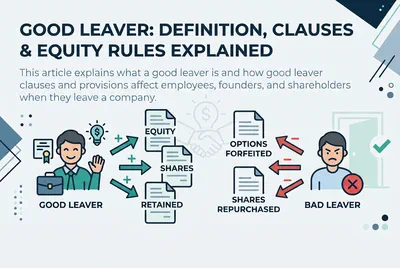
Good Leaver: Definition, Clauses & Equity Rules Explained
This article explains what a good leaver is and how good leaver clauses and provisions affect employees, founders, and shareholders when they leave a company.

Best Equity Management Software for Startups 2026
Discover the best equity management software for startups. Compare top platforms, key features, cap table tools, and compliance capabilities to manage equity.
Cap Table Guide: What It Is & How It Works | Incentrium
All you need to about Cap Table as a Startup Founder
Ready to simplify your equity programs?
See how Incentrium helps you manage share-based compensation with ease. Book a demo to learn more.
Book a Demo