Cliff Vesting: What It Is and How It Works | Incentrium

If you’ve recently received a job offer that includes equity compensation, you’ve likely encountered the phrase “cliff vesting.” Whether you’re an employee trying to understand your stock options or a startup founder designing compensation packages to retain employees, understanding how cliff vesting works is essential.
This guide breaks down everything you need to know — from the basic definition to real-world examples, comparisons with graded vesting, and the pros and cons for both employers and employees.
What Is Cliff Vesting?
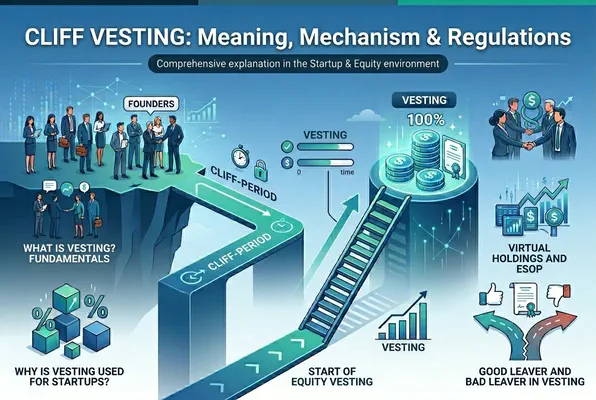
Cliff vesting is a type of time-based vesting schedule in which an employee becomes fully vested in their equity compensation or employer contributions after completing a specific period of service. During the cliff period — which typically lasts one to four years — the employee earns no vested equity at all. Once that initial waiting period is complete, however, ownership transfers entirely and all at once.
This approach is widely used in equity compensation structures, including stock options, restricted stock units (RSUs), and 401(k) retirement plan employer contributions.
Think of the cliff as a formal probation period: the company gets time to assess whether an employee is the right long-term fit before granting full equity rights.
How Does Cliff Vesting Work?
Under a cliff vesting plan, an employee must remain with the company for a defined period — the cliff period — before any equity or benefits vest. If the employee leaves the company before reaching that vesting date, they forfeit all unvested options or contributions.
Once the cliff is cleared, one of two things happens:
- Full vesting at the cliff: All equity vests on that specific date (pure cliff vesting).
- Cliff plus graded vesting: A portion vests at the cliff, and the rest vests gradually over time on a schedule.
For 401(k) retirement plans specifically, the Internal Revenue Service (IRS) limits cliff vesting schedules to a maximum of three years of service. This means that for employer contributions in a retirement plan, employees must become fully vested no later than after three years.
The 1-Year Cliff Explained
The one-year cliff is the most common cliff vesting period used by startups and established companies alike. It means that an employee must remain with the company for at least one year before any equity vests. On their first work anniversary — the vesting date — the cliff is cleared and vesting begins.
In isolation, a 1-year cliff vesting plan grants all equity on that date. More commonly, it is combined with a four-year vesting schedule, which is explained in detail below.
Cliff Vesting Schedules: Common Examples
1-Year Cliff Vesting
An employee is granted 4,000 stock options. Under a one-year cliff vesting schedule, none of those options vest until the employee has completed one full year of service. On the one-year anniversary, all 4,000 options vest at once, and the employee can begin exercising them.
3-Year Cliff Vesting
Under a 3-year cliff vesting schedule, an employee receives no equity until they have completed 3 years of service. Once that milestone is reached, the entire grant becomes available at once. This schedule is frequently seen in retirement plan employer contributions.
4-Year Vesting with a 1-Year Cliff
This is the most widely used vesting schedule in startup equity compensation and stock option plans. Here is how it works:
- Year 1 (cliff period): No equity vests. The employee must stay with the company for at least one year.
- End of Year 1: 25% of total equity vests immediately — this is the cliff.
- Years 2–4: The remaining 75% vests gradually over time, typically monthly over 36 months.
Example: An employee is granted 1,200 stock options on a four-year vesting schedule with a 1-year cliff. After year one, 300 options vest. Over the next three years, roughly 25 options vest each month until the employee becomes fully vested at the four-year mark.
If the employee leaves the company before completing year one, they forfeit all 1,200 unvested options.
Cliff Vesting vs. Graded Vesting
Both cliff vesting and graded vesting are types of time-based vesting schedules, but they differ fundamentally in structure.
| Feature | Cliff Vesting | Graded Vesting |
|---|---|---|
| When equity starts to vest | All at once after the cliff | Gradually over time from the start |
| Risk for employees | Higher — forfeit everything if leaving early | Lower — partial vesting accrues over time |
| Common use case | Startups, stock option plans | 401(k) plans, long-term retention |
| Complexity | Simple | More complex to administer |
A graded vesting schedule that increases incrementally may feel fairer to employees, especially those uncertain about long-term tenure. However, cliff vesting is simpler to structure and strongly encourages employees to stay through the cliff before making a career move.
Many companies combine both: using a cliff as the initial qualifying period, followed by a graded vesting schedule for the remainder.
Advantages and Disadvantages of Cliff Vesting
For Employers
Advantages:
- Reduces cap table complexity by limiting equity distribution to employees who demonstrate commitment
- Lowers the risk of equity going to employees who leave quickly
- Cliff vesting encourages employees to remain loyal through the cliff period, supporting team stability
- Cost-effective, as no equity is distributed until the cliff is cleared
Disadvantages:
- May deter candidates who are risk-averse or who have competing offers with more favorable vesting terms
- Can feel punitive if an employee is let go just before the cliff date
- A 4-year cliff without any graded component may be unattractive in competitive hiring markets
For Employees
Advantages:
- Simple and easy to understand — one specific date determines full vesting
- Lump-sum equity can be highly valuable in a fast-growing startup
Disadvantages:
- Risky for employees — leaving before the cliff means forfeiting everything
- An employee might miss out on significant value if the company grows substantially during the cliff period
- Limits flexibility if better opportunities arise before the vesting date
When Is Cliff Vesting Used?
Cliff vesting is most commonly used in two contexts:
- Startup equity compensation: Stock option plans and RSU grants for employees typically use a 4-year vesting schedule with a 1-year cliff. This helps founders manage the cap table and retain employees during the critical early stages.
- 401(k) retirement plans: Employers use cliff vesting for employer contributions. Under IRS rules, a cliff vesting schedule in a retirement plan cannot exceed 3 years of service.
Understanding the specific type of vesting in your plan — whether for equity or retirement — is essential before making any career decisions.
Designing a Cliff Vesting Schedule
If you’re a founder or HR professional building a vesting schedule, consider the following:
- Align the cliff period with your hiring risk. A 1-year cliff is standard and widely accepted.
- Combine cliff vesting with graded vesting to balance company protection with employee fairness.
- Keep the vesting period reasonable. Four-year vesting with a 1-year cliff is the industry norm for startup stock options.
- Use equity management software to track vesting dates, manage the cap table, and stay compliant.
At Incentrium , we help companies design, manage, and communicate equity compensation programs — including cliff vesting schedules — with clarity and compliance built in.
Understanding cliff vesting is fundamental for anyone navigating equity compensation. Whether you’re an employee evaluating a job offer or a founder structuring your first option scheme, the right vesting schedule can make a meaningful difference to both retention and financial outcomes.
FAQ
What is cliff vesting?
What happens if I leave the company before the cliff period ends?
What is the difference between cliff vesting and graded vesting?
What does 4-year vesting with a 1-year cliff mean?
Written by
Dominik KonoldCEO & Founder
Dominik Konold is the CEO and founder of Finidy GmbH, specializing in share-based compensation and treasury accounting. With a background in audit and investment banking, he is a certified Professional Risk Manager (PRMIA) and lectures for the Association of Public Banks and the Academy of International Accounting.
Related Posts
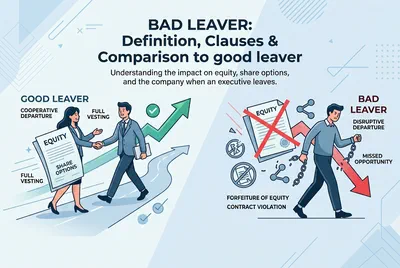
Bad Leaver: Definition, Clauses & Comparison to good leaver
This article explains the differences between good leavers and bad leavers and how their departure can affect equity, share options, and the company.
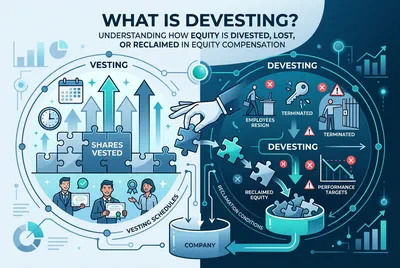
Devest Definition: What Does It Mean to Divest Equity and How Does Devesting Work?
This guide explains the concept of devesting in equity compensation, how it relates to vesting and employee share ownership, and why understanding the conditions under which equity can be lost or reclaimed is essential for employees, founders, and HR professionals.
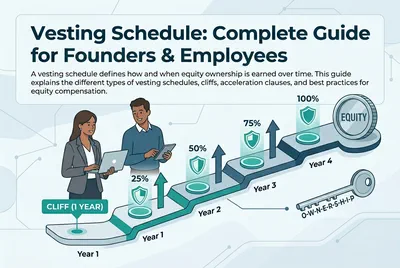
Vesting Schedule: Complete Guide for Founders & Employees
A vesting schedule defines how and when equity ownership is earned over time. This guide explains the different types of vesting schedules, cliffs, acceleration clauses, and best practices for equity compensation.
Ready to simplify your equity programs?
See how Incentrium helps you manage share-based compensation with ease. Book a demo to learn more.
Book a Demo