Dead Equity: Causes, Risks & How to Prevent It for startups
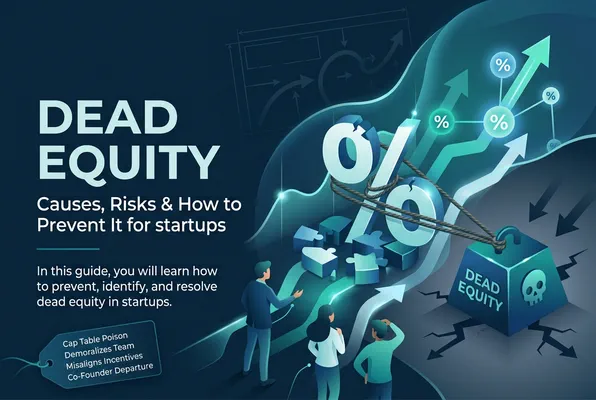

Equity is the lifeblood of any early-stage startup. It’s the currency used to attract brilliant co-founders, incentivize a talented team, and bring investors on board. But what happens when a chunk of that equity ends up in the hands of someone who is no longer in the building — physically or metaphorically? That’s the silent, compounding problem known as dead equity, and it’s one of the most common yet least-discussed reasons why promising startups struggle to grow, raise funds, or retain top talent.
Whether you’re a first-time founder structuring your initial team or a seasoned operator cleaning up a messy cap table, understanding dead equity is non-negotiable. This guide breaks down everything you need to know.
What Is Dead Equity?
Dead equity is equity held by a person who no longer actively contributes to the startup’s success. The shares exist on the cap table, the person is a legitimate shareholder, but their day-to-day involvement, and in most cases their motivation to help the company succeed, is gone.
The Most Common Sources of Dead Equity
1. Departed Co-Founders
The co-founder breakup is one of the most painful and common experiences in startup life. Studies suggest that roughly 65% of high-potential startups fail due to co-founder conflict. When a co-founder leaves, whether amicably or not, they often walk away with a substantial equity stake that was never formally tied to continued contribution.
2. Early Employees Who Left
An engineer who joined at the very beginning and received a generous equity package may have left after 18 months. If proper vesting structures were not in place, they could be sitting on a 3–5% stake, contributing nothing.
3. Advisors and Consultants
Advisors are sometimes granted equity in lieu of cash fees during the early days. When the relationship fades, as many advisor relationships do, their shares remain, frozen in the cap table.
4. Friends, Family, and Angel Investors Who Were Over-Allocated
Well-meaning early backers who received equity in exchange for a small check or a favor can become dead equity holders if their allocation was disproportionate to their contribution and they’re not involved in the business.
Why Dead Equity Is So Dangerous
The problem with dead equity isn’t just symbolic. It has tangible, damaging consequences across multiple dimensions of your business.
For venture capital firms and angel investors, dead equity often signals governance issues that may complicate future fundraising. If someone has achieved little recent involvement but still owns a significant amount of the company, or is longer contributing to the company while retaining much equity, investors may question the startup’s ability to manage ownership effectively. Too much dead equity reduces the flexibility to expand the option pool, recruit experienced board members, and raise money at an attractive valuation. As a result, investors may require founders to resolve equity on the cap table before completing an investment.
It Poisons the Cap Table
Investors, especially institutional VCs, will conduct a thorough review of your capitalization table as part of due diligence. A cap table riddled with dead equity is a red flag. It suggests:
- Poor planning and governance from the start
- Potential future legal disputes with departed shareholders
- A reduced pool for employee stock option plans (ESOPs), new hires, and investor allocations
In many cases, a Series A investor will require that dead equity situations be resolved before they will close a round.
It Demoralizes the Active Team
Imagine working 60-hour weeks to build something meaningful while someone who quit 18 months ago still owns 8% of the company. That’s not just unfair, it’s actively corrosive to team morale and culture. Active team members who discover this disparity often become disengaged or begin their own exit.
It Misaligns Incentives
Equity is designed to align the interests of shareholders with the long-term success of the company. A dead equity holder has little incentive to help the company and every incentive to cash out at the earliest liquidity event, even if the timing isn’t ideal for the business. This misalignment can surface at critical moments: secondary sales, acquisition offers, or bridge financing rounds.
It Reduces Optionality for Future Growth
As a company grows, it needs to issue new equity, for new hires, for investor rounds, for acquisitions. When a large percentage of the fully diluted cap table is locked in dead equity, the founders have less flexibility to make these moves without excessive dilution or complex restructuring.
Real-World Example: The Co-Founder Departure Scenario
Consider this scenario: Two co-founders, Alex and Jamie, each take 40% of a startup, leaving 20% for future investors and employees. Twelve months in, Jamie decides to leave and pursue another venture. No vesting schedule was in place.
Jamie now owns 40% of the company, contributes nothing, and has no particular interest in the company’s long-term success. Alex is left grinding away at 100% effort for 40% of a company.
When Alex approaches a seed-stage VC, the investor sees a cap table where a non-contributing party holds nearly half the company. The investor is skeptical. Even if they proceed, their ownership will come from heavy dilution on Alex’s side. The ESOP pool is barely viable. Hiring a CTO or Head of Sales with meaningful equity becomes nearly impossible.
This is dead equity in its most destructive form.
How to Prevent Dead Equity: The Proactive Toolkit
Prevention is always better than cure when it comes to dead equity. The good news is that the tools to prevent it are well-established and widely used in the startup ecosystem.
Founder Agreements Create Long-Term Alignment
One of the best ways to avoid dead equity is to establish comprehensive founder agreements before any shares are issued. These agreements should explain how founders split equity, document each founder’s initial contributions, and define what happens if a founder’s or co-founder’s priorities diverge. In most cases, this careful consideration includes implementing vesting schedules for all founders, a year cliff, standard vesting schedules, and clearly drafted acceleration clauses or acceleration provisions. Putting these rules in place during the early stage of a startup protects the business if the founders eventually part ways and helps ensure that equity continues to reflect ongoing contributions to the company’s success.
1. Implement a Vesting Schedule from Day One
A vesting schedule makes equity conditional on continued service over time. The industry standard for founders and employees is a 4-year vesting schedule with a 1-year cliff.
Here’s how it works: - 1-year cliff: No equity vests during the first year. If the person leaves before 12 months, they receive nothing. - Monthly vesting after the cliff: After the cliff is passed, equity vests monthly (or quarterly) over the remaining 3 years.
This means that if a co-founder leaves after 18 months, they would receive approximately 37.5% of their total allocation (6 months of monthly vesting out of 48 total months) — not 100%.
Critical tip: Set up vesting before anyone officially joins, and document it formally in a shareholder agreement or founders’ agreement.
2. Include Buyback Provisions in Shareholder Agreements
A buyback clause gives the company the right (but not always the obligation) to repurchase shares from a departing shareholder, typically at a predetermined price or formula.
Common buyback triggers include: - Voluntary resignation - Termination for cause - Failure to meet defined contribution milestones
Buyback provisions are most powerful when combined with vesting schedules. Together, they create a comprehensive framework for managing equity transitions cleanly.
3. Use Reverse Vesting for Founder Shares
Reverse vesting is a structure where founders receive their full share allocation upfront but agree that the company (or remaining founders) has the right to buy back unvested shares if they leave before the vesting period ends.
This is particularly common in jurisdictions where it’s tax-advantageous for founders to hold shares from the beginning but still provides the contractual protection of a vesting-based framework.
4. Draft a Comprehensive Founders’ Agreement Early
Many dead equity disasters stem from a simple lack of written documentation. A proper founders’ agreement should address:
- Equity splits and the rationale behind them
- Vesting terms and cliff periods
- What happens to equity if a founder leaves voluntarily vs. is removed for cause
- Drag-along and tag-along rights
- Non-compete and non-solicitation clauses
- Decision-making authority and roles
The best time to draft this agreement is before the company is officially formed. Doing it when tensions are low and goodwill is high produces the most balanced and enforceable terms.
5. Structure Advisor and Consultant Equity Carefully
For advisors, a common best practice is: - Grant smaller amounts of equity (typically 0.1%–0.5% depending on stage and engagement level) - Apply a 1–2 year vesting schedule - Include performance milestones rather than purely time-based vesting
Tools like the FAST Agreement (Founder/Advisor Standard Template) from the Founder Institute provide a standardized framework for structuring advisor equity that limits the risk of dead equity accumulating from advisor relationships.
6. Conduct Regular Cap Table Reviews
Your cap table is a living document. Reviewing it at least annually, and certainly before any fundraising round, allows you to identify:
- Shareholders who are no longer active
- Shares that have not vested but are being held informally
- Equity allocations that no longer reflect current contributions
Using a dedicated equity management platform (such as Incentrium ) makes this process significantly easier, providing real-time visibility into vesting schedules, ownership percentages, and shareholder status.
How to Fix Dead Equity That Already Exists
Despite your best efforts, you may find yourself managing a dead equity problem that already exists. Here are the most viable paths forward.
Share Buybacks Can Restore Cap Table Flexibility
When a founder or employee decides to leave the company, repurchasing shares may be the most viable option. Depending on the terms of the shareholder agreement, the company buys back shares or company takes back the shares from individuals who are no longer contributing to the business. The process typically distinguishes between vested shares and equity that is not yet fully vested. Recovering ownership in this way helps avoid dead equity, prevents inactive shareholders from holding too much equity, and creates additional capacity for future employees, advisors, or financing rounds.
Negotiate a Voluntary Share Buyback
The most straightforward solution is to approach the inactive shareholder and negotiate a buyback. This works best when:
- The relationship ended amicably
- The shareholder understands how their stake affects the company’s future
- You can offer fair compensation (cash, a promissory note, or a token consideration)
The key is to be honest and frame the conversation around mutual benefit. A dead equity holder with 5% of nothing is worse off than a former shareholder with a small cash payment and a goodwill relationship intact.
Issue New Equity to Dilute the Dead Equity Holder
While this doesn’t remove the dead equity, issuing new shares to active team members and investors can reduce the dead equity holder’s percentage on a fully diluted basis. This approach is often used in tandem with ESOP creation or new fundraising rounds.
The risk: it dilutes everyone, not just the dead equity holder.
Use Legal Remedies if Shareholder Agreements Allow
If your shareholder agreement contains drag-along provisions, forced buyback clauses, or good leaver/bad leaver provisions, you may have legal grounds to compel a buyback or share transfer. Consult with a qualified startup attorney before pursuing this route.
Restructure Through a New Entity
In extreme cases, particularly early-stage startups before significant value has been created, it may be worth restructuring into a new entity with a clean cap table. This is a drastic measure with legal and tax implications, but it can be the cleanest solution when the existing structure is fundamentally broken.
Dead Equity vs. Dilution: Understanding the Difference
It’s worth clarifying a common confusion: dead equity is not the same as dilution.
| Concept | Definition | Impact |
|---|---|---|
| Dead Equity | Shares held by non-contributing parties | Misalignment, governance issues, morale problems |
| Dilution | Reduction in ownership % due to new share issuance | Normal part of growth; affects all shareholders |
Dilution is an expected and often healthy part of startup financing. A founder who starts at 60% and is diluted to 25% after multiple funding rounds may have seen their absolute value increase enormously. Dead equity, by contrast, creates no such value, it simply locks up the cap table and creates drag on the business.
The Role of Equity Management Software in Preventing Dead Equity
Managing equity manually, through spreadsheets and informal agreements, is a recipe for the kind of confusion that leads to dead equity. As your team and investor base grows, the complexity of tracking vesting schedules, option grants, and shareholder agreements increases exponentially.
Modern equity management platforms like Incentrium provide:
- Automated vesting tracking: Real-time visibility into what has vested, what is unvested, and what will vest on any future date
- Cap table management: A single source of truth for all shareholders, share classes, and ownership percentages
- Scenario modeling: Simulate the impact of new hires, funding rounds, or departures on the cap table
- Document management: Store and access shareholder agreements, option grant letters, and vesting schedules in one place
- Departure workflows: Structured processes for handling leaver situations, including automatic calculations of unvested shares subject to buyback
By centralizing your equity data and automating vesting calculations, you significantly reduce the operational and legal risk of dead equity accumulating over time.
Planning Equity for Future Growth
Founders should think beyond the initial ownership split and regularly review how future financing will affect the cap table. Whether equity is issued through an option pool, a convertible note, raising capital and onboarding advisors, or acquiring another company, every transaction changes the balance of shares owned and outstanding shares. Companies should also evaluate pay equity initiatives and potential markup effects during financing rounds to ensure ownership remains aligned with long-term objectives. Maintaining a disciplined equity strategy from the beginning makes it easier to avoid dead equity while supporting sustainable growth across the entire portfolio company lifecycle.
Key Takeaways
Dead equity is one of the most preventable yet most damaging problems in the startup ecosystem. Here’s what every founder needs to remember:
- Dead equity is ownership held by non-contributing parties, and it creates misalignment, investor concerns, and team morale problems.
- The most effective prevention is a properly structured vesting schedule with a cliff period, established before any founding team members are formalized.
- Buyback provisions and comprehensive founders’ agreements provide the legal infrastructure to manage departures cleanly.
- Advisor equity should be small, time-limited, and milestone-based to prevent it becoming dead weight on the cap table.
- If dead equity already exists, options include voluntary buybacks, new equity issuance, legal remedies, or entity restructuring.
- Equity management software makes it dramatically easier to track vesting, manage the cap table, and handle leaver situations before they become dead equity problems.
Building a startup is hard enough without giving away the future of your company to people who are no longer part of its story. Get the foundations right from day one, and dead equity will never become your problem.
FAQ
What is dead equity in a startup?
How does dead equity affect fundraising?
What is the best way to prevent dead equity?
Can dead equity be fixed after it has already occurred?
Written by
Dominik KonoldCEO & Founder
Dominik Konold is the CEO and founder of Finidy GmbH, specializing in share-based compensation and treasury accounting. With a background in audit and investment banking, he is a certified Professional Risk Manager (PRMIA) and lectures for the Association of Public Banks and the Academy of International Accounting.
Related Posts
Accelerated Vesting: How to Accelerate Your Vesting Schedule for Stock Options & Restricted Stock
This guide explains accelerated vesting, including single- and double-trigger acceleration, vesting schedules, equity grants, and what happens to employee equity during major corporate events.
Equity Dilution: What Founders & Employees Need to Know
Learn how equity dilution works, why it occurs, how it affects founders, employees, and investors, and how to manage its impact on ownership and shareholder value.
Growth Shares: Everything Startups Need to Know in 2026
A comprehensive guide explaining how growth shares work, their benefits, tax implications, and how they compare with other employee equity incentive schemes.
Ready to simplify your equity programs?
See how Incentrium helps you manage share-based compensation with ease. Book a demo to learn more.
Book a Demo