Dry Income: Meaning, Tax Impact & Management Tips
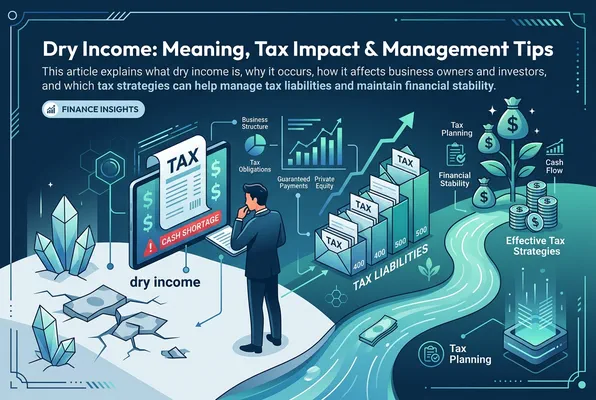

Understanding dry income is essential for business owners, investors, and anyone involved in partnerships or pass-through entities. While the term may sound unusual at first, it describes a surprisingly common and often frustrating financial situation: owing taxes on money you haven’t actually received. This article breaks down what dry income means, why it happens, and how businesses and individuals can manage it effectively.
What Is Dry Income?
Dry income is taxable income that an individual or entity must report and pay taxes on, even though the cash associated with that income has not yet been distributed or received. It’s most commonly seen in pass-through entities such as partnerships, limited liability companies (LLCs), and S corporations, where profits are allocated to owners for tax purposes regardless of whether cash distributions are made.
In simpler terms: the IRS says you earned the money, so you owe taxes on it, but your bank account tells a different story.
How Dry Income Typically Arises
Dry income situations commonly occur in the following scenarios:
- Partnerships and LLCs: Profits are allocated to partners based on ownership percentages, but the company may retain cash for reinvestment, debt repayment, or operating expenses instead of distributing it.
- S Corporations: Shareholders are taxed on their share of corporate income whether or not that income is actually paid out as dividends.
- Private Equity and Venture Capital: Investors may be allocated taxable gains from fund activities before any cash is returned to them.
- Stock Options and Equity Compensation: Employees exercising certain stock options may trigger a tax event without receiving liquid proceeds.
- Real Estate Partnerships: Depreciation recapture or phantom gains from debt relief can generate tax liability without cash flow.
How Business Structure Influences Tax Obligations
The legal structure of a company plays an important role in determining how business income is taxed. For example, a sole proprietorship generally reports its profits on the owner’s personal tax return, whereas an LLC may be taxed as a partnership if it has multiple members and has not elected a different tax classification. Under applicable Internal Revenue Service (IRS) rules, these structures can have different implications for income tax small business owners must pay. Understanding the distinction is particularly important when calculating the effective tax rate and determining whether self-employment taxes apply. Business owners should also review whether their contractual agreements and internal bylaws establish specific rules for allocating profits, retaining earnings, and making distributions.
Dry Income vs. Phantom Income
These two terms are often used interchangeably, but there are subtle differences worth noting.
Phantom income is a broader category that includes any income reported for tax purposes without a corresponding cash receipt, this can include forgiven debt, imputed interest, or certain accounting adjustments.
Dry income specifically refers to the cash-flow mismatch scenario: the income is real and will eventually translate into cash flow, but the timing is delayed. The tax bill, however, doesn’t wait.
Why Dry Income Creates Financial Strain
The core problem with dry income is straightforward: taxpayers must find cash from other sources to cover a liability tied to income they haven’t yet collected. This can lead to several downstream issues:
- Liquidity Crunch: Individuals may need to dip into personal savings or take out loans to pay taxes on dry income.
- Investor Dissatisfaction: Limited partners in funds or real estate deals may become frustrated if they’re repeatedly taxed on gains without seeing corresponding cash.
- Cash Flow Mismanagement: Businesses that don’t plan for dry income obligations among partners risk reputational damage and strained relationships.
- Forced Asset Sales: In extreme cases, taxpayers may need to sell other investments or assets just to cover the tax bill generated by dry income.
The Role of Guaranteed Payments and Self-Employment Taxes
In partnerships, guaranteed payments can create additional tax considerations when a partner receives compensation for services or the use of capital, regardless of the partnership’s profitability. Unlike ordinary profit distributions, these payments are generally included in the recipient’s taxable income and may be subject to self-employment taxes, depending on the circumstances. These taxes help fund Social Security and Medicare and can represent a significant expense for individuals whose business income fluctuates throughout the year. Partners should distinguish between guaranteed payments, allocated profits, and wage income because each may receive different tax treatment. Reviewing these categories before filing a tax return can help taxpayers calculate their obligations more accurately and avoid unexpected liabilities.
Common Industries Where Dry Income Appears
Private Equity and Hedge Funds
Fund managers often allocate taxable gains to limited partners before actual cash distributions are made, particularly when investments remain unrealized or reinvested.
Real Estate Syndications
Real estate partnerships frequently generate dry income through depreciation recapture, debt forgiveness, or refinancing events, where taxable gain is recognized without a cash distribution event.
Professional Services Firms
Law firms, consulting partnerships, and medical practices structured as pass-through entities can generate dry income when profits are reinvested into the business rather than distributed to partners.
Startups and Stock Compensation
Employees who exercise incentive stock options (ISOs) may trigger alternative minimum tax (AMT) liabilities, a classic dry income scenario where no cash is received at the time of the taxable event.
How to Manage and Mitigate Dry Income
1. Build Tax Distribution Provisions into Agreements
One of the most effective tools for preventing dry income problems is including a tax distribution clause in partnership or operating agreements. This requires the entity to distribute enough cash to cover partners’ estimated tax liabilities, even if other profits are retained.
2. Maintain Cash Reserves
Businesses anticipating dry income scenarios should proactively build reserve funds specifically earmarked for tax distributions, reducing the risk of liquidity shortfalls.
3. Communicate Clearly with Investors
Transparency is critical. Investors and partners should understand, well in advance, how and when taxable income will be allocated versus when cash distributions will occur. Clear reporting and proactive tax estimates help avoid surprises.
4. Plan for Estimated Tax Payments
Taxpayers facing dry income should work closely with tax advisors to estimate quarterly tax payments accurately, factoring in allocated income that may not come with cash.
5. Consider Structuring Alternatives
In some cases, businesses can restructure compensation, equity, or distribution policies to minimize dry income exposure, for example, timing stock option exercises strategically or adjusting partnership distribution waterfalls.
Balancing Reinvestment, Deductible Expenses, and Long-Term Profitability
A business may accumulate revenue to finance expansion, cover fluctuations in the cost of living, or fund future operating needs rather than distribute all available cash to its owners. However, revenue is not the same as taxable profit: a qualifying business expense may be deductible when calculating taxable income, while money invested in the business is not automatically deductible merely because it reduces available cash. Owners should therefore distinguish between cash reserves, accounting profit, and taxable income when assessing profitability. Depending on the entity’s structure and the nature of its activities, certain income may receive different tax treatment, while tax-exempt income generally follows separate rules. Careful bookkeeping and regular financial reviews can help ensure that funds reserved for growth do not leave owners unprepared for tax payments. Although no tax strategy can guarantee a particular outcome, a well-planned approach can improve financial stability and help businesses remain profitable over the long term.
Dry Income and Tax Planning Strategies
Effective tax planning can significantly reduce the burden of dry income. Strategies include:
- Timing income recognition: Where possible, deferring recognition of taxable events to align more closely with cash receipt.
- Utilizing installment sales: Spreading taxable gain over multiple years can reduce the mismatch between tax liability and cash flow.
- Electing alternative tax treatments: In certain entity structures, elections (such as Section 83(b) elections for equity compensation) can shift the timing of tax recognition to a more favorable point.
- Working with experienced advisors: Given the complexity of partnership taxation and pass-through entity rules, professional guidance is invaluable in minimizing dry income exposure.
The Investor Perspective: What to Watch For
If you’re an investor in a partnership, fund, or private business, it’s wise to ask specific questions before committing capital:
- Does the partnership agreement include tax distribution provisions?
- How often are cash distributions made relative to taxable income allocations?
- What is the fund’s or business’s historical track record regarding dry income events?
- How are unrealized gains, debt forgiveness, or depreciation recapture handled?
Understanding these details upfront can prevent unpleasant tax surprises down the road.
Final Thoughts
Dry income is a critical concept for anyone involved in partnerships, pass-through entities, or complex investment structures. While it’s a normal part of how many business arrangements operate, it can create real financial stress if not properly anticipated and managed. By incorporating tax distribution provisions, maintaining adequate reserves, and working closely with tax professionals, businesses and investors can navigate dry income challenges with confidence and avoid unwelcome cash flow surprises.
Whether you’re a fund manager, business owner, or investor, understanding how dry income works, and proactively planning for it, is a key component of sound financial management.
FAQ
What is dry income?
Why is dry income a problem for businesses?
How can companies avoid dry income issues?
Is dry income the same as phantom income?
Written by
Dominik KonoldCEO & Founder
Dominik Konold is the CEO and founder of Finidy GmbH, specializing in share-based compensation and treasury accounting. With a background in audit and investment banking, he is a certified Professional Risk Manager (PRMIA) and lectures for the Association of Public Banks and the Academy of International Accounting.
Related Posts

Best Equity Management Software for Startups 2026
Discover the best equity management software for startups. Compare top platforms, key features, cap table tools, and compliance capabilities to manage equity.

Advisory Shares: Complete Guide for Startup Founders
Everything founders, advisors and investors need to know about the scope of application and functioning of advisory shares.

Cap Table Guide: What It Is & How It Works | Incentrium
All you need to about Cap Table as a Startup Founder
Ready to simplify your equity programs?
See how Incentrium helps you manage share-based compensation with ease. Book a demo to learn more.
Book a Demo