Employee participation in startups: Everything you need to know about ESOP, VSOP, vesting and more

Employee participation in startups is more than just a bonus. It is a strategic tool that creates motivation, loyalty and long-term commitment when founders and teams understand how participation programmes work. The focus is on terms such as vesting, cliff or strike price, but also good leaver, transfer restrictions or exercise price. Those who are familiar with these technical terms can develop fair, transparent participation programmes and confidently conduct difficult discussions with investors and employees.
Why employee participation is crucial for startups
Employee participation programmes balance out high salaries: it binds team members to the company, makes them co-entrepreneurs and aligns personal motivation with entrepreneurial success. At the same time, a good participation model promotes strategic thinking and long-term perspectives.
ESOP and VSOP explained
Before we go through the most important terms, it is worth taking a brief look at the different models:
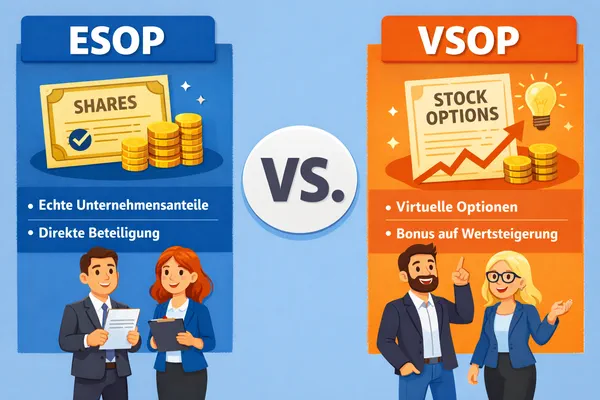
- ESOP: Employees receive real company shares or options on them. This often means voting rights, dividend rights and genuine co-ownership after exercise.
- VSOP: Employees receive virtual shares that are converted into a cash payment upon exit or sale without transferring real shares.
Which shareholding model is best?
Both models pursue the same goal namely to give employees a share in the company’s success, but they differ significantly in their design. An ESOP strengthens genuine co-ownership, as employees participate in long-term value growth and often also receive voting or dividend rights. At the same time, this model signals a high degree of trust and entrepreneurial equality.
A VSOP, on the other hand, is particularly appealing due to its flexibility and ease of implementation. The corporate structure remains unchanged, dilution among shareholders is avoided and the administrative burden is lower. For young startups in Germany in particular, the VSOP is therefore often the more practical entry point into employee participation.
Which model is more suitable depends on the type of company, its growth phase and its strategic goals. It is crucial that all parties involved understand which rights and obligations associated with the respective shareholding and what economic value they can realistically expect.
Grant: Allocation of participation rights
The grant refers to the point in time at which an employee is promised participation rights. The corresponding agreement specifies the extent of the participation, the exercise price at which it is granted and the conditions under which the rights are actually acquired, for example within the framework of a vesting model.
The strike price: at what value does participation become worthwhile?
The strike price, also known as the exercise price, is the price at which employees can later exercise their options and purchase company shares. This is often set at the current company value at the time of allocation. If the company value is significantly higher at a later exit, this results in an economic advantage for the employee, and this is precisely where the incentive lies. A sensibly chosen strike price is therefore essential for motivation and tax clarity.
Vesting: How participation develops step by step
Vesting means that shares are not transferred immediately in full but must be ’earned’ over a specified period of time. Only after such a vesting period do employees acquire an irrevocable claim to their shares. A typical vesting period is time-based, e.g. four years, during which the share becomes vested gradually or in stages. Such a model promotes long-term loyalty and protects against immediate departure shortly after the grant.
Cliff: The starting point in the vesting plan
The cliff is the minimum period an employee must remain with the company before vesting begins. Only after the cliff has expired does vesting begin and with it the first transfer of shares. A common cliff is 12 months. If an employee stays for less than this, they receive nothing. After the cliff, e.g. 25% of all shares can be ‘vested’ at once.
Good leaver vs. bad leaver
Leaver provisions regulate what happens when an employee leaves the company. A distinction is made between good leavers and bad leavers:
- Good leaver: An employee leaves under recognised circumstances, such as retirement or illness. In these cases, share rights that have already been acquired, i.e. vested, may generally be retained.
- Bad leaver: An employee leaves the company for reasons that are considered negative, for example, by resigning without good cause or breaching their duties. In such cases, participation rights that have already been acquired, i.e. vested, often lapse. Such clauses provide certainty about the treatment in the event of separation and should be clearly defined.
Transfer restrictions and clawback clauses
- Transfer restrictions: These specify the conditions under which employees may transfer their shares to third parties. This protects the circle of shareholders and keeps the ownership structure of the company stable.
- Clawback clauses: These give the company the option of reclaiming participation rights that have already been acquired or exercised under certain conditions, for example in the event of misconduct.
Expiry date and exercise period
Every option has an expiry date. It expires if it has not been exercised. In addition, there is an exercise period during which an option can be used, even if vesting has already been completed.
Why clear terms are important
An equity model only works if all parties involved understand under what conditions they acquire which rights. Unclear or missing definitions lead to misunderstandings, disappointment or even legal conflicts. Startups should therefore use comprehensible glossaries and clear plan documents from the outset.
Conclusion
Employee participation only works if the founders and team really understand the mechanisms behind it. Those who are familiar with terms such as vesting, cliff, exercise price and good leaver rules can not only design participation programmes that are legally sound but also use them strategically. In this way, participation becomes an instrument that promotes motivation, loyalty and joint value enhancement, thus making a real contribution to the long-term success of the company.
FAQ
What is employee participation in startups?
How does vesting work in employee stock option plans?
What is the difference between a good leaver and a bad leaver?
Written by
Dominik KonoldCEO & Founder
Dominik Konold is the CEO and founder of Finidy GmbH, specializing in share-based compensation and treasury accounting. With a background in audit and investment banking, he is a certified Professional Risk Manager (PRMIA) and lectures for the Association of Public Banks and the Academy of International Accounting.
Related Posts
ESOP or VSOP? The crucial comparison for founders
ESOP or VSOP? Compare the crucial differences between real and virtual stock option plans to find the right fit for your startup.

Future Financing Act: changes offer new opportunities for startups
How Germany's Future Financing Act (Zukunftsfinanzierungsgesetz) creates new opportunities for startups using share-based compensation programs.

Equity Evolution: Transforming the Future of Work
ESOPs and VSOPs are transforming the way that employees are compensated and incentivized for their work. Learn more about the benefits of share-based compensation and how it can benefit your company.
Ready to simplify your equity programs?
See how Incentrium helps you manage share-based compensation with ease. Book a demo to learn more.
Book a Demo