Equity Dilution: What Founders & Employees Need to Know
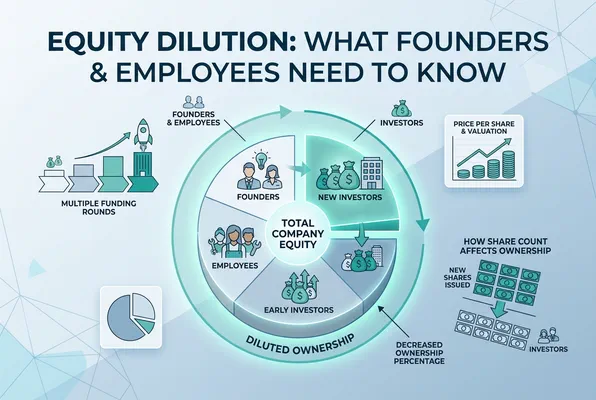

Equity dilution is one of the most important, and often misunderstood, concepts in startup finance and corporate ownership. Whether you’re a founder raising your first funding round, an early employee negotiating stock options, or an investor evaluating a cap table, understanding how equity dilution works can significantly impact your financial outcomes and decision-making.
This guide breaks down everything you need to know about equity dilution: what causes it, how to calculate it, and practical strategies to manage it effectively.
What Is Equity Dilution?
Equity dilution refers to the reduction in existing shareholders’ ownership percentage that occurs when a company issues new shares. As the total number of outstanding shares increases, each existing share represents a smaller slice of the overall pie, even though the company itself may be growing in value.
Think of it like slicing a pizza. If you start with a pizza cut into 10 slices and you own 2, you have 20% of the pizza. If the pizza is then re-cut into 20 slices, your 2 slices now represent only 10% of the total, even though the pizza itself hasn’t changed size. In this analogy, the “pizza” grows as the company’s valuation increases, which is why dilution isn’t necessarily bad, it depends on whether the increased valuation offsets the reduced ownership percentage.
Why Equity Dilution Happens
Companies dilute equity for several common reasons:
- Raising capital: Issuing new shares to investors in exchange for funding (seed rounds, Series A, B, C, etc.)
- Employee stock option pools (ESOPs): Reserving shares to attract and retain talent
- Convertible notes and SAFEs: These instruments convert into equity, often at a discount, during a future financing round
- Warrants and options exercised: When option holders exercise their right to purchase shares
- Additional co-founders or advisors: Bringing on new equity partners
- Follow-on funding rounds: Each subsequent round typically dilutes existing shareholders further
How Equity Dilution Works in Practice
To understand equity dilution concretely, let’s walk through a simplified example.
How Share Count Affects Ownership
The number of shares a company has does not determine its value by itself. What matters is how those shares are distributed across the total number of shares and how many issued shares each shareholder owns. During a fundraising process, a company may increase its total pool of shares through an issuance of new shares. For example, if a founder owns 1 million shares and the company has 2 million shares outstanding, the founder owns 50% of the percentage of a company. If another 1 million shares are issued to new investors, the founder still owns 1 million shares, but their ownership percentage of a company falls to 33.3%. This illustrates why the number of shares issued matters when assessing dilution for existing shareholders.
A Basic Dilution Example
Imagine a startup founder owns 1,000,000 shares out of 1,000,000 total shares outstanding, 100% ownership. The company decides to raise a seed round and issues 250,000 new shares to investors.
- Before the round: 1,000,000 shares outstanding, founder owns 100%
- After the round: 1,250,000 shares outstanding, founder now owns 1,000,000 / 1,250,000 = 80%
The founder’s ownership percentage dropped from 100% to 80%, even though they didn’t sell a single share. This is the essence of equity dilution.
The Impact of Multiple Funding Rounds
Dilution compounds across multiple financing rounds. A founder who starts with 100% ownership might see their stake shrink to 60-70% after a seed round, 40-50% after Series A, and even lower after subsequent rounds. This is normal and expected in the startup lifecycle, what matters most is the absolute value of the ownership stake, not just the percentage.
For example, owning 10% of a company valued at $100 million ($10 million) is far more valuable than owning 50% of a company worth $1 million ($500,000).
Price Per Share and Company Valuation
The price per share is another important factor when evaluating dilution. A company raising $5 million at a price per share of $5 would issue 1 million new shares, whereas raising the same amount at $10 per share would require only 500,000 new shares. The relationship between the amount raised, the number of shares issued, and the company’s company valuation therefore directly influences dilution. In a fundraising round, investors typically negotiate their ownership based on the valuation of the business and the resulting percentage of the company they will receive. Looking at the price per share alongside the value of the company can help founders understand whether a financing creates excessive dilution relative to the capital being raised.
Types of Equity Dilution
1. Dilution from Funding Rounds
Each time a company raises a new round of financing, it issues new equity to investors. This is the most common and expected form of dilution, particularly for venture-backed startups.
2. Dilution from Employee Stock Option Pools
Most startups reserve a portion of equity, typically 10-20%, as an option pool to grant to employees. This pool is often created or expanded before a funding round, which means existing shareholders (including founders) absorb the dilution, not the incoming investors.
3. Dilution from Convertible Instruments
SAFEs (Simple Agreements for Future Equity) and convertible notes are popular early-stage financing tools. They don’t dilute ownership immediately but convert into equity during a later financing event, often causing significant dilution when multiple instruments convert simultaneously.
4. Anti-Dilution Adjustments
In “down rounds” (when a company raises money at a lower valuation than previous rounds), anti-dilution provisions can protect certain investors by adjusting their conversion price, which often results in additional dilution for founders and other shareholders.
Common Shares, Preferred Shares, and Voting Power
Not all shares necessarily carry identical rights. Common shares are typically held by founders and employees, while investors in venture-backed private companies often receive preferred shares with additional economic or contractual rights. These differences can affect voting power, liquidation preferences, and other aspects of equity ownership even when two shareholders own the same percentage of the company. As a result, the implications of equity dilution go beyond simply calculating an ownership percentage. A founder may still own a significant percentage of the company, for example, while having less voting power than expected because of different share classes or investor rights.
Stock Options and Future Share Issuance
Future dilution can also result from equity that has not yet become issued shares. Stock options exercise can increase the number of shares outstanding when employees exercise their options, while additional grants can expand the potential share pool. This means founders should consider not only the current total number of shares, but also the shares that could be created through future option grants, warrants, or other equity instruments. When assessing issuance stock dilution, investors and founders should model the fully diluted capitalization to understand how future issuance of new shares could affect equity ownership, voting power, and the value of their shares.
How to Calculate Equity Dilution
The basic formula for calculating dilution is:
New Ownership % = Existing Shares / (Existing Shares + New Shares Issued)
To determine the dilution impact:
Dilution % = 1 − (New Ownership % / Original Ownership %)
Understanding this calculation helps founders and employees evaluate the true cost of raising capital or expanding the option pool, and it’s a critical part of any cap table management strategy.
Managing Equity Dilution: Strategies for Founders
While dilution is often unavoidable, there are several ways to manage it strategically.
1. Negotiate Pro-Rata Rights
Pro-rata rights allow existing shareholders (often investors) to participate in future funding rounds to maintain their ownership percentage. Founders can also negotiate similar protections in certain circumstances.
2. Optimize the Size of the Option Pool
Rather than over-allocating shares to the employee stock option pool, calculate the pool size based on realistic hiring plans. An oversized pool dilutes existing shareholders unnecessarily.
3. Raise Capital Efficiently
Avoid raising more money than necessary at each stage. Every dollar raised typically comes with a corresponding equity cost, so efficient capital raising minimizes unnecessary dilution.
4. Use Convertible Instruments Wisely
SAFEs and convertible notes can delay dilution and valuation conversations, but founders should model out various conversion scenarios to understand the eventual dilutive impact.
5. Understand Anti-Dilution Provisions
Familiarize yourself with “full ratchet” versus “weighted average” anti-dilution provisions, as these terms significantly affect how much dilution occurs during a down round.
6. Leverage Equity Management Tools
Modern cap table and equity management platforms help founders model dilution scenarios before finalizing a funding round, giving clarity on how new investment, option grants, or convertible conversions will impact ownership structure.
Equity Dilution and Employee Stock Options
For employees receiving equity compensation, understanding dilution is equally important. When you’re granted stock options, your ownership percentage will likely decrease over time as the company raises additional funding rounds and expands the option pool for future hires.
This is normal and doesn’t necessarily mean your equity is losing value, as long as the company’s valuation grows faster than the dilution rate, your equity stake can still increase in absolute value. When evaluating a job offer with equity compensation, ask about:
- The current fully diluted share count
- The size and history of the option pool
- The company’s funding stage and anticipated future rounds
- Vesting schedules and strike prices
Is Equity Dilution Always Bad?
Not necessarily. While dilution reduces your ownership percentage, it often accompanies capital infusion that fuels growth, hiring, product development, and market expansion. A smaller percentage of a rapidly growing, well-funded company can be far more valuable than a larger percentage of a stagnant one.
The key question isn’t “How much am I being diluted?” but rather “Is this dilution creating enough additional value to offset my reduced ownership percentage?”
Founder Dilution and Shareholder Value
Founder dilution should also be evaluated in terms of economic outcomes rather than ownership percentage alone. The effects of dilution depend on what happens to the value of the company after a financing. If a founder’s ownership falls from 40% to 25%, but the company valuation increases substantially, the value of your stake may still rise. The same principle applies to employees and other shareholders: the value of their shares can increase even as their ownership percentage declines. Understanding these dilution effects is therefore essential when assessing shareholder value rather than focusing solely on the percentage of ownership.
Final Thoughts
Equity dilution is an inherent part of building and scaling a company, whether you’re a founder navigating funding rounds or an employee evaluating a stock option offer. By understanding how dilution works, calculating its impact accurately, and employing strategic approaches like optimized option pools and informed negotiation, founders and employees alike can make smarter decisions about equity and ownership.
Managing equity dilution effectively requires ongoing attention to cap table structure, funding strategy, and long-term company goals, but with the right knowledge and tools, it becomes a manageable and even strategic part of company growth.
FAQ
What is equity dilution?
How does equity dilution affect founders?
Can equity dilution be prevented?
What is the difference between equity dilution and share dilution?
Written by
Dominik KonoldCEO & Founder
Dominik Konold is the CEO and founder of Finidy GmbH, specializing in share-based compensation and treasury accounting. With a background in audit and investment banking, he is a certified Professional Risk Manager (PRMIA) and lectures for the Association of Public Banks and the Academy of International Accounting.
Related Posts
Dry Income: Meaning, Tax Impact & Management Tips
This article explains what dry income is, why it occurs, how it affects business owners and investors, and which tax strategies can help manage tax liabilities and maintain financial stability.

Accelerated Vesting: How to Accelerate Your Vesting Schedule for Stock Options & Restricted Stock
This guide explains accelerated vesting, including single- and double-trigger acceleration, vesting schedules, equity grants, and what happens to employee equity during major corporate events.

Growth Shares: Everything Startups Need to Know in 2026
A comprehensive guide explaining how growth shares work, their benefits, tax implications, and how they compare with other employee equity incentive schemes.
Ready to simplify your equity programs?
See how Incentrium helps you manage share-based compensation with ease. Book a demo to learn more.
Book a Demo