Good Leaver: Definition, Clauses & Equity Rules Explained

What Is a Good Leaver?
A good leaver is a term used in shareholder agreements, employment contracts, and equity incentive plans to describe an employee, founder, or shareholder who leaves a company under circumstances the company considers acceptable or unavoidable. This classification determines what happens to that person’s shares, stock options, or other equity awards upon departure.
The concept is central to good leaver / bad leaver provisions, a standard feature in venture-backed companies, private equity-owned businesses, and startups that offer equity compensation. These provisions protect the company’s cap table integrity while giving departing employees fair treatment if they leave for legitimate reasons.
Understanding good leaver status matters whether you’re a founder drafting a shareholders’ agreement, an HR leader designing an employee stock ownership plan (ESOP), or an employee trying to understand what happens to your vested shares if you resign, retire, or are made redundant.
Good Leaver vs. Bad Leaver: The Core Distinction
Most equity agreements split departing shareholders into two categories:
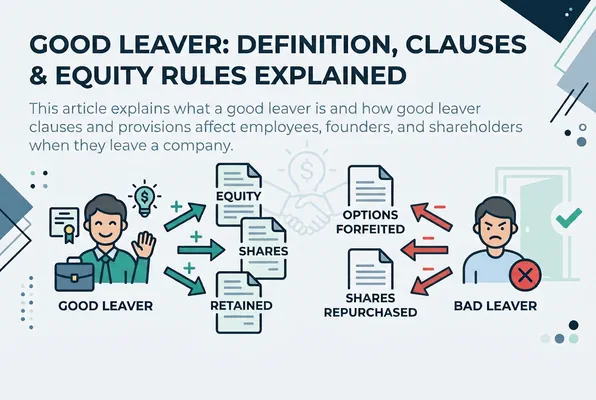
Good Leaver
A good leaver typically exits due to circumstances outside their control or that are viewed as legitimate and non-punitive, such as:
- Retirement at normal retirement age
- Death or permanent incapacity
- Long-term illness or disability
- Redundancy or company-initiated termination without cause
- Mutual agreement to terminate employment
- Sale of the business (in some structures)
Consequence: Good leavers generally retain their vested shares or options and are entitled to sell them at fair market value (FMV), either immediately or at a future liquidity event.
Bad Leaver
A bad leaver is someone whose departure is viewed negatively by the company, including:
- Voluntary resignation without good reason
- Termination for cause (misconduct, fraud, gross negligence)
- Breach of restrictive covenants (non-compete, confidentiality)
- Poor performance leading to dismissal
Consequence: Bad leavers often forfeit unvested equity entirely and may be forced to sell vested shares back to the company at nominal value or original cost, rather than fair market value.
Some agreements include a middle category, sometimes called an “intermediate leaver” or “good leaver by default,” where the board has discretion to decide the classification based on the specific circumstances.
Good Leaver Treatment and the Right to Leave the Company
A well-drafted good leaver provision should make clear what happens when an employee or founder decides to leave the company under circumstances that qualify for favorable treatment. Rather than simply defining a good leaver by reference to termination, the agreement should set out the precise rights the individual will retain in relation to their employee share, share option, or other equity interest.
In many cases, good leaver treatment allows an employee shareholder to retain vested equity or to sell their shares following departure. The specific number of shares that the individual is entitled to receive or retain will depend on the relevant vesting arrangements, the period of service, and the terms of the applicable option agreements or employment agreement. Where an employee leaves because of ill health or due to death, the agreement may also provide specific protections for the employee or their estate.
Why Good Leaver Clauses Exist
Good leaver clauses serve several important purposes for companies, especially those backed by venture capital or private equity:
1. Protecting the Cap Table
Without leaver provisions, former employees could retain significant equity stakes indefinitely, even after contributing nothing further to the company’s growth. Good leaver clauses ensure equity ownership remains aligned with active contribution.
2. Incentivizing Retention
By tying favorable treatment to specific exit circumstances, companies encourage employees to stay engaged and discourage early, opportunistic departures purely to cash out equity.
3. Fairness for Legitimate Departures
Employees who leave due to illness, retirement, or company restructuring shouldn’t be penalized the same way as someone terminated for misconduct. Good leaver status recognizes this distinction and protects employees acting in good faith.
4. Investor Protection
Venture capital and private equity investors typically require these clauses in shareholder agreements to prevent dilution risk and ensure equity incentives function as intended throughout the investment lifecycle.
Common Triggers for Good Leaver Status
While exact definitions vary by jurisdiction and company, typical good leaver triggers include:
- Retirement at an agreed age or after a minimum tenure
- Death of the shareholder or employee
- Permanent disability or long-term illness preventing continued work
- Redundancy due to restructuring, downsizing, or role elimination
- Termination without cause initiated by the employer
- Constructive dismissal, where an employee resigns due to employer breach of contract
Some agreements also classify departures following a change of control (acquisition or merger) as good leaver events, since the employee’s exit isn’t voluntary in the traditional sense.
Defining What Will Constitute a Good Leaver Event
One of the most important drafting considerations is defining what will constitute a qualifying departure. Many companies distinguish between circumstances such as retirement, redundancy, disability, or ill health, and departures involving fraud or gross misconduct.
The agreement should therefore explain whether a particular event will constitute a good leaver event automatically or whether a decision by the board or shareholders is required. Clear definitions can reduce uncertainty for both the departing individual and the remaining shareholders, particularly where substantial equity value is involved.
How Good Leaver Status Affects Vesting and Valuation
Vesting, Performance Targets and Equity Value
Good leaver provisions should also be considered alongside the company’s vesting arrangements. Where an employee share scheme includes performance targets, the agreement should explain what happens to equity when an employee leaves before all shares vest.
For example, an agreement may provide that vested shares remain with the employee while the vesting of unvested shares stops on the departure date. Other arrangements may provide additional vesting in specific circumstances. The treatment of shares depending on the reason for departure can therefore have a substantial impact on the employee’s eventual shareholder value and equity value.
Vesting Schedules
Most equity plans use a vesting schedule, often four years with a one-year cliff. Good leaver status usually doesn’t accelerate vesting automatically, unvested shares typically remain unvested regardless of leaver classification, unless the agreement specifies otherwise (e.g., accelerated vesting upon death or disability).
Valuation of Shares
The critical financial difference lies in valuation method upon departure:
| Leaver Type | Vested Shares | Unvested Shares |
|---|---|---|
| Good Leaver | Fair market value (FMV) | Typically forfeited |
| Bad Leaver | Nominal value or original cost | Forfeited |
| Intermediate/Discretionary | Board decides, often between FMV and nominal | Forfeited |
Fair market value is usually determined through an independent valuation, a formula set in the agreement, or the price of the most recent funding round.
Compulsory Transfer of Shares
A good leaver provision may also be linked to a compulsory transfer mechanism. Instead of allowing a departing shareholder to retain their shares indefinitely, the relevant shareholder provisions may require a transfer of shares following a qualifying departure.
A compulsory transfer can give the company or the remaining shareholders the right to purchase the departing shareholder’s interest. The agreement should specify how the value of shares is calculated, when payment must be made, and whether the transfer is based on fair market value or another agreed valuation method. These arrangements are often included in a shareholder agreement and may also need to be reflected in the company articles of association.
Good and Bad Leaver Clauses in Shareholder Agreements
Although a company’s equity arrangements may focus primarily on good leaver treatment, good and bad leaver clauses are often drafted together so that the consequences of different departure scenarios are clear. Bad leaver clauses may apply where an individual commits serious misconduct, breaches contractual obligations, or leaves in circumstances expressly defined as a bad leaver event.
The purpose is not necessarily to penalise someone simply for leaving. Instead, these shareholder provisions establish different consequences depending on the circumstances in which someone departs. The distinction can be particularly important where shares and options represent a significant proportion of an individual’s compensation.
Drafting a Good Leaver Clause: Key Considerations
Companies structuring equity plans or shareholder agreements should address the following:
1. Clear, Objective Definitions
Ambiguous language creates disputes. Define good leaver and bad leaver triggers precisely, using objective criteria wherever possible (e.g., “termination without cause” clearly defined in the employment contract).
2. Board Discretion vs. Fixed Rules
Decide whether the board retains discretion to reclassify leavers based on circumstances, or whether the agreement uses strict, non-negotiable definitions. Discretion offers flexibility but can create uncertainty and potential conflict.
3. Repurchase Mechanisms
Specify how and when the company (or other shareholders) can exercise a repurchase right or call option over a leaver’s shares, including payment timelines and valuation methodology.
4. Interaction with Vesting
Clarify whether any acceleration applies in good leaver scenarios (common for death or disability) and how partial vesting is calculated for mid-cycle departures.
5. Tax and Legal Implications
Good leaver and bad leaver treatment can trigger different tax consequences depending on jurisdiction. Consult legal and tax advisors when drafting these provisions, particularly for cross-border teams.
Good Leaver Provisions in Employee Equity Plans
For companies running ESOPs (Employee Stock Ownership Plans), VSOPs (Virtual Stock Option Plans), or other equity incentive structures, good leaver rules are typically embedded directly into the plan documentation. This ensures consistency across all participants and reduces case-by-case negotiation.
Key elements often included:
- A defined exercise window for vested options after a good leaver event (commonly 90 days to several years)
- Automatic forfeiture of unvested options upon any termination
- Specific carve-outs for retirement, death, or disability that may extend exercise windows or accelerate vesting
- Clear valuation methodology referencing the latest 409A valuation (in the U.S.) or equivalent fair value assessment
Modern equity management platforms help HR and finance teams administer these rules consistently, track vesting in real time, and avoid manual errors when employees depart under different circumstances.
Practical Example
Imagine an employee holding 40,000 stock options with a four-year vesting schedule. After three years, 30,000 options have vested. The company undergoes restructuring and the employee is made redundant.
- If classified as a good leaver: The employee can exercise the 30,000 vested options at the exercise price and later sell them at fair market value during a liquidity event. The remaining 10,000 unvested options are forfeited.
- If classified as a bad leaver (e.g., terminated for gross misconduct): The employee may lose the right to exercise even the vested options, or be forced to sell them back at the original exercise price, depending on the plan’s specific bad leaver provisions.
This example illustrates why the good leaver / bad leaver distinction has significant financial consequences for departing employees.
Best Practices for Employees Reviewing Good Leaver Terms
If you’re negotiating an offer that includes equity, review the following before signing:
- Read the full shareholders’ agreement, not just the offer letter summary.
- Identify what counts as a good leaver event in your specific contract.
- Check whether resignation for “good reason” (e.g., relocation, demotion, unpaid wages) is treated as good leaver.
- Understand the valuation method used for vested shares upon exit.
- Clarify the exercise window for stock options after departure.
- Negotiate ambiguous discretionary clauses where possible, especially in senior roles.
Final Thoughts
The good leaver classification is one of the most consequential, yet often overlooked, elements of equity compensation and shareholder agreements. It determines whether a departing employee walks away with fair value for their contribution or with significantly reduced compensation. For companies, well-drafted good leaver and bad leaver provisions protect the integrity of the cap table while maintaining fairness for employees who leave under legitimate circumstances.
Whether you’re structuring an equity incentive plan from scratch or reviewing an existing agreement, clarity around good leaver definitions, valuation methods, and vesting treatment will save significant time, cost, and potential disputes down the road.
FAQ
What is the difference between a good leaver and a bad leaver?
Who decides whether someone is a good leaver or a bad leaver?
Do good leaver provisions apply to stock options as well as shares?
Can a good leaver clause be negotiated before signing an employment or investment agreement?
Written by
Dominik KonoldCEO & Founder
Dominik Konold is the CEO and founder of Finidy GmbH, specializing in share-based compensation and treasury accounting. With a background in audit and investment banking, he is a certified Professional Risk Manager (PRMIA) and lectures for the Association of Public Banks and the Academy of International Accounting.
Related Posts

Cap Table Explained: The Ultimate Cap Table Guide for Founders
A cap table shows a startup’s ownership structure, including founders, employees, and investors, and explains how shares change through funding, dilution, and exits.

Best Equity Management Software for Startups 2026
Discover the best equity management software for startups. Compare top platforms, key features, cap table tools, and compliance capabilities to manage equity.

Cap Table Guide: What It Is & How It Works | Incentrium
All you need to about Cap Table as a Startup Founder
Ready to simplify your equity programs?
See how Incentrium helps you manage share-based compensation with ease. Book a demo to learn more.
Book a Demo