Growth Shares: Everything Startups Need to Know in 2026

Growth shares have become an increasingly popular tool for startups and scale-ups seeking to attract, retain, and motivate top talent without triggering excessive dilution or unfavorable tax consequences. As competition for skilled employees intensifies, understanding how growth shares work, and how they compare to other equity incentive structures, can make a significant difference in building a motivated, long-term workforce.
This guide explores what growth shares are, how they function, their tax implications, and why more companies are turning to this equity structure as part of their employee incentive strategy.
What Are Growth Shares?
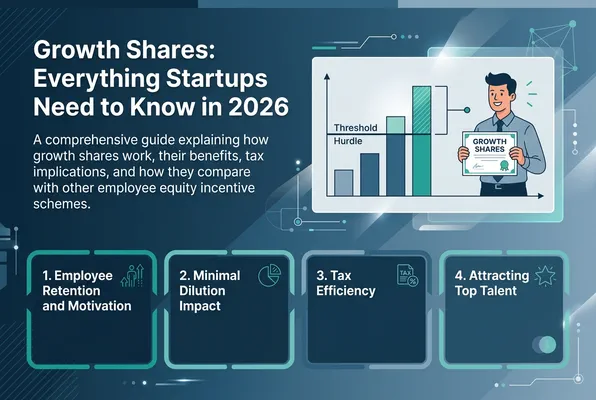
Growth shares are a distinct class of company shares designed to reward employees or key stakeholders based on the future growth of a business. Unlike ordinary shares, growth shares only carry value once the company’s valuation exceeds a specific threshold, commonly referred to as the hurdle price or hurdle rate.
This means that if the company is sold or valued at the current market price today, growth shareholders would receive little to no value. However, once the business grows beyond the hurdle, growth shareholders can participate in the upside, hence the name “growth” shares.
How Growth Shares Work
The mechanics of growth shares are relatively straightforward:
- Setting the Hurdle Price – The company determines a valuation threshold based on its current market value, often validated through an independent valuation.
- Issuing Growth Shares – Employees or other recipients are issued growth shares, often at a low or nominal cost, since the shares have limited value at the point of issuance.
- Vesting Period – Growth shares often come with vesting schedules, requiring recipients to remain with the company for a set period before fully owning their shares.
- Value Realization – When the company is sold, lists publicly, or reaches a liquidity event, growth shareholders receive a portion of the value that exceeds the hurdle price.
This structure aligns employee incentives directly with company performance, ensuring that shareholders only benefit when genuine value creation occurs.
How the Value of Growth Shares Is Determined
A key consideration when designing a growth share plan is determining the value of the growth share at the point it is issued. The company valuation should reflect the market value of the company and, where appropriate, the market value of the shares before the new incentive arrangement is introduced. This establishes the initial value of the growth that existing shareholders have already created and helps determine the economic threshold at which participants begin to benefit from future growth.
The value of growth shares will therefore depend on the rights attached to the relevant class of growth shares, as well as the hurdle that has been established. If the value of the company remains below that hurdle, the shares may have little or no economic value. As the business grows, however, the growth in value above the agreed threshold can increasingly be attributed to the holders of growth shares.
This distinction is particularly important when a new class of shares is created. The company’s constitutional documents should clearly define how the capital of the company, voting rights, dividend rights and proceeds on an exit are allocated between the different share classes. In practice, the share capital of the company may therefore contain ordinary shares alongside a special class of shares issued specifically for employee incentives.
Why Companies Use Growth Shares
Growth shares offer several strategic advantages, particularly for startups and high-growth companies operating with limited cash resources but strong growth potential.
1. Employee Retention and Motivation
By tying compensation to company growth, employees are incentivized to contribute directly to increasing the company’s valuation. This alignment fosters a performance-driven culture and long-term commitment.
2. Minimal Dilution Impact
Since growth shares only capture value above the hurdle price, existing shareholders retain more control and ownership value compared to issuing full-value ordinary shares.
3. Tax Efficiency
One of the most significant advantages of growth shares is their potential tax efficiency. Because growth shares are typically issued at (or close to) their fair market value, which is low due to the hurdle price mechanism, employees often face minimal or no income tax at the point of grant. Instead, any subsequent increase in value is generally taxed as a capital gain, which is usually taxed at a lower rate than ordinary income.
4. Attracting Top Talent
In competitive talent markets, offering equity incentives like growth shares can be a decisive factor for candidates evaluating job offers, especially in the startup and scale-up ecosystem.
Growth Shares in Private Companies
Growth shares are particularly relevant to private companies, where there may be no readily available public market for the shares. In these businesses, employees may hold an interest for several years before there is an opportunity to realise its value.
A future sale of the company is often the event that makes the economic benefit tangible. If the company has achieved substantial growth prospects and its valuation has increased significantly, the difference between the original hurdle and the eventual sale price can create meaningful value for participants.
This can also make growth shares attractive where founders want employees to share in new growth without giving them the same economic exposure to the value that existed before they joined. The structure can effectively separate the existing capital of the company from the additional value created during the employee’s participation.
Growth Shares vs. Other Equity Incentives
Understanding how growth shares compare to other common equity structures helps clarify their unique advantages.
Growth Shares vs. Share Options
| Feature | Growth Shares | Share Options |
|---|---|---|
| Ownership | Immediate | Deferred until exercised |
| Tax Treatment | Often capital gains | Can trigger income tax on exercise |
| Dilution | Limited to growth above hurdle | Full dilution upon exercise |
| Complexity | Requires valuation and legal setup | Generally simpler to administer |
While share options grant the right to purchase shares in the future at a fixed price, growth shares provide immediate ownership, albeit with value contingent on future growth. This distinction often results in more favorable tax treatment for growth shares in various jurisdictions.
Growth Shares vs. Ordinary Shares
Ordinary shares represent full ownership and voting rights from the outset, with value tied directly to the company’s current valuation. Growth shares, by contrast, are specifically structured to limit value to future growth, making them more suitable for incentive purposes without diluting the value held by founders and early investors.
Growth Shares Compared with EMI and Performance-Based Incentives
For UK businesses, it can also be useful to compare growth shares with an EMI option arrangement. An EMI option gives an eligible employee the right to acquire shares in the future under the terms of an approved option arrangement, whereas growth shares are actual shares issued to the employee from the outset, subject to their specific rights and restrictions.
The choice between an EMI option and a growth share plan will depend on factors such as eligibility, company size, the desired employee experience, valuation considerations and the intended tax treatment. Companies should assess both structures rather than assuming that one will always provide the better outcome.
Growth shares can also be compared with performance shares. Performance shares generally link the eventual entitlement to specified financial, operational or individual targets. Growth shares, by contrast, can place greater emphasis on the overall increase in company value. In some circumstances, the two concepts can be combined so that an employee must both remain with the business and satisfy defined performance conditions before the full benefit becomes available.
Setting Up a Growth Shares Scheme
Implementing a growth shares scheme requires careful planning and professional guidance to ensure compliance with legal, tax, and corporate governance requirements.
Key Steps to Implementation
- Independent Valuation – Obtain a professional valuation to establish the current market value and set an appropriate hurdle price.
- Legal Structuring – Draft the necessary legal documentation, including amendments to the company’s articles of association to create the new share class.
- Tax Advice – Consult with tax professionals to structure the scheme in a tax-efficient manner, considering jurisdiction-specific regulations.
- Vesting and Leaver Provisions – Define clear vesting schedules and leaver provisions (good leaver vs. bad leaver clauses) to protect the company’s interests.
- Communication to Employees – Clearly explain the scheme’s mechanics, benefits, and risks to employees to ensure understanding and buy-in.
Common Pitfalls to Avoid
- Incorrect Valuation – Setting the hurdle price too low or too high can undermine the scheme’s effectiveness or create unnecessary tax risk.
- Poor Documentation – Inadequate legal documentation can create disputes or compliance issues down the line.
- Lack of Employee Understanding – Employees who don’t understand how growth shares work may undervalue the incentive, reducing its motivational impact.
Designing a Sustainable Growth Share Plan
Companies that decide to issue growth shares should consider the scheme as part of their broader employee share schemes strategy rather than treating it as a standalone legal exercise. The plan should be designed around the company’s expected financing requirements, future hiring plans and anticipated changes to its ownership structure.
A well-designed arrangement should establish what happens following future investment rounds, acquisitions, reorganisations or changes to the capital of the company. It should also explain whether existing awards are adjusted when additional shares are issued and how the rights of existing holders of growth shares interact with those of future participants.
The number of awards should also be reviewed as the company develops. A company with high growth expectations may need to reserve sufficient equity for future hires while avoiding an incentive pool that becomes unnecessarily large. Regular reviews can help ensure that the scheme continues to provide meaningful rewards for the people responsible for creating additional company value.
Ultimately, growth shares are a type of equity incentive that can be particularly effective where a business expects significant future appreciation but wants to distinguish that future upside from the value already created. With appropriate valuation, documentation and tax planning, a growth share structure can form an important part of a broader long-term incentive strategy.
Tax Considerations for Growth Shares
Tax treatment of growth shares varies by jurisdiction, but several general principles typically apply:
- At Grant: Since growth shares are usually issued at a value reflecting the hurdle price, the taxable value at grant is often minimal.
- At Sale or Exit: Gains realized upon sale or exit are generally taxed as capital gains rather than income, often resulting in a lower overall tax burden for employees.
- Employer Considerations: Companies should also evaluate potential National Insurance or payroll tax implications, depending on local regulations.
Given the complexity of tax rules surrounding equity compensation, companies should work closely with tax advisors and legal experts when designing a growth shares scheme.
What Employees Should Consider Before Accepting Growth Shares
For employees, the headline number of shares is not necessarily the most important factor. A grant of 10,000 growth shares, for example, needs to be considered alongside the total share capital, the number of growth shares issued to other participants, the company’s current valuation and the rights attached to the relevant share class.
Employees should also understand how much of the future value of the company they could realistically participate in. A business may grow substantially while the employee receives less value than expected because of the hurdle, further fundraising, dilution, preference rights held by investors or other provisions governing an exit.
It is equally important to understand what happens if shares vest but the company does not experience a liquidity event. Growth shares can represent a valuable long-term incentive, but they are not the same as cash compensation. There may be no practical way to sell the shares until an investor transaction, secondary sale, flotation or sale of the company takes place.
Is a Growth Shares Scheme Right for Your Company?
Growth shares are particularly well-suited for:
- Startups and scale-ups aiming to preserve cash while incentivizing key employees.
- Companies anticipating significant future growth, where the hurdle price mechanism provides meaningful upside potential.
- Businesses seeking tax-efficient compensation structures for both the company and its employees.
However, growth shares may not be ideal for every business. Companies with limited growth prospects, complex ownership structures, or those unable to bear the administrative and legal costs of establishing a new share class may find alternative incentive structures more suitable.
Final Thoughts
Growth shares represent a powerful tool for aligning employee incentives with company performance while offering potential tax advantages and limited dilution impact. As more startups and scale-ups compete for top talent, understanding and effectively implementing growth shares can provide a meaningful edge in building a motivated, long-term team.
Before implementing a growth shares scheme, companies should seek professional legal and tax advice to ensure the structure aligns with their specific business goals and regulatory environment. When designed thoughtfully, growth shares can serve as a win-win solution, rewarding employees for the value they help create while preserving the interests of founders and existing shareholders.
FAQ
What are growth shares?
How are growth shares taxed?
What is the difference between growth shares and share options?
Are growth shares suitable for all companies?
Written by
Dominik KonoldCEO & Founder
Dominik Konold is the CEO and founder of Finidy GmbH, specializing in share-based compensation and treasury accounting. With a background in audit and investment banking, he is a certified Professional Risk Manager (PRMIA) and lectures for the Association of Public Banks and the Academy of International Accounting.
Related Posts
Accelerated Vesting: How to Accelerate Your Vesting Schedule for Stock Options & Restricted Stock
This guide explains accelerated vesting, including single- and double-trigger acceleration, vesting schedules, equity grants, and what happens to employee equity during major corporate events.
Equity Dilution: What Founders & Employees Need to Know
Learn how equity dilution works, why it occurs, how it affects founders, employees, and investors, and how to manage its impact on ownership and shareholder value.
Leaver Provisions in Equity Compensation Explained
This guide explains what leaver provisions are, how good leaver and bad leaver clauses work, and how companies can design fair, legally robust equity rules that protect both the business and its employees.
Ready to simplify your equity programs?
See how Incentrium helps you manage share-based compensation with ease. Book a demo to learn more.
Book a Demo