IFRS Conversion: Accounting Standards, Audit Requirements and Key IFRS Conversion Considerations
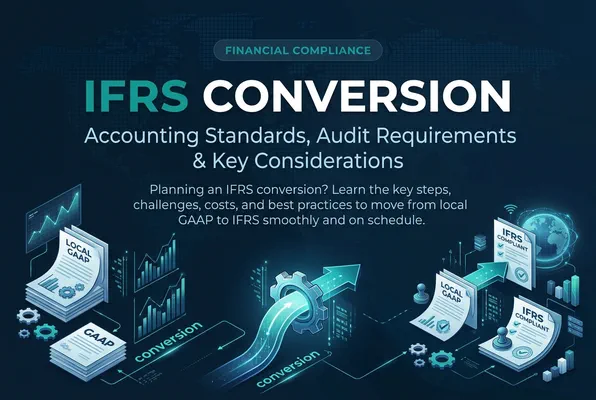

For multinational groups, fast-growing scale-ups, and companies preparing for an IPO, an IFRS conversion is one of the most demanding finance transformation projects they will ever undertake. It touches accounting policies, data, systems, controls, tax, treasury, and even how management communicates performance to investors.
Done well, an IFRS conversion delivers a single, globally understood accounting language, better comparability, and easier access to capital. Done poorly, it leads to restatements, missed deadlines, and a loss of credibility with stakeholders.
This guide walks through what an IFRS conversion involves, how to plan and execute it, where companies typically struggle, and how to turn a compliance exercise into a lasting improvement in your finance function.
What Is an IFRS Conversion?
An IFRS conversion is the process of transitioning a company’s financial reporting from its current framework, such as local GAAP, US GAAP, or another national standard, to International Financial Reporting Standards issued by the IASB.
The conversion is not simply a matter of re-labeling accounts. It requires:
- Reassessing every material accounting policy against IFRS requirements
- Restating opening balances and comparative periods
- Producing new and often more extensive disclosures
- Adapting systems, processes, and internal controls
- Re-training finance teams and informing external stakeholders
The formal rules for the transition are set out in IFRS 1, First-time Adoption of International Financial Reporting Standards, which defines how an entity prepares its first IFRS financial statements and what exemptions and exceptions it may apply.
IFRS Conversion vs. IFRS Adoption
The terms are often used interchangeably, but there is a useful distinction:
- IFRS adoption usually refers to a jurisdiction deciding to require or permit IFRS for domestic reporting.
- IFRS conversion refers to the company-level project of moving from one framework to IFRS.
From a practitioner’s perspective, the conversion project is where the real work happens.
The Role of Accounting Standards and Regulatory Frameworks
The global accounting landscape is shaped by different accounting standards and regulatory bodies, which makes understanding the applicable reporting framework an important part of any transition. In the United States, generally accepted accounting principles (GAAP) are developed primarily by the Financial Accounting Standards Board, while international accounting standards are issued by the International Accounting Standards Board. Although both frameworks aim to improve the quality of financial reporting, their requirements and interpretations can differ. The adoption of IFRS has also developed differently across jurisdictions. For example, the European Union has established its own endorsement process for IFRS standards, while Canada introduced Canadian GAAP requirements based on IFRS for publicly accountable enterprises. Organizations following IFRS therefore need to consider not only the international standards themselves but also the specific regulatory environment in which they operate.
Why Companies Convert to IFRS
Organizations pursue an IFRS conversion for a mix of regulatory, strategic, and operational reasons.
Regulatory Requirements
In many countries, listed entities must prepare consolidated financial statements under IFRS. A company that lists on a regulated market, or whose parent is subject to IFRS reporting, may be required to convert within a defined timeframe.
Access to International Capital Markets
Investors and lenders are familiar with IFRS. Reporting in a globally recognized framework reduces the need for reconciliations and can lower the perceived risk and cost of capital when raising equity or debt abroad.
Group Reporting Efficiency
Groups with subsidiaries in multiple countries often maintain several sets of books under different local GAAPs. Converging on IFRS for group reporting can reduce reconciliation effort, simplify consolidation, and enable shared service centers.
Mergers, Acquisitions, and IPO Readiness
Buyers, sellers, and underwriters prefer financials that are comparable across targets. A completed IFRS conversion shortens due diligence and removes a major obstacle ahead of a listing.
Better Decision-Making
IFRS often requires fair-value measurement, more detailed segment reporting, and stronger disclosures about risks. While this adds work, it also provides management with richer information.
Strategic Considerations Before Starting an IFRS Conversion
Organizations contemplating a conversion from U.S. generally accepted accounting principles should evaluate the broader implications before committing to the project. International accounting IFRS conversion considerations extend beyond technical accounting differences and include contractual arrangements, regulatory expectations, and the availability of qualified personnel. Companies considering a conversion should assess whether the expected benefits justify the financial and operational investment. This assessment is particularly relevant for financial institutions and businesses with international investors, as the investor community may have specific expectations regarding comparability and reporting quality. Consulting experienced CPAs and external specialists can help organizations determine whether a conversion to the international financial reporting framework is an expedient strategic decision. A preliminary assessment also allows organizations contemplating a conversion to identify potential obstacles before significant resources are committed.
Key Differences Between IFRS and Local GAAP
The scope of your conversion depends heavily on how far your current GAAP differs from IFRS. Some frameworks are close; others diverge significantly. Areas that frequently generate the largest adjustments include the following.
Revenue Recognition (IFRS 15)
IFRS 15 applies a five-step model based on the transfer of control. Companies with multi-element arrangements, variable consideration, long-term contracts, or licensing revenue often see changes in timing and amount of revenue recognized.
Leases (IFRS 16)
IFRS 16 brings nearly all leases onto the balance sheet for lessees as right-of-use assets and lease liabilities. This affects leverage ratios, EBITDA, and covenant calculations, making early stakeholder communication essential.
Financial Instruments (IFRS 9)
IFRS 9 introduces an expected credit loss model for impairment, new classification and measurement categories, and revised hedge accounting. Banks, insurers, and corporates with significant receivables or derivatives are especially affected.
Property, Plant, and Equipment and Intangibles
IFRS requires component depreciation, allows revaluation models in certain cases, and imposes specific rules on capitalizing development costs. Impairment testing under IAS 36 can also differ materially from local requirements.
Consolidation and Business Combinations
IFRS 10 uses a control-based model, which may bring previously unconsolidated entities into the group. IFRS 3 requires fair-value measurement of acquired assets and liabilities, and prohibits goodwill amortization in favor of annual impairment testing.
Employee Benefits and Share-Based Payments
IAS 19 and IFRS 2 can generate significant measurement differences, especially for defined benefit plans and equity-settled incentive schemes.
Deferred Taxes
IAS 12 applies a balance sheet approach to temporary differences, which often results in more deferred tax assets and liabilities than under simpler local regimes.
The IFRS Conversion Roadmap: Step-by-Step
A structured approach is the best defense against surprises. Most successful projects follow a phased roadmap.
Phase 1: Scoping and Impact Assessment
The first phase establishes what needs to change and how big the effort will be.
- Define the scope: which entities, reporting levels, and periods are affected
- Determine the transition date (the start of the earliest comparative period) and the first IFRS reporting date
- Conduct a high-level GAAP gap analysis to identify the most significant differences
- Estimate the impact on key metrics such as equity, net income, EBITDA, and leverage
- Secure executive sponsorship and a realistic budget
Phase 2: Detailed Design and Policy Development
Once priorities are clear, move into detailed design.
- Perform a line-by-line analysis of accounting policies against IFRS
- Decide which IFRS 1 optional exemptions to apply, such as deemed cost for property, plant, and equipment, or business combination relief
- Document new group accounting policies and a revised chart of accounts
- Define disclosure requirements and reporting templates
- Assess tax, treasury, and legal implications, including debt covenants and dividend capacity
Phase 3: Implementation
This is where the project moves from paper to practice.
- Configure or upgrade ERP, consolidation, and reporting systems
- Build processes to collect additional data, for example lease contracts or contract-level revenue information
- Prepare the opening IFRS balance sheet at the transition date
- Restate comparative periods and prepare reconciliations from previous GAAP to IFRS
- Train finance staff, business controllers, and internal audit
Phase 4: Parallel Run and Dry Runs
Running IFRS in parallel with the existing framework allows the team to test the numbers before they become official.
- Perform at least one full dry-run close under IFRS
- Reconcile results to local GAAP and investigate variances
- Validate controls and refine processes
- Engage the external auditor early for feedback on key judgments
Phase 5: First IFRS Reporting and Stabilization
Finally, the first set of IFRS financial statements is published.
- Prepare the required IFRS 1 reconciliations and disclosures
- Communicate the impact to investors, analysts, lenders, and employees
- Capture lessons learned and move the project into business-as-usual
- Monitor new and amended standards to stay compliant in subsequent periods
Understanding IFRS 1: The Foundation of Every Conversion
IFRS 1 governs how a first-time adopter prepares its opening statement of financial position and its first IFRS financial statements. A few principles are particularly important.
Retrospective Application as the Default
The general rule is that an entity applies the standards in force at the end of its first IFRS reporting period retrospectively, as if it had always applied them. This is why restating comparatives is such a significant effort.
Mandatory Exceptions
IFRS 1 prohibits retrospective application in certain areas, such as estimates, derecognition of financial assets and liabilities, hedge accounting, and some aspects of non-controlling interests. These exceptions protect against hindsight bias.
Optional Exemptions
To reduce cost and complexity, IFRS 1 offers optional exemptions. Common examples include:
- Business combinations before the transition date
- Deemed cost for property, plant, and equipment, investment property, and intangibles
- Cumulative translation differences
- Leases and employee benefits
- Share-based payment transactions
Selecting the right combination of exemptions is a strategic decision. It affects the resulting equity, future earnings, and the effort required during the project.
Disclosure Requirements
First-time adopters must present reconciliations of equity and total comprehensive income from previous GAAP to IFRS, along with explanations of material adjustments. These disclosures are closely scrutinized by investors and auditors.
Common Challenges in an IFRS Conversion
Even well-resourced projects encounter obstacles. Knowing the typical pitfalls helps you plan around them.
Underestimating Effort and Timelines
The visible accounting adjustments are only part of the work. Data collection, system changes, controls, and stakeholder communication frequently take longer than expected, especially in multi-entity groups.
Data Availability and Quality
Restating comparatives often requires historical data that was never captured, such as contract-level revenue details, lease terms, or fair values at acquisition dates. Gaps in data are among the most common causes of delay.
Limited IFRS Expertise
Finance teams trained on local GAAP may lack deep IFRS knowledge. Without dedicated training or external support, interpretation errors and inconsistent application across subsidiaries become likely.
System and Process Limitations
Legacy ERP and consolidation tools may not support parallel ledgers, IFRS-specific calculations, or new disclosure requirements. System changes require lead time and rigorous testing.
Impact on Covenants, Tax, and Compensation
Changes in reported equity, EBITDA, and leverage can trigger covenant breaches, change tax positions, or affect bonus targets. These implications should be identified early and addressed with lenders, tax authorities, and HR.
Change Management and Communication
Business units may not understand why new processes or additional data requests are necessary. Clear communication and visible leadership support are critical for cooperation across the organization.
Best Practices for a Successful IFRS Conversion
Experience from many conversion projects points to a consistent set of success factors.
Start Early and Build a Realistic Plan
Begin well before the transition date. Build in contingency time for data issues, system testing, and audit discussions.
Establish Strong Governance
Appoint a steering committee with senior finance leadership, a dedicated project manager, and clear responsibilities across entities. Regular progress reporting keeps the project visible and accountable.
Prioritize by Materiality and Complexity
Not every difference deserves the same attention. Focus first on high-impact areas such as revenue, leases, financial instruments, and consolidation, then address smaller adjustments.
Standardize Group Accounting Policies
A single, well-documented group accounting manual reduces inconsistency and simplifies consolidation, audit, and future updates.
Involve Auditors Early
Discuss significant judgments, exemptions, and disclosure approaches with your external auditor before finalizing them. Early alignment avoids late-stage disputes.
Invest in Training
Targeted training for accountants, controllers, and business partners builds the internal capability needed to sustain IFRS reporting long after the project ends.
Use the Project to Improve Finance
Treat the conversion as an opportunity to streamline the chart of accounts, automate reconciliations, strengthen controls, and shorten the close. Companies that do so often realize benefits well beyond compliance.
Systems, Data, and Technology Considerations
Technology is a decisive factor in the efficiency and accuracy of an IFRS conversion.
Parallel Accounting and Ledgers
Many companies need to maintain local statutory or tax books alongside IFRS. Modern ERP systems support parallel ledgers, but configuration and mapping must be planned carefully.
Consolidation and Reporting Tools
Group consolidation platforms should support IFRS-specific adjustments, standardized reporting packages, and automated generation of notes and disclosures.
Data Governance
Define ownership for critical data, such as lease registers, contract databases, and fixed asset records. Clear data governance improves accuracy and audit readiness.
Automation and Controls
Automating recurring calculations, such as lease accounting, expected credit losses, or deferred taxes, reduces manual errors and supports a robust internal control environment.
The Impact on Internal Reporting and Management Information
An IFRS conversion can also change how management uses accounting and reporting information to evaluate the company’s financial position. Financial statements in accordance with IFRS may provide greater transparency, but management should also consider whether existing internal reports adequately reflect the new accounting requirements. Changes in measurement and classification can influence performance metrics, departmental budgets, and the interpretation of financial results. Consequently, business processes should be reviewed to ensure that operational departments provide the information required for external and internal reporting. Information systems may need additional functionality to capture data that was previously not relevant under the former accounting framework. Relying exclusively on manual Excel spreadsheets can create difficulties when information must be consolidated across several entities or reporting periods. Establishing consistent data structures and clearly defined reporting responsibilities can help ensure that management decisions remain based on reliable and comparable information.
Estimating the Cost and Timeline of an IFRS Conversion
Costs vary widely based on company size, number of entities, GAAP gaps, and the level of external support. Typical cost components include:
- Internal staff time and backfilling of day-to-day roles
- External advisory and technical accounting support
- Systems implementation, upgrades, and licensing
- Training and change management
- Additional audit fees for restated periods and first-year IFRS work
As a rule of thumb, a mid-sized group should expect a project duration of 12 to 24 months, while large, complex multinationals may need longer. Starting too late forces compressed timelines, higher costs, and increased risk of errors.
Life After the Conversion: Staying IFRS-Compliant
Completing the first set of IFRS financial statements is a milestone, not the finish line. IFRS evolves continuously, with new standards and amendments issued regularly.
To stay compliant:
- Assign ownership for monitoring IASB developments
- Maintain and update the group accounting policy manual
- Continue investing in training and knowledge sharing
- Review controls and data processes after each reporting cycle
- Keep an open dialogue with auditors, regulators, and investors
Organizations that embed IFRS expertise into their finance function find that subsequent standard changes become routine rather than disruptive.
Preparing for Future Developments in IFRS Reporting
The successful implementation of IFRS should be viewed as an ongoing responsibility rather than a project with a fixed completion date. The issuance of new accounting standards and amendments can introduce additional requirements that affect recognition, measurement, presentation, or disclosure in subsequent reporting periods. Companies should therefore establish a structured process for evaluating new accounting developments and determining their potential impact on existing policies. This includes identifying the effective date of each change, assessing whether early application is permitted, and determining which departments or subsidiaries will be affected. A documented change in accounting policy should also be supported by appropriate approvals and clear explanations of its financial consequences. CPAs and internal accounting specialists play an important role in interpreting these developments and maintaining compliance with IFRS. By regularly assessing upcoming requirements, organizations can prepare their systems and reporting procedures in advance instead of reacting only when a new standard becomes mandatory.
How Incentrium Can Support Your IFRS Conversion
A successful IFRS conversion requires a combination of technical accounting expertise, project management discipline, and practical experience with systems and processes. Whether you are performing an initial gap analysis, designing group accounting policies, restating comparatives, or preparing for your first IFRS reporting date, working with experienced specialists can reduce risk and accelerate delivery.
At incentrium.com , the focus is on helping finance teams navigate complex transformations with clarity and confidence. If your organization is considering or already executing an IFRS conversion, early expert guidance can help you avoid costly missteps and build a reporting foundation that supports growth.
Conclusion
An IFRS conversion is far more than a technical accounting exercise. It reshapes policies, data, systems, controls, and stakeholder communication across the entire organization. By understanding the differences between your current GAAP and IFRS, following a structured roadmap anchored in IFRS 1, anticipating common challenges, and investing in people and technology, you can deliver a conversion that is accurate, on time, and sustainable.
Start with a thorough impact assessment, secure strong governance, engage your auditors early, and treat the project as a chance to strengthen your finance function. Companies that do so emerge from their IFRS conversion not only compliant, but better equipped to compete in a global marketplace.
FAQ
What is an IFRS conversion?
How long does an IFRS conversion project take?
What are the biggest challenges in an IFRS conversion?
Who needs to complete an IFRS conversion?
Written by
Dominik KonoldCEO & Founder
Dominik Konold is the CEO and founder of Finidy GmbH, specializing in share-based compensation and treasury accounting. With a background in audit and investment banking, he is a certified Professional Risk Manager (PRMIA) and lectures for the Association of Public Banks and the Academy of International Accounting.
Related Posts
IFRS 2 Modification: Accounting for Share-Based Payment, Cancellations and Equity Awards
This article explains IFRS 2 accounting for share-based payment modifications, cancellations and settlements, including fair value calculations and their impact on financial reporting.
Monte Carlo Simulation: How the Simulation Works, the Monte Carlo Method & Software Applications
Learn how Monte Carlo Simulation works, how the Monte Carlo method quantifies uncertainty, and which software tools help improve data-driven decision-making.

IPO Explained: How Initial Public Offerings Work
This article explains how IPOs work, how companies determine their IPO prices, and what investors should consider when evaluating new stock offerings. It covers market demand, company financial health, valuation, investment opportunities, and the risks of IPO investing.
Ready to simplify your equity programs?
See how Incentrium helps you manage share-based compensation with ease. Book a demo to learn more.
Book a Demo