Leaver Provisions in Equity Compensation Explained

Equity compensation is one of the most powerful tools a company can use to attract, retain, and motivate talent. But what happens when an employee leaves? That question is answered by one of the most important, and most frequently misunderstood, clauses in any equity plan: the leaver provision.
Whether you are a founder designing your first employee share option plan (ESOP), a finance professional reviewing your company’s equity documentation, or an employee trying to understand what your options are worth if you resign, leaver provisions will directly affect outcomes. Getting them wrong can destroy trust, spark legal disputes, and cause valuable team members to walk out the door.
This guide breaks down everything you need to know about leaver provisions: what they are, how they work, the key variables you can control, and how to design them in a way that is fair, legally sound, and strategically smart.
What Is a Leaver Provision?
A leaver provision is a clause, or set of clauses, within an equity compensation agreement, share option plan, or shareholders’ agreement that governs what happens to an employee’s equity interests when their employment or service relationship ends.
In practical terms, a leaver provision answers questions such as:
- Do unvested options lapse immediately upon termination?
- Can the employee keep vested shares, or must they sell them back?
- At what price can the company repurchase any shares?
- Does the reason for leaving affect the outcome?
- How long does the employee have to exercise their options after leaving?
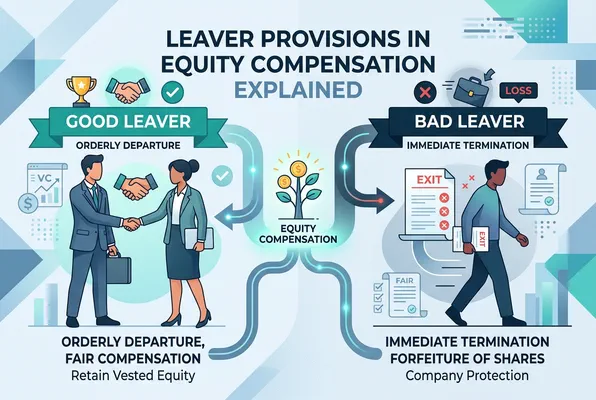
Most leaver provisions revolve around two central classifications: the good leaver and the bad leaver. Each classification carries different rights, obligations, and financial consequences. Understanding this distinction is the starting point for any analysis of equity upon departure.
Leaver Provisions in Venture Capital Transactions
In venture capital financings, leaver provisions are an essential part of almost every term sheet and the subsequent legal documentation. Both the investor and the founding team want to ensure that founders and key employees remain committed to the company throughout critical growth phases. For this reason, leaver provisions set clear expectations for what happens if someone ceases to be employed or if there is a departure of a founder. During term sheet negotiations, these provisions are often among the most important key negotiation points, as they play a central role in aligning the interests of founders with those of investors before the investment is completed.
The Good Leaver vs. Bad Leaver Framework
What Defines a Good Leaver?
A good leaver is typically an employee or service provider who departs for reasons that are considered sympathetic, involuntary, or otherwise beyond their control. Common good leaver events include:
- Death – The employee’s estate usually retains vested equity.
- Serious illness or permanent disability – The employee is unable to continue working through no fault of their own.
- Redundancy – The role is made redundant as part of a restructuring.
- Retirement – The employee reaches a defined retirement age or meets certain service criteria.
- Constructive dismissal – The employee is effectively forced out by the employer’s conduct.
- Mutual agreement – The parties agree to part on terms that explicitly classify the departure as a good leaver event.
- Expiry of a fixed-term contract – In some plans, this is treated as a good leaver event.
The specific events that qualify as good leaver situations should always be explicitly listed in the equity plan rules. Vague or undefined language leads to disputes.
What Defines a Bad Leaver?
A bad leaver is someone whose departure reflects negatively on them or creates a risk to the company. The consequences for bad leavers are typically far more punitive. Common bad leaver scenarios include:
- Voluntary resignation – Particularly if the employee leaves to join a competitor.
- Dismissal for cause – Misconduct, gross negligence, fraud, or serious breach of employment terms.
- Breach of restrictive covenants – Violating non-compete, non-solicitation, or confidentiality obligations.
- Criminal conviction – Relevant to the employee’s role or the company’s business.
- Insolvency – Personal bankruptcy in some jurisdictions.
In many plans, voluntary resignation defaults to bad leaver status unless the plan rules or a separate agreement specify otherwise. This is an important nuance that employees often overlook when they hand in their notice.
The Grey Area: “Intermediate” or “Standard” Leavers
Some modern equity plans, particularly those designed by progressive companies competing for top talent, introduce a third category: the intermediate leaver or standard leaver. This category typically applies to employees who resign voluntarily in good standing, without cause or wrongdoing. They are treated better than bad leavers but do not receive the full protections of a good leaver.
An intermediate leaver might, for example: - Retain a time-pro-rated portion of unvested equity - Be allowed to exercise vested options at fair market value - Receive a longer post-termination exercise window than a bad leaver
This three-tier approach is increasingly common in competitive talent markets, especially in technology and life sciences sectors.
Why the Drafting of Leaver Clauses Matters
Well-written bad leaver clauses reduce uncertainty and help avoid costly disputes later. Because leaver provisions are contractual terms, they should be carefully documented in the employment agreement, articles of association, shareholder agreements and every subsequent draft of the transaction documents. The distinction between good and bad leavers should never rely on vague wording. Instead, the agreement should clearly define whether the leaver qualifies as a good leaver or bad leaver, including situations such as ill health, gross misconduct, or fraud or gross misconduct. Precise drafting protects both the company or remaining shareholders and the departing employee.
Key Components of a Leaver Provision
1. Treatment of Unvested Equity
This is often the most financially significant element of a leaver provision. Unvested equity represents future value that has not yet been “earned” under the vesting schedule. The key questions are:
- Does unvested equity lapse automatically? In most traditional plans, unvested shares or options are forfeited immediately upon termination, regardless of good or bad leaver status.
- Is there time-pro-rated vesting? Some plans allow good leavers to retain a proportion of unvested equity based on their service to date within the current vesting period.
- Is there accelerated vesting? In certain circumstances, such as a change of control coinciding with termination, unvested equity may vest immediately. This is sometimes called “double-trigger acceleration.”
The treatment of unvested equity should be crystal clear in the plan rules. Ambiguity here is a leading cause of post-departure disputes.
2. Treatment of Vested Equity
Vested equity is generally considered already “earned,” but leaver provisions frequently include mechanisms that affect even vested shares:
- Compulsory transfer / call option – Many private company plans grant the company (or major shareholders) the right to repurchase vested shares from a departing employee. This protects the cap table from unwanted minority shareholders.
- Good leaver price – Typically fair market value (FMV), often determined by the most recent valuation or an independent appraiser.
- Bad leaver price – Often the lower of cost (what the employee paid) or FMV, sometimes even a nominal value such as the par value of the shares. This can result in the employee receiving little or nothing for their vested equity.
- Tag-along and drag-along rights – Some leaver provisions interact with these broader shareholder rights, affecting when and how a departing employee can realize value.
The ability to repurchase vested shares at a punitive price from bad leavers is one of the most controversial aspects of equity plan design. While it gives companies significant protection, it can also create perceptions of unfairness, particularly where the reason for dismissal is disputed.
Fair Valuation of Leaver Shares
One of the most sensitive questions is the treatment of their shares after an employee leaves. Leaver provisions determine whether a departing shareholder may retain equity, transfer leaver shares, or must sell vested shares back to the company or remaining shareholders within a certain period. In many market-standard plans, good leavers receive fair compensation and can keep or sell vested shares at fair market value once the shares have fully vested. They therefore receive shares at fair value and appropriate value for their shares, whereas bad leavers are often subject to less favourable pricing mechanisms.
3. Post-Termination Exercise Window
For share option plans (as opposed to direct share awards), a critical element of the leaver provision is the post-termination exercise period (PTEP)—the window of time during which a departing employee can exercise their vested options before they lapse.
Common PTEP structures include:
| Leaver Category | Typical Exercise Window |
|---|---|
| Bad leaver | 0–30 days (or immediate lapse) |
| Standard / intermediate leaver | 30–90 days |
| Good leaver | 90 days to 12 months |
| Death | 12–18 months (exercised by estate) |
A short exercise window can be deeply problematic for employees in private companies where shares are illiquid. If an employee cannot sell shares immediately, they may need to pay the exercise price out of pocket, potentially tens of thousands of pounds or euros, with no guarantee of when they will realize a return.
Some companies, particularly those influenced by US best practices, are moving toward longer PTEPs (up to 10 years) or providing “net exercise” mechanisms that allow employees to exercise without cash outlay by surrendering a portion of their options to cover the exercise price.
4. Repurchase Price Mechanics
Where a company retains the right to buy back equity from a leaver, the repurchase price mechanism is critical. Common approaches include:
- Fair Market Value (FMV) – Most favorable to the employee; typically determined by the latest 409A valuation (US) or an independent valuation in other jurisdictions.
- Board-determined value – The board sets the price using a defined methodology. Employees should seek transparency about how this is calculated.
- Formula-based price – Based on a multiple of earnings, revenue, or book value. Predictable but may not reflect true market value in all scenarios.
- Nominal value – The lowest possible price; essentially a forfeiture of value. Reserved for bad leavers in most well-drafted plans.
Leaver Provisions and Vesting Schedules
Standard Vesting Schedules
Leaver provisions do not operate in isolation, they interact directly with the company’s vesting schedule. The most common structure is a four-year vesting schedule with a one-year cliff:
- No equity vests during the first 12 months (the cliff period).
- After the cliff, equity vests monthly or quarterly over the remaining three years.
- An employee who leaves before the cliff forfeits all equity regardless of good/bad leaver status.
Understanding where an employee sits on their vesting schedule at the time of departure is essential to calculating the financial impact of leaver provisions.
Cliff-Related Issues
The cliff creates a binary outcome that can feel arbitrary. An employee who leaves 11 months into their tenure receives nothing, while one who leaves 13 months in retains 25% of their equity. This cliff effect can:
- Encourage employees to delay departure past the cliff, then leave shortly after
- Create legal risks if a company terminates an employee just before their cliff date to avoid vesting (known as “cliff avoidance”)
- Lead to disputes if the reason for termination is contested
Well-drafted leaver provisions should address these edge cases explicitly.
Acceleration on Change of Control
A closely related concept is acceleration vesting on a change of control, for example, when a company is acquired. Two common models are:
- Single-trigger acceleration – Vesting accelerates upon the change of control itself, regardless of what happens to the employee afterward.
- Double-trigger acceleration – Vesting accelerates only if the change of control occurs and the employee is subsequently terminated or constructively dismissed.
Many leaver provisions include specific language about how departure during or shortly after a change of control is treated. This is often heavily negotiated in M&A transactions.
Legal Considerations Across Jurisdictions
United Kingdom
In the UK, leaver provisions in Enterprise Management Incentive (EMI) option plans must comply with HMRC requirements. Key considerations include:
- EMI qualifying conditions – An employee who no longer meets the qualifying working time requirement (25 hours per week or 75% of working time) may inadvertently trigger a disqualifying event, affecting tax treatment.
- Employment law – Punitive bad leaver provisions that effectively strip employees of significant value upon dismissal may be challenged under employment law, particularly if the dismissal itself is wrongful or unfair.
- Tax on exercise – Under EMI, good leavers who exercise within 90 days of leaving can typically retain their beneficial tax treatment. Those who exercise later may face income tax rather than CGT treatment.
European Union
Across EU member states, equity plan design and leaver provisions must navigate a patchwork of local employment law, securities regulation, and tax rules. Notable considerations include:
- France – Free share plans (actions gratuites) and BSPCE warrants have specific rules about what happens upon departure.
- Germany – Virtual share plans (phantom equity) and real share plans are treated differently, with leaver provisions subject to the German Civil Code’s general principles of fairness.
- Netherlands – STAK structures and cooperative entity arrangements introduce additional complexity for leaver treatment.
United States
In the US, the most common equity vehicle is the incentive stock option (ISO) or non-qualified stock option (NSO). Key US-specific leaver provision issues include:
- ISO qualification rules – ISOs must be exercised within 90 days of termination to retain their favorable tax treatment. Options exercised after this window automatically convert to NSOs.
- 409A compliance – Deferred compensation arrangements triggered by termination must comply with Section 409A of the Internal Revenue Code to avoid significant tax penalties.
- State law variation – California, New York, and other states have their own employment law rules that can affect the enforceability of certain leaver provision terms.
Common Mistakes in Leaver Provision Design
Overly Broad Bad Leaver Definitions
Defining voluntary resignation as a bad leaver event, regardless of circumstances, can lead to talented employees feeling trapped or treated unfairly. This can damage employer brand and make equity compensation less effective as a retention tool.
Failure to Define Key Terms
Courts and arbitrators are frequently asked to resolve disputes over whether a particular departure constitutes a good or bad leaver event. Vague language such as “mutual agreement” or “misconduct” without clear definitions is an invitation to litigation.
Ignoring Tax Consequences
The timing and structure of equity repurchases, the length of the post-termination exercise window, and the classification of leaver events all have tax consequences, for both the company and the departing employee. These should be modeled in advance with qualified tax advisors.
Inconsistent Application
Applying leaver provisions inconsistently across different employees, for example, treating two similarly situated employees differently based on their seniority or relationship with founders, can create legal liability and destroy trust across the organization.
Not Updating Plans as the Company Grows
Leaver provisions that were appropriate for a 10-person startup may be inadequate or counterproductive for a 200-person scale-up preparing for an IPO. Equity plans should be reviewed and updated as the company’s stage, workforce, and legal exposure evolve.
Best Practices for Designing Leaver Provisions
Be Specific About Categories
List every qualifying event for good leaver status explicitly. Do not rely on catch-all language. If in doubt, include more detail rather than less.
Treat Employees Fairly
The best leaver provisions balance company protection with employee fairness. This means: - Allowing good leavers to retain vested equity at fair market value - Providing reasonable post-termination exercise windows - Considering time-pro-rated vesting for long-serving employees who resign in good standing
Align with Market Norms
Research what comparable companies in your sector and geography are offering. Unusually punitive leaver provisions will disadvantage you in competitive hiring situations, particularly for senior hires who are sophisticated enough to scrutinize equity plan terms.
Involve Legal Counsel
Leaver provisions intersect employment law, securities law, tax law, and contract law. Always involve qualified legal counsel in plan design, ideally advisors who specialize in equity compensation in the relevant jurisdictions.
Use Technology to Manage Equity Tracking
Tracking vesting schedules, monitoring termination dates, and administering leaver processes manually is error-prone and time-consuming. Equity management platforms can automate much of this work, reduce the risk of errors, and provide employees with real-time visibility into their equity position.
Communicating Leaver Provisions to Employees
One often-overlooked aspect of leaver provision design is employee communication. Even the most carefully crafted provisions will fail to achieve their purpose, retaining and motivating employees, if employees do not understand them.
Best practices for communication include:
- Plain-language summaries – Alongside the legal documentation, provide a simple explanation of what happens to equity in different departure scenarios.
- Scenario modeling – Show employees worked examples of what their equity is worth if they leave at different points in their vesting schedule.
- Onboarding education – Introduce leaver provisions as part of the equity compensation onboarding process, not as an afterthought.
- Regular updates – If plan terms change, communicate this proactively and clearly to all equity holders.
Employees who understand their equity are more likely to value it, and more likely to stay.
Leaver Provisions in Different Equity Vehicles
Share Option Plans
Share option plans, whether EMI in the UK, ISOs/NSOs in the US, or qualifying stock option plans in other jurisdictions, are the most common context for leaver provisions. The post-termination exercise window is a particularly critical design element for options, given that employees must actively exercise (and pay the exercise price) to realize value.
Restricted Share Units (RSUs)
RSUs deliver shares upon vesting rather than requiring an exercise. For RSUs, the key leaver provision issue is whether unvested RSUs are forfeited, accelerated, or pro-rated upon departure. In public company RSU plans, vested but undelivered RSUs may also be affected by blackout period restrictions at the time of departure.
Direct Share Awards
Where employees are awarded shares directly (rather than options), they immediately become shareholders. Leaver provisions for direct share awards typically focus on the company’s right to repurchase shares, the price mechanism, and any restrictions on transfer that apply post-departure.
Phantom Equity and Virtual Plans
Phantom equity plans and virtual employee participation programs do not grant actual shares, they provide economic exposure to equity value through cash or cash-equivalent payments. Leaver provisions in these plans define when and how phantom equity “accounts” are settled upon departure, often triggering specific payment timing rules to comply with deferred compensation regulations.
The Future of Leaver Provisions
Equity compensation is evolving rapidly. Several trends are reshaping how leaver provisions are designed:
- Employee-friendly reforms – Pressure from talent markets is pushing companies toward longer exercise windows, fairer repurchase prices, and more nuanced leaver categories.
- Remote and global workforces – Companies with employees across multiple jurisdictions need leaver provisions that are legally compliant in each country, or that use jurisdiction-specific addenda.
- Regulatory change – Governments in several countries are reviewing and updating equity compensation rules, which may affect the tax treatment of leaver events.
- Increased transparency – Employees increasingly expect—and in some jurisdictions are legally entitled to—clear disclosure of their equity terms, including leaver provisions.
Companies that design leaver provisions with these trends in mind will be better positioned to attract and retain the talent they need.
Reviewing Leaver Provisions as the Company Grows
As companies scale, their equity arrangements should evolve as well. Leaver provisions often need to be reviewed after new financing rounds, changes to the management structure or before a sale of the company. What qualifies you as a good leaver during the early startup phase may no longer reflect the interests of the business after significant growth. Founders should ensure that the provisions continue to balance the interests of founders and investors, particularly for members of the management team who receive equity incentives. Regular legal reviews help maintain fair outcomes while protecting the long-term ownership structure.
Conclusion
A leaver provision is far more than a legal formality buried in an equity plan document. It is a statement of how a company values its people, and how it treats them when the employment relationship ends. Done well, a leaver provision reinforces trust, protects the company, and ensures that equity compensation delivers on its promise. Done poorly, it creates resentment, litigation, and reputational damage.
Whether you are designing an equity plan from scratch or reviewing an existing one, the key principles are the same: be specific, be fair, align with market norms, and get qualified legal and tax advice. And make sure your employees actually understand what they have signed.
For companies looking to build and administer equity plans, including managing leaver events at scale, dedicated equity management platforms can make the process significantly more efficient and less error-prone. The goal is not just compliance, but genuine alignment between company and employee interests.
FAQ
What is a leaver provision in an equity compensation plan?
What is the difference between a good leaver and a bad leaver?
Can a leaver provision require employees to sell back vested shares?
How should companies design leaver provisions to attract and retain talent?
Written by
Dominik KonoldCEO & Founder
Dominik Konold is the CEO and founder of Finidy GmbH, specializing in share-based compensation and treasury accounting. With a background in audit and investment banking, he is a certified Professional Risk Manager (PRMIA) and lectures for the Association of Public Banks and the Academy of International Accounting.
Related Posts
Good Leaver: Definition, Clauses & Equity Rules Explained
This article explains what a good leaver is and how good leaver clauses and provisions affect employees, founders, and shareholders when they leave a company.
Bad Leaver: Definition, Clauses & Comparison to good leaver
This article explains the differences between good leavers and bad leavers and how their departure can affect equity, share options, and the company.

Accelerated Vesting: How to Accelerate Your Vesting Schedule for Stock Options & Restricted Stock
This guide explains accelerated vesting, including single- and double-trigger acceleration, vesting schedules, equity grants, and what happens to employee equity during major corporate events.
Ready to simplify your equity programs?
See how Incentrium helps you manage share-based compensation with ease. Book a demo to learn more.
Book a Demo