RSU Meaning: Restricted Stock Units Explained
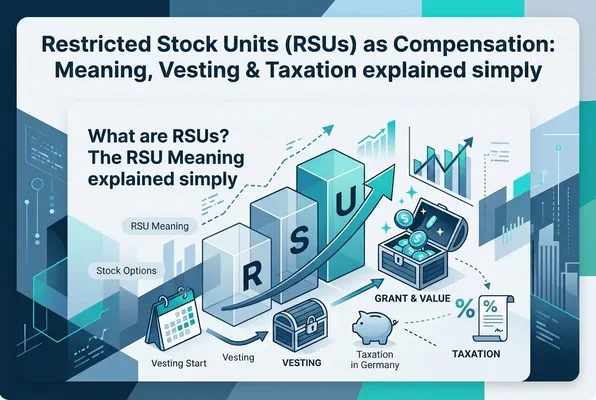

If you have recently started a new job at a technology company or received an updated compensation package, you may have come across the term RSU and wondered what it means. Understanding the RSU meaning is increasingly important as equity compensation becomes a standard part of how companies attract and retain talent. This guide explains exactly what RSUs are, how they work, how they are taxed, and how they compare to other forms of equity compensation like stock options.
What Is the RSU Meaning?
RSU stands for Restricted Stock Unit. A restricted stock unit is a type of equity compensation in which a company promises to grant an employee a specific number of shares of company stock, or the cash equivalent, at a future date, provided that certain conditions are met.
The “restricted” part of the name reflects the fact that the stock cannot be accessed immediately. Instead, it becomes available only after the employee satisfies specific requirements, most commonly staying with the company for a defined period of time. The process of satisfying these requirements and gaining access to the shares is called vesting.
RSUs are not the same as actually owning shares from day one. Until the RSUs vest, the employee has no ownership rights, cannot sell the shares, and does not typically carry voting rights. Once the stock units vest and are settled, the employee receives actual shares of common stock or an equivalent cash payment.
RSU vs. Restricted Stock Award
It is worth distinguishing a restricted stock unit from a restricted stock award (RSA). With an RSA, the employee receives actual shares immediately but faces restrictions on selling them until vesting conditions are met. With RSUs, the employee receives no shares at all until vesting occurs. This is a meaningful difference from a tax and ownership perspective.
How Do RSUs Work?
When a company decides to include RSUs in your compensation package, it issues you an RSU grant. This grant specifies the number of RSUs you have been awarded, the vesting schedule, and any additional conditions that must be satisfied.
The Vesting Schedule
The vesting schedule is the timeline that determines when and how your RSUs convert into actual shares of stock. The most common structure is time-based vesting, where a portion of your RSUs vest at regular intervals over a fixed period, often four years, sometimes with a one-year “cliff” at the start.
For example, under a four-year vesting schedule with a one-year cliff, you might receive 25% of your RSUs after your first year at the company, then the remaining shares vesting monthly or quarterly over the following three years. This structure encourages employee retention by spreading the reward over time.
Some companies also use performance stock units (PSUs), sometimes called performance stock awards, which tie vesting not only to time but also to company or individual performance milestones. These are common among senior executives and at larger public companies.
Vesting Conditions: Single vs. Double Trigger
For private companies especially, RSUs may require more than one condition to vest, a structure known as double-trigger vesting. A single-trigger RSU typically vests after a time-based condition alone. A double-trigger RSU requires both a time-based condition and a separate event, such as an IPO or acquisition, before shares are released.
This distinction matters enormously. If you leave a private company before a liquidity event occurs, you may lose unvested restricted stock even if you have met the time-based portion of the condition.
From Grant to Vesting to Settlement
Here is how the process typically unfolds:
- Grant date: Your employer issues the RSU grant. You have no immediate tax liability and no actual shares yet.
- Vesting period: You fulfill the conditions over time or through performance milestones.
- Vesting date: The shares vest. At this point, you are taxed on the fair market value of the shares as ordinary income.
- Settlement: The company converts the vested RSUs into actual shares of stock. Sometimes this happens simultaneously with vesting; in other cases, there is a brief administrative delay.
- Post-vesting decision: You can choose to hold the shares or sell them, each with different tax implications.
RSU Meaning in the Context of Equity Compensation
RSUs represent one of the most common forms of equity compensation used by companies today, particularly at larger, later-stage, or publicly traded firms. Unlike stock options, which give employees the right to purchase shares at a set price, RSUs are granted outright, you do not need to pay anything to receive the shares upon vesting.
This makes RSUs more straightforward and generally less risky than stock options. Even if the stock price falls after the grant date, vested RSUs will still carry some value as long as the stock price is above zero. With stock options, if the stock price drops below the exercise price, the options may be essentially worthless.
RSUs and Stock Options: Key Differences
| Feature | RSUs | Stock Options |
|---|---|---|
| Employee pays to receive shares | No | Yes (at the strike price) |
| Value at vesting | Always has value (if stock > $0) | Only valuable if stock price exceeds strike price |
| Taxation trigger | At vesting | At exercise and/or sale |
| Common at | Public and late-stage companies | Early-stage startups |
| Voting rights before vesting | No | No |
Unlike stock options, RSUs do not give employees an opportunity to benefit from stock appreciation before vesting, but they also carry far less downside risk. Incentive stock options (ISOs) can potentially offer preferential tax treatment under certain holding period rules, which RSUs do not provide.
How Are RSUs Taxed?
Understanding the tax implications of RSUs is critical for any employee who receives them as part of their compensation.
Tax at Vesting: Ordinary Income
When your RSUs vest, the fair market value of the shares on the vesting date is treated as ordinary income, the same as your salary. Your employer is required to withhold taxes on this income. At the federal level, employers typically withhold at the supplemental wage rate (22% for most employees, 37% for amounts over $1 million in supplemental income in a given year), plus Social Security, Medicare, and applicable state income taxes.
Because the flat 22% withholding rate may be lower than your actual effective income tax rate, you could owe additional taxes when you file your annual tax return. It is essential to plan accordingly. Many employees are caught off guard by an unexpected tax bill.
Sell-to-Cover: How Employers Handle Withholding
A common method employers use to handle the tax obligation upon vesting is called sell-to-cover or shares-to-cover. Under this approach, your employer automatically sells a portion of your vested shares to generate cash to pay the required taxes. You receive the remaining vested shares in your brokerage account.
In some cases, employees are given the option to pay the tax bill in cash instead, allowing them to receive the full number of vested shares.
Capital Gains Tax After Vesting
Once your RSUs have vested and you have received the actual shares, any subsequent gain or loss when you sell those shares is treated as a capital gain or loss. The cost basis for the shares is the fair market value at the time of vesting, the amount on which you already paid ordinary income tax.
If you sell your shares immediately upon vesting, there is typically little to no capital gains tax because the sale price and cost basis are essentially the same.
If you hold the shares after vesting, the tax treatment depends on how long you hold them:
- Less than one year after vesting: Any gain is taxed as a short-term capital gain, at your ordinary income tax rate.
- More than one year after vesting: Any gain qualifies for long-term capital gains tax rates, which are significantly lower — 0%, 15%, or 20% depending on your income.
This holding period consideration can be a meaningful factor in deciding when to sell your RSUs. However, it also means taking on more stock price risk, since the shares could fall in value during that time.
What Happens to RSUs When You Leave a Company?
One of the most commonly asked questions about RSUs concerns what happens if you leave your employer before all your shares have vested.
Vested Shares
Any RSUs that have already vested by the time you leave are yours to keep. Whether you resign, are laid off, or retire, you typically retain the actual shares you have already received. You can hold them or sell them according to your own financial goals.
Unvested RSUs
Unvested restricted stock units are generally forfeited when you leave a company. This applies whether you leave voluntarily or involuntarily. Some companies include provisions in the RSU agreement for accelerated vesting under certain circumstances. For example, if you are laid off following an acquisition, but this is not the default.
If your RSUs are subject to double-trigger vesting and you leave before the second trigger (such as a company IPO) occurs, you may lose all unvested equity even if you have satisfied the time-based condition.
When Can You Sell RSU Shares?
Public Company Employees
If you work for a publicly traded company, you can typically sell your shares as soon as they vest, subject to your company’s internal trading policy. Many companies impose blackout periods during which employees cannot trade, such as in the weeks before an earnings announcement.
Private Company Employees
If your company is privately held, selling vested shares is more complicated. There is usually no public market for the stock, meaning you must wait for a liquidity event, such as an IPO, acquisition, or company-sponsored secondary transaction, before you can sell your shares. Some companies facilitate limited secondary market transactions, but these require company approval.
Benefits and Risks of RSUs
Benefits
- No upfront cost: Unlike stock options, you do not need to pay anything to receive shares upon vesting.
- Guaranteed value: As long as the stock has any value, vested RSUs will be worth something.
- Simplicity: RSUs are easier to understand than many other forms of equity compensation.
- Alignment with company performance: Like all forms of company stock, RSUs grow in value when the company performs well.
Risks
- Concentration risk: Holding large amounts of a single company’s stock can be risky. Diversification may be a prudent long-term strategy.
- Tax liability at vesting: You owe tax whether or not you sell the shares. If the stock price drops after vesting but before you sell, you may have paid tax on value you no longer have.
- Forfeiture: Leaving before vesting means losing unvested shares.
- Illiquidity at private companies: RSUs from private companies may be difficult or impossible to sell for years.
RSU Summary: Key Takeaways
The RSU meaning is straightforward: a Restricted Stock Unit is a promise from your employer to give you shares of company stock once you meet defined vesting conditions. Here is a quick recap of the most important points:
- RSUs are a form of equity compensation offered by many employers, particularly large or public companies.
- Shares do not transfer until the vesting date, when all conditions in the RSU agreement are met.
- Upon vesting, the fair market value of the shares is treated as ordinary income and is subject to income tax and payroll taxes.
- After vesting, any appreciation in the stock is subject to capital gains tax, with more favorable rates available if you hold the shares for more than one year.
- If you leave your employer, unvested RSUs are typically forfeited.
- RSUs differ from stock options in that they require no purchase and carry guaranteed value as long as the stock is worth anything.
Understanding how RSUs work can help you make more informed decisions about your equity compensation, from how to plan for the tax impact at vesting, to whether to hold or sell your vested shares, to how RSUs fit into your broader financial situation. For personalized guidance, consider consulting a tax professional or financial advisor who specializes in equity compensation.
FAQ
What does RSU stand for?
How are RSUs taxed?
What happens to RSUs when you leave a company?
Is 1 RSU equal to 1 share of stock?
Written by
Dominik KonoldCEO & Founder
Dominik Konold is the CEO and founder of Finidy GmbH, specializing in share-based compensation and treasury accounting. With a background in audit and investment banking, he is a certified Professional Risk Manager (PRMIA) and lectures for the Association of Public Banks and the Academy of International Accounting.
Related Posts
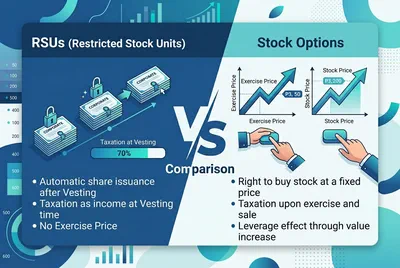
Restricted stock units (RSU) vs Stock Options: Key Differences Explained
This guide explains stock options and RSUs as a form of equity compensation, highlighting RSUs vs stock options, key differences, tax implications, and how startups structure employee equity.
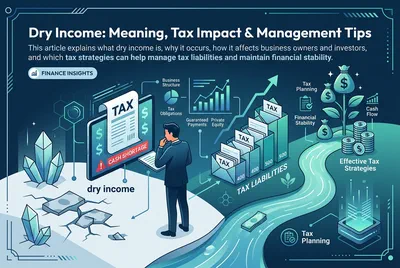
Dry Income: Meaning, Tax Impact & Management Tips
This article explains what dry income is, why it occurs, how it affects business owners and investors, and which tax strategies can help manage tax liabilities and maintain financial stability.

Accelerated Vesting: How to Accelerate Your Vesting Schedule for Stock Options & Restricted Stock
This guide explains accelerated vesting, including single- and double-trigger acceleration, vesting schedules, equity grants, and what happens to employee equity during major corporate events.
Ready to simplify your equity programs?
See how Incentrium helps you manage share-based compensation with ease. Book a demo to learn more.
Book a Demo