Restricted stock units (RSU) vs Stock Options: Key Differences Explained

Equity compensation has become one of the most powerful tools companies use to attract, retain, and motivate top talent. Whether you are evaluating a job offer at a tech startup or reassessing your total compensation package at a public company, understanding the difference between RSU vs stock options is critical for making informed financial decisions.
Both instruments give employees a stake in the company’s future, but they work in fundamentally different ways — with different risk profiles, tax implications, and payout mechanics. Getting this wrong can cost you thousands of dollars or cause you to leave significant wealth on the table.
This guide breaks down everything you need to know about RSUs and stock options, helping you understand which form of equity compensation fits your situation, career stage, and financial goals.
What Are RSUs (Restricted Stock Units)?
A Restricted Stock Unit (RSU) is a promise from your employer to grant you a specific number of company shares at a future date, provided you meet certain conditions — typically a vesting schedule tied to continued employment.
Unlike actual stock, you do not own the shares when the RSU is granted. You receive them only when they vest. At that point, the shares are transferred to you and are typically subject to income tax immediately.
How RSU Vesting Works
RSUs almost always come with a vesting schedule, which determines when you receive the shares. Common structures include:
- Cliff vesting: You receive a lump sum of shares after a set period (e.g., 25% after one year)
- Graded vesting: Shares vest incrementally over time (e.g., monthly or quarterly over four years)
- Performance-based vesting: Shares vest upon reaching specific company or individual performance milestones
A typical RSU package at a technology company might vest over four years with a one-year cliff, meaning 25% vests after your first year and the remainder vests monthly or quarterly thereafter.
RSU Tax Treatment
RSUs are taxed as ordinary income at the time of vesting. The taxable amount equals the fair market value (FMV) of the shares on the vesting date. Your employer will typically withhold taxes automatically — often by selling a portion of your vested shares to cover the tax liability.
After vesting, any subsequent gain or loss when you sell the shares is treated as a capital gain or loss. If you hold the shares for more than one year after vesting, the gain qualifies for long-term capital gains rates, which are generally lower than ordinary income rates.
Example: - You receive 1,000 RSUs - 250 shares vest after one year; the stock price is $40 on vesting date - You owe ordinary income tax on $10,000 (250 × $40) - If you sell the shares six months later at $45, the $5 per share gain is a short-term capital gain
What Are Stock Options?
A stock option grants you the right — but not the obligation — to purchase a specific number of company shares at a predetermined price, known as the strike price or exercise price, within a set time window.
The key distinction: stock options only have value if the company’s stock price rises above the strike price. If the stock never exceeds your exercise price, your options expire worthless.
Types of Stock Options
There are two main types of stock options employees typically receive:
Incentive Stock Options (ISOs)
ISOs are available only to employees and come with potentially favorable tax treatment. Key characteristics:
- No ordinary income tax at the time of exercise (though the spread may trigger the Alternative Minimum Tax)
- If you meet specific holding requirements — holding shares at least two years from the grant date and one year from the exercise date — gains are taxed at long-term capital gains rates
- Subject to an annual vesting limit of $100,000 in fair market value
Non-Qualified Stock Options (NSOs or NQSOs)
NSOs can be granted to employees, contractors, board members, and advisors. Their tax treatment is less favorable:
- The difference between the stock’s fair market value and the strike price (the “spread”) is taxed as ordinary income at the time of exercise
- Subsequent gains after exercise are treated as capital gains
- No annual vesting cap like ISOs
Stock Option Vesting and Expiration
Like RSUs, stock options typically vest over time. They also come with an expiration date — usually 10 years from the grant date. However, if you leave the company, you typically have only 30 to 90 days to exercise your vested options before they expire, which can create significant financial pressure.
RSU vs Stock Options: A Direct Comparison
Understanding the core differences side by side helps clarify which instrument may serve you better.
Key Differences in Employee Stock Compensation
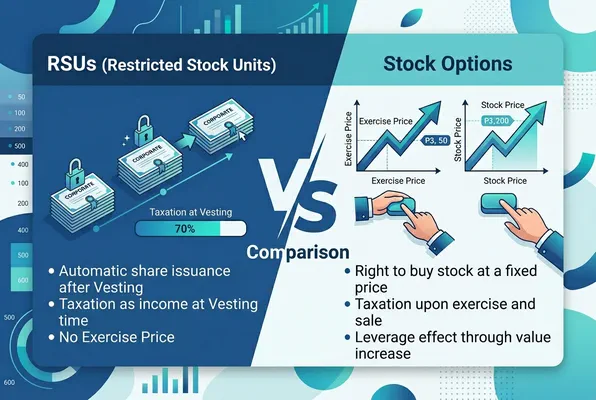
When comparing stock options and RSUs, the key differences lie in ownership timing, risk exposure, and potential upside. Employee stock options give the right to buy company shares at a fixed exercise price, while restricted stock units represent a direct grant of shares that vest over time. Unlike stock options, RSUs vest automatically and immediately convert into shares of stock once conditions are met, which makes their value easier to understand.
The difference between the exercise price and the market value is central when evaluating stock options. Employees may benefit from a lower purchase price if the company performs well, but they also face the risk that options expire worthless. RSUs vs stock options is therefore often a question of risk tolerance, company stage, and long term financial planning rather than just potential upside.
Taxation, Value of RSUs, and Long Term Planning
From a tax perspective, both stock options and RSUs have significant implications for employees. RSUs trigger income taxes on the value of the RSUs at the time of vesting, meaning employees pay income tax on shares received even if they do not sell them immediately. In contrast, stock options involve taxes on the difference between the exercise price and the fair market value when options are exercised, which can create complex planning decisions.
Understanding capital gains tax is also important when employees later sell shares of stock. Whether using stock options or restricted stock units, the timing of purchase company stock decisions and the right to buy company shares can significantly impact net returns. Proper equity education helps employees evaluate stock plans, compare RSUs vs stock options, and make informed decisions about their long term wealth strategy.
Value at Grant
| RSUs | Stock Options | |
|---|---|---|
| Value at grant | Equal to current share price × number of units | Zero until stock price exceeds strike price |
| Downside risk | Limited (shares always worth ≥ $0) | Can expire worthless |
| Upside potential | Proportional to stock appreciation | Leveraged upside above strike price |
RSUs have intrinsic value from day one because they represent actual shares. Stock options only acquire value — called being “in the money” — when the stock price rises above the exercise price.
Risk and Reward Profile
RSUs are generally considered the lower-risk form of equity compensation. Even if the stock price drops significantly after the grant, your RSUs still represent real shares with real value. This makes RSUs particularly attractive at more mature, publicly traded companies where the stock price is relatively stable.
Stock options carry more risk but also offer greater leverage. If you join an early-stage startup with a low strike price and the company grows substantially, your options could generate returns that far exceed what an equivalent RSU grant would yield. But if the company’s value stagnates or declines, options can become underwater — meaning the stock price falls below the strike price — leaving them effectively worthless.
Liquidity Considerations
With RSUs at a public company, you receive liquid shares upon vesting that you can sell immediately if you choose. The tax withholding is handled automatically, making the process relatively seamless.
With stock options, you must actively choose to exercise your options, which requires either paying the exercise price in cash or using a same-day sale (cashless exercise). At private companies, even exercised options may result in illiquid shares you cannot sell until a liquidity event such as an IPO or acquisition.
When RSUs Make More Sense
RSUs tend to be the preferred choice in the following scenarios:
1. You Work at a Public or Late-Stage Company
At established public companies — think large tech firms, financial institutions, or Fortune 500 employers — RSUs are the dominant form of equity compensation. The stock price is transparent, vesting events create predictable income, and there is an immediate market to sell your shares.
2. You Prefer Predictability Over Speculation
RSUs deliver value regardless of whether the stock price appreciates dramatically. If you value financial stability and want to know roughly what your compensation will be worth when shares vest, RSUs offer a cleaner, more predictable picture.
3. You Are Risk-Averse
If you are nearing a major financial milestone — funding a home purchase, saving for education, or approaching retirement — RSUs provide more certainty than options that could expire worthless.
4. You Lack Capital to Exercise Options
Exercising stock options requires upfront cash. If you do not have liquid capital available, RSUs eliminate this barrier entirely — shares are simply delivered to you at vesting.
When Stock Options Make More Sense
Stock options can be the superior choice in these situations:
1. You Are Joining an Early-Stage Startup
The classic case for stock options is joining a high-growth startup early. If the company’s current valuation is low and the strike price is set accordingly, even a modest appreciation in company value can translate to enormous gains. The leverage embedded in options is where generational wealth is often built.
2. The Potential Upside Is Substantial
If you have strong conviction in a company’s growth trajectory, options amplify your returns in ways that RSUs cannot match. A company whose stock price doubles gives option holders significantly greater percentage returns than RSU holders (above the strike price).
3. You Can Plan Strategically Around ISO Tax Benefits
If you receive ISOs and can manage your exercise timing carefully — early exercise when the fair market value is low, extended holding periods — you may be able to convert much of your gain into long-term capital gains income and significantly reduce your tax burden.
4. You Are Willing to Accept Higher Risk
Sophisticated investors and employees who understand the mechanics of options and are financially stable enough to absorb potential losses are better positioned to benefit from the leverage options provide.
Key Factors to Evaluate in Your Equity Package
Whether you are negotiating an offer or assessing your existing compensation, here are the critical variables to examine:
Vesting Schedule and Cliff
Understand exactly when your equity starts to vest and how quickly. A four-year vesting schedule with a one-year cliff is standard, but some companies offer accelerated vesting upon a change of control (acquisition), which can be enormously valuable.
Strike Price Relative to Current Valuation (for Options)
For stock options, assess how the strike price compares to the current 409A valuation (at private companies) or market price. The lower the strike price relative to current value, the more “in the money” your options already are.
Company Stage and Liquidity Timeline
At a private company, neither RSUs nor options provide liquidity until an IPO, acquisition, or secondary market sale. Understand the company’s expected timeline to liquidity — a 10-year exit horizon changes the calculus entirely compared to a company 18 months from an IPO.
Grant Size and Refresh Grants
One RSU or stock option grant rarely tells the whole story. Most companies offer refresh grants — additional equity awards given to retain employees over time. Ask about the company’s equity refresh policy when evaluating total compensation.
Tax Implications of Your Specific Grant
Work with a qualified tax advisor or equity compensation specialist to model out the after-tax value of your equity under various scenarios. The pre-tax headline number and the after-tax value in your pocket can differ dramatically depending on your income level, state of residence, and the type of equity you hold.
RSU vs Stock Options: Tax Summary
| Tax Event | RSUs | NSOs | ISOs |
|---|---|---|---|
| At grant | No tax | No tax | No tax |
| At vesting | Ordinary income on FMV | No tax | No tax |
| At exercise | N/A | Ordinary income on spread | Possible AMT on spread |
| At sale (long-term) | LTCG on post-vesting gains | LTCG on post-exercise gains | LTCG on entire gain (if holding periods met) |
| At sale (short-term) | Ordinary income on post-vesting gains | Ordinary income | Ordinary income |
LTCG = Long-Term Capital Gains; FMV = Fair Market Value; AMT = Alternative Minimum Tax
Common Mistakes to avoid
Failing to Exercise Options before they expire
Vested options do not last forever. Many employees lose significant value by forgetting about expiration dates, especially after leaving a company. Track your equity carefully and understand the post-termination exercise window.
Ignoring the Tax Bite on RSU Vesting
RSU vesting creates a tax liability even if you do not sell the shares. Employees sometimes hold all vested shares and then face a surprise tax bill without sufficient cash to pay it. Consider selling enough shares at vesting to cover your tax liability if your employer does not handle withholding automatically.
Treating Equity as Guaranteed Compensation
Both RSUs and stock options carry inherent risk. Equity should be considered a component of your total compensation, not a guaranteed windfall. Avoid concentrating too much of your net worth in a single company’s stock.
Not Negotiating Your Equity Package
Equity is negotiable. Candidates who understand the mechanics of RSUs and stock options are better equipped to negotiate for more favorable terms — including grant size, vesting schedule, and acceleration provisions.
How Incentrium Can Help
Navigating equity compensation is complex, and the stakes are high. At Incentrium , we specialize in helping employees, founders, and finance teams fully understand the value of their equity packages — from modeling after-tax outcomes to optimizing exercise strategies for stock options.
Whether you are comparing an RSU offer to one with stock options, or trying to decide when and whether to exercise your ISOs, getting expert guidance can make a meaningful difference to your financial outcome.
Final Thoughts: RSU vs Stock Options
There is no universal answer to the RSU vs stock options debate. The right choice depends on your personal financial situation, career stage, risk tolerance, the company’s maturity and growth trajectory, and your ability to plan strategically around tax implications.
In summary: - RSUs are better suited for employees at mature or public companies who value predictability, simplicity, and reduced downside risk - Stock options are better suited for early-stage company employees and risk-tolerant individuals who want maximum upside potential and can navigate the tax complexity
The most important step is to become an informed participant in your own compensation. Understand the terms of your grant, model the tax outcomes, and align your equity strategy with your broader financial goals. The difference between an informed and uninformed approach to equity compensation can amount to hundreds of thousands of dollars over the course of a career.
FAQ
What is the main difference between RSUs and stock options?
Are RSUs or stock options taxed differently?
Which is better for employees at an early-stage startup: RSUs or stock options?
Can you lose money with RSUs compared to stock options?
Written by
Dominik KonoldCEO & Founder
Dominik Konold is the CEO and founder of Finidy GmbH, specializing in share-based compensation and treasury accounting. With a background in audit and investment banking, he is a certified Professional Risk Manager (PRMIA) and lectures for the Association of Public Banks and the Academy of International Accounting.
Related Posts
Warrants vs Options: Key Differences Explained
This guide explains the key differences between warrants and stock options, how they work in practice, and their role in corporate equity structures.

Secondary Market: Stock Trade Across Private Companies, NASDAQ & Private Market vs Primary Markets
Discover how secondary markets shape the trading of existing securities, improve liquidity, and enable investors to buy and sell stocks, bonds, and private assets based on market dynamics.
RSU Meaning: Restricted Stock Units Explained
RSUs explained: meaning, vesting, taxation, and key differences to stock options clearly for employees and employers in equity compensation plans.
Ready to simplify your equity programs?
See how Incentrium helps you manage share-based compensation with ease. Book a demo to learn more.
Book a Demo