SAYE Plan: How Save As You Earn Schemes Work

Employee share ownership has become a cornerstone of modern compensation strategies, and one scheme stands out for its simplicity and tax efficiency: the SAYE Plan. Short for Save As You Earn, this UK-based savings scheme allows employees to build a stake in their employer’s company while enjoying significant tax advantages. Whether you’re an employer exploring equity compensation options or an employee trying to understand your benefits package, this guide breaks down everything you need to know about SAYE Plans.
What Is a SAYE Plan?
A SAYE Plan, or Save As You Earn scheme, is a government-approved savings-related share option plan available to employees in the United Kingdom. It enables staff to save a fixed monthly amount directly from their payroll over a set period, typically three or five years, and then use those savings to purchase shares in their employer’s company at a discounted price fixed at the start of the scheme.
Introduced decades ago as part of the UK’s broader push toward employee share ownership, SAYE Plans remain one of the most popular HM Revenue & Customs (HMRC) approved share schemes today. Companies like to offer them because they align employee interests with company performance, while employees value them for their low-risk, high-reward structure.
How SAYE Plans Fit Into Employee Share Schemes
SAYE Plans belong to a broader family of tax-advantaged share plans, which also include Share Incentive Plans (SIPs) and Company Share Option Plans (CSOPs). What makes SAYE unique is the combination of a savings contract with a share option, employees aren’t obligated to buy shares at the end of the term, giving them flexibility and protection against market downturns.
How Does a SAYE Plan Work?
Understanding the mechanics of a SAYE Plan is essential for both employers designing the scheme and employees deciding whether to participate.
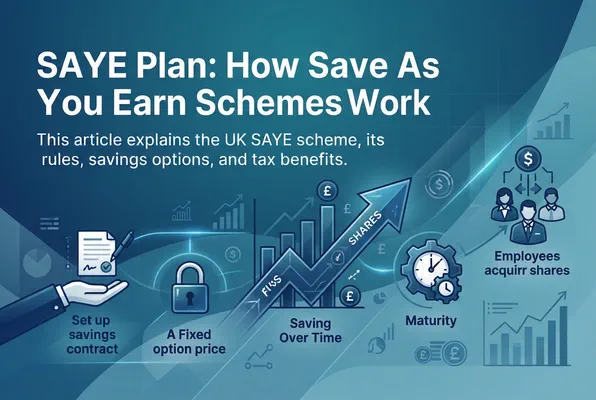
Step 1: Setting the Savings Contract
Employees choose to save a fixed amount each month, usually ranging from £5 to £500, directly deducted from their salary. This amount remains consistent throughout the savings period, which is typically three or five years.
Step 2: Fixing the Option Price
At the start of the scheme, the employer sets an option price, the price at which employees can buy shares when the savings period ends. This price is often discounted by up to 20% compared to the market value of the shares at the time the scheme launches.
Step 3: Saving Over Time
Throughout the savings period, contributions are automatically deducted from the employee’s pay and placed into a dedicated savings account, often administered by a building society or bank partnered with the employer.
Step 4: Maturity and Share Purchase
When the SAYE Plan matures, employees have a choice:
- Exercise the option and use their savings to buy shares at the discounted price
- Withdraw the cash savings without purchasing shares, especially if the share price has fallen below the option price
This flexibility is one of the standout features of a SAYE Plan, employees are never forced into a losing position.
Exercise Price, Savings and the Option to Acquire Shares
When employees join a Sharesave plan, the date of grant establishes the point at which the option terms are determined. Employers decide on the level of discount given, from zero up to the permitted maximum, and establish the exercise price used to calculate how much participants must pay for the shares. The exercise price may be below the market value at the date of grant, allowing employees to benefit if the share price increases during the savings period. Depending on the applicable rules, employees can save up to £500 per month and use their accumulated savings to buy the shares when the scheme ends. The option to acquire shares gives participants the right, but not the obligation, to purchase shares at the agreed price. Employees can compare the shares and what they’re worth at the end of the scheme with the exercise price before deciding whether to exercise the options. If the price at the end is lower than the exercise price, the option may have little or no financial value, and the option will lapse if it is not exercised within the permitted period.
Key Benefits of a SAYE Plan
Tax Advantages
One of the most attractive aspects of a SAYE Plan is its favorable tax treatment. Savings and any accrued bonus are not subject to income tax or National Insurance contributions. While Capital Gains Tax (CGT) may apply if shares are later sold at a profit above the annual exemption threshold, many employees find the overall tax efficiency compelling compared to standard savings or investment vehicles.
Low-Risk Savings Mechanism
Unlike direct share purchases, a SAYE Plan protects employees from downside risk. If the company’s share price drops below the agreed option price, employees can simply withdraw their savings in cash rather than exercising the option to buy shares at a loss.
Discounted Share Price
The ability to purchase shares at up to a 20% discount to market value at the start of the scheme provides a built-in financial incentive, making SAYE Plans an attractive long-term wealth-building tool for employees.
Encourages Employee Engagement
From an employer’s perspective, SAYE Plans foster a sense of ownership and loyalty. Employees who hold shares in the company they work for are often more engaged, motivated, and aligned with long-term business goals.
Eligibility Criteria for a SAYE Plan
While specific rules can vary by employer, most SAYE Plans require:
- Employment status: Participants must typically be employees or full-time directors of the company (or a participating subsidiary) at the time of enrollment.
- Minimum service period: Some companies set a minimum length of service before employees can join the scheme, though many open it to all staff from day one.
- All-employee participation: HMRC rules require that SAYE Plans be offered to all eligible employees on similar terms, promoting fairness and broad participation across the organization.
SAYE Scheme Rules, Eligibility and Employee Participation
The SAYE scheme, also known as Sharesave or the Sharesave scheme, is a savings related share option scheme and a tax-advantaged employee share arrangement in the UK. It is also known as a statutory SAYE option and is designed to be tax efficient for participating employees. The scheme must be offered to all employees who meet the applicable eligibility criteria, although employers can choose to exclude certain categories where permitted by the rules. Employers may also set a minimum service requirement for participants, provided the minimum service requirement is applied consistently and complies with the scheme’s statutory conditions. The scheme must be offered to eligible employees on similar terms, and any requirement that shares in your company be available to staff should be reflected in the scheme rules. Employers should clearly explain how employees enter into a savings contract, the maximum savings limit for that year, and the conditions that apply when the scheme ends.
SAYE Plan Savings Limits and Contract Terms
HMRC sets the boundaries within which companies can design their SAYE Plans:
- Monthly savings range: Between £5 and £500 per month
- Contract length: Typically three or five years, with some schemes offering a combined five-year contract with a two-year bonus extension
- Bonus structure: Historically, SAYE Plans included a tax-free bonus at maturity, though bonus rates have fluctuated based on government policy and prevailing interest rates
Employers should work closely with equity compensation specialists to structure contract terms that comply with current HMRC guidelines while remaining attractive to employees.
Savings Period, Interest Rates and What Happens When the Scheme Ends
A Sharesave plan generally allows employees to save over a period of three or five years, with a maximum of five years for the standard savings contract. Employers may decide on the level of discount offered, establish the savings terms and, where permitted, set a minimum service requirement before participation. Any bonus or interest payable may depend on the applicable rules and rates, including the Bank of England base rate, although a bonus is not guaranteed. When the scheme ends, employees can use their savings to buy the shares or withdraw the accumulated cash instead. If an employee chooses not to exercise the option, or fails to exercise it within the applicable deadline, the option may lapse. In certain circumstances, employees must exercise their option within 90 days of the date their employment ends or another relevant event occurs, depending on the scheme rules. Employees should therefore review the plan documentation carefully to understand the available options, applicable deadlines and any tax consequences before deciding how to proceed.
Tax Treatment of a SAYE Plan in Detail
Understanding the tax implications of a SAYE Plan helps employees make informed decisions about participation and share retention.
At the Savings Stage
Monthly contributions are deducted from net pay (after tax), meaning there’s no upfront income tax relief. However, no tax is due on the savings or interest earned during the contract period.
At the Option Exercise Stage
When employees exercise their option to buy shares at the discounted price, there is no income tax or National Insurance liability on the discount received, a significant advantage compared to other forms of equity compensation.
At the Sale Stage
If employees sell their shares after exercising the option, any gain above the annual Capital Gains Tax allowance may be taxable. However, employees can often mitigate this by transferring shares into an Individual Savings Account (ISA) within 90 days of exercise, sheltering future gains from CGT entirely.
Tax Benefits and Corporation Tax Deduction
One of the main advantages of a Sharesave arrangement is that the exercise of the options is generally exempt from income tax and National Insurance on the difference between what you pay for the shares and their market value at exercise, provided the statutory conditions are satisfied. However, employees may have to pay capital gains tax when they sell their shares if the gain exceeds the applicable annual exemption and no relief applies. In this context, the scheme is tax-free at the option exercise stage, but selling the shares can create a separate tax liability. Employers should also consider whether the company obtains a statutory corporation tax deduction in connection with the share options. A statutory corporation tax deduction may be available under the relevant legislation, subject to the applicable conditions and calculation rules. Companies should confirm the treatment for tax purposes and distinguish between employee tax benefits and any corporation tax deduction available to the employer.
What Happens If You Leave Your Job?
Leaving an employer before a SAYE Plan matures affects your options significantly:
- Voluntary resignation: In most cases, you must withdraw your savings within six months, forfeiting the right to buy shares at the discounted price.
- Redundancy, retirement, or ill health: These “good leaver” categories often allow employees to exercise their options early, sometimes retaining the discounted purchase price.
- Company acquisition or takeover: If the employer is acquired, SAYE Plan holders are typically given the opportunity to exercise their options early, often within six months of the takeover.
Employees should always review their specific scheme rules, as terms can vary between companies.
SAYE Plan vs. Other Share Schemes
To understand where a SAYE Plan fits within the broader landscape of equity compensation, it’s helpful to compare it against alternatives:
| Feature | SAYE Plan | Share Incentive Plan (SIP) | Company Share Option Plan (CSOP) |
|---|---|---|---|
| Contribution method | Monthly salary deduction | Salary deduction or free shares | No regular contributions |
| Discount on shares | Up to 20% | N/A (often free shares) | No discount, but tax advantages on growth |
| Risk level | Low (cash withdrawal option) | Low | Moderate |
| Tax efficiency | High | High | High |
| Flexibility at maturity | Buy shares or withdraw cash | Shares are held in trust | Buy shares or let option lapse |
Each scheme serves different strategic purposes, and many companies offer multiple plans to cater to varying employee preferences and financial goals.
Why Employers Choose to Offer a SAYE Plan
For businesses evaluating employee benefits and equity compensation strategies, SAYE Plans offer several compelling advantages:
- Cost-effective administration: Compared to more complex equity structures, SAYE Plans are relatively straightforward to administer, especially with the help of specialized platforms.
- Broad-based participation: Because all employees must be eligible, SAYE Plans help democratize company ownership rather than concentrating equity among executives.
- Retention tool: The multi-year savings commitment naturally encourages employee retention, as participants have a financial incentive to remain with the company through the contract term.
- Positive employer branding: Offering tax-advantaged savings schemes enhances a company’s reputation as an employer that invests in its workforce’s financial wellbeing.
Common Challenges and Considerations
While SAYE Plans offer significant benefits, companies and employees should be aware of potential challenges:
- Administrative complexity: Managing payroll deductions, option pricing, and HMRC compliance requires careful coordination, often necessitating specialized software or external administrators.
- Market volatility: Share price fluctuations can affect employee perception of the scheme’s value, even though the downside protection mechanism mitigates actual financial risk.
- Communication gaps: Employees sometimes misunderstand the mechanics of SAYE Plans, underscoring the importance of clear, ongoing education about how the scheme works and its benefits.
Final Thoughts on SAYE Plans
A SAYE Plan remains one of the most employee-friendly and tax-efficient ways to build equity ownership within a UK-based organization. By combining disciplined monthly savings with the option, not obligation, to purchase discounted shares, it offers a low-risk pathway for employees to benefit directly from their company’s growth and success.
For employers, implementing a well-structured SAYE Plan can strengthen retention, boost engagement, and reinforce a culture of shared ownership. For employees, it represents a straightforward opportunity to grow savings while potentially sharing in the financial upside of the business they help build.
Whether you’re a business leader considering equity compensation strategies or an employee weighing participation in your company’s scheme, understanding the fundamentals of a SAYE Plan is the first step toward making informed, confident decisions about your financial future.
FAQ
What is a SAYE Plan?
How much can I save in a SAYE Plan?
Is a SAYE Plan tax-free?
What happens to my SAYE Plan if I leave my job?
Written by
Dominik KonoldCEO & Founder
Dominik Konold is the CEO and founder of Finidy GmbH, specializing in share-based compensation and treasury accounting. With a background in audit and investment banking, he is a certified Professional Risk Manager (PRMIA) and lectures for the Association of Public Banks and the Academy of International Accounting.
Related Posts
Dry Income: Meaning, Tax Impact & Management Tips
This article explains what dry income is, why it occurs, how it affects business owners and investors, and which tax strategies can help manage tax liabilities and maintain financial stability.

Binomial Tree Model: Option Price and Binomial Option Pricing Explained
Learn how the binomial tree model calculates option prices, incorporates risk-neutral probabilities, and compares with other option pricing models.

Accelerated Vesting: How to Accelerate Your Vesting Schedule for Stock Options & Restricted Stock
This guide explains accelerated vesting, including single- and double-trigger acceleration, vesting schedules, equity grants, and what happens to employee equity during major corporate events.
Ready to simplify your equity programs?
See how Incentrium helps you manage share-based compensation with ease. Book a demo to learn more.
Book a Demo