Secondary Market: Stock Trade Across Private Companies, NASDAQ & Private Market vs Primary Markets

The financial world revolves around two fundamental arenas of asset exchange: the primary market and the secondary market. While the primary market is where new assets are born, the secondary market is where they truly come alive—traded, valued, and repriced continuously by market participants seeking liquidity, returns, and strategic positioning.
For companies running equity incentive programs, token-based compensation schemes, or complex cap table structures, understanding how the secondary market functions is not merely academic. It directly affects how employees value their compensation, how investors assess liquidity, and how companies plan their financial futures.
This comprehensive guide breaks down everything you need to know about the secondary market—its mechanics, participants, significance for incentive programs, and the strategies that help stakeholders navigate it successfully.
What Is the Secondary Market?
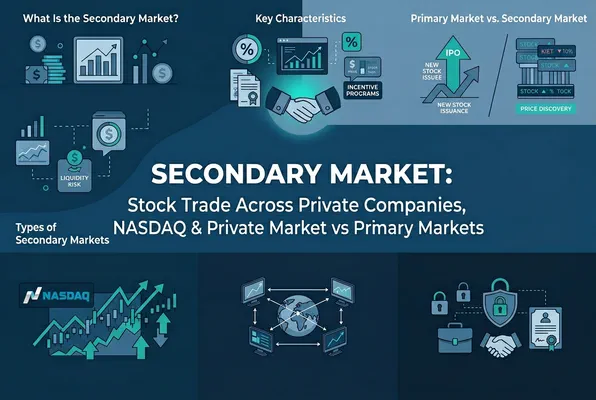
The secondary market is a financial marketplace where previously issued securities, assets, or financial instruments are bought and sold among investors. Unlike the primary market—where assets are created and sold for the first time—the secondary market facilitates the exchange of existing assets between parties without any new capital flowing to the original issuer.
Think of it this way: when a company conducts an Initial Public Offering (IPO), that is a primary market event. The moment those shares begin trading on a stock exchange the next day, they have entered the secondary market.
Key Characteristics of the Secondary Market
- No involvement from the original issuer: Proceeds from secondary market trades go to the selling investor, not the company that originally issued the asset.
- Continuous price discovery: Market forces—supply, demand, news, macroeconomic trends—work together to establish fair market value.
- Liquidity provision: The secondary market transforms otherwise illiquid assets into tradeable instruments, allowing investors to enter and exit positions.
- Regulatory oversight: Organized secondary markets, such as stock exchanges, operate under regulatory frameworks designed to ensure transparency and fairness.
Primary Market vs. Secondary Market: Understanding the Difference
The distinction between the primary and secondary market is foundational to financial literacy and particularly important for participants in equity incentive or token programs.
| Feature | Primary Market | Secondary Market |
|---|---|---|
| Asset origin | Newly issued | Previously issued |
| Who receives proceeds | Issuing company or entity | Selling investor |
| Price setting | Fixed by issuer | Determined by market forces |
| Examples | IPO, private placement, token generation event | Stock exchange, OTC trading, private secondary sales |
| Frequency | Occasional | Continuous |
Why This Distinction Matters for Incentive Programs
When a company grants stock options or token-based rewards to employees, those assets are created in a primary context. Their eventual value, however, is almost always realized in the secondary market—either through a public listing, a merger and acquisition event, or a private secondary transaction.
This means that the secondary market is not just a theoretical concept for employees with equity stakes. It is the mechanism through which their compensation ultimately converts to real, spendable value.
Types of Secondary Markets
The secondary market is not a monolithic entity. It encompasses several distinct structures, each with different rules, participants, and asset classes.
1. Public Stock Exchanges
The most visible form of secondary market is the organized stock exchange. Platforms like the New York Stock Exchange (NYSE), NASDAQ, the London Stock Exchange (LSE), or Frankfurt’s Xetra provide centralized venues where publicly listed company shares trade between buyers and sellers throughout each business day.
These exchanges are highly regulated, offer real-time price transparency, and benefit from deep liquidity pools. Settlement is typically handled through clearinghouses that reduce counterparty risk.
2. Over-the-Counter (OTC) Markets
OTC markets are decentralized networks where securities trade directly between parties without a centralized exchange. These markets often handle:
- Bonds and fixed-income instruments
- Derivatives and structured products
- Shares of smaller companies not listed on major exchanges
- Foreign exchange (forex) transactions
OTC markets tend to be less transparent and less liquid than exchange-traded markets, but they offer flexibility for non-standard instruments and bespoke transactions.
3. Private Secondary Markets
Perhaps the most relevant for growth-stage companies and their employees, private secondary markets facilitate the trading of shares, options, or tokens in private companies before any public listing or liquidity event.
Platforms and brokers in this space enable:
- Employee secondary sales of vested shares
- Investor-to-investor share transfers
- Tender offers organized by the company or third parties
- Structured liquidity programs for pre-IPO companies
Private secondary transactions are subject to company approval rights, transfer restrictions, and regulatory requirements, making them considerably more complex than exchange-based trading.
4. Cryptocurrency and Token Secondary Markets
The rise of blockchain technology has created an entirely new class of secondary market activity. Cryptocurrency exchanges—both centralized (CEX) and decentralized (DEX)—serve as secondary markets for digital tokens and coins. For companies using token-based incentive programs, these markets are where token recipients ultimately realize (or lose) value.
Key considerations in token secondary markets include:
- Vesting and lockup periods: Tokens may be subject to release schedules that restrict immediate secondary market access.
- Market depth and liquidity: Smaller token projects may have thin secondary market trading, making it difficult to exit positions without significant price impact.
- Regulatory landscape: Token secondary markets face evolving regulatory scrutiny in most jurisdictions.
Secondary Markets and Market Dynamics
The stock market and broader financial market operate through supply and demand, where securities are issued in the primary market and later traded in the secondary market. Here, existing securities such as private company shares, corporate bonds, and OTC securities are bought and sold by investors based on current market conditions and market prices. Different types of secondary markets, including public exchanges and the secondary market for private assets, allow participants to trade securities and provide liquidity to investors, enabling them to liquidate their holdings and adjust positions as the value of securities changes over time.
Secondary Market Participants
Understanding who operates in the secondary market helps illuminate how prices are formed and how liquidity is generated.
Individual Retail Investors
Retail investors buy and sell securities for personal accounts, often through brokerage platforms. Their collective behavior significantly influences price action in public markets, particularly for widely held assets.
Institutional Investors
Hedge funds, mutual funds, pension funds, insurance companies, and sovereign wealth funds are among the largest participants in secondary markets. Their substantial capital and sophisticated strategies often drive market trends and provide the bulk of trading volume in organized exchanges.
Market Makers
Market makers are firms or individuals that continuously quote buy (bid) and sell (ask) prices for securities, providing liquidity by always being willing to transact. In exchange, they profit from the bid-ask spread. Their role is critical to ensuring that secondary markets function smoothly, even during periods of volatility.
Broker-Dealers
Broker-dealers act as intermediaries between buyers and sellers, executing trades on behalf of clients (brokerage function) or trading for their own accounts (dealing function). They are essential conduits for secondary market access, particularly for retail participants.
Private Equity and Venture Capital Firms
In private secondary markets, PE and VC firms may sell stakes in portfolio companies to other investors before a formal exit event. This has spawned an entire sub-industry known as secondary private equity, where specialized funds acquire LP interests or direct company stakes from sellers seeking early liquidity.
The Role of the Secondary Market in Equity Incentive Programs
For companies with equity compensation programs—stock options, restricted stock units (RSUs), warrants, or performance shares—the secondary market is the ultimate arbiter of value. Here is how it intersects with incentive program management at every stage.
Valuation and Fair Market Value
Even before a company goes public, secondary market transactions in its shares can inform its 409A valuation (in the US context) or equivalent fair market value assessments in other jurisdictions. Active private secondary trading creates observable pricing data that financial assessors use to establish defensible valuations.
This matters enormously for option pricing. Strike prices for stock options must reflect fair market value at grant date to avoid adverse tax treatment for employees.
Liquidity Events and Tender Offers
One of the most common mechanisms for enabling secondary market access in private companies is the tender offer—a structured process in which a buyer (often the company itself, an existing investor, or a third party) offers to purchase shares from employees and early investors at a defined price.
Tender offers provide:
- A controlled liquidity mechanism that does not require a full IPO
- Clear pricing transparency for all selling participants
- Company oversight over who becomes a shareholder
Lock-Up Periods After IPO
When a company goes public, existing shareholders—including employees with vested equity—are typically subject to lock-up periods (commonly 90 to 180 days) during which they cannot sell their shares into the secondary market. Once the lock-up expires, a wave of secondary market selling can occur, sometimes putting downward pressure on share prices.
Employees and incentive program managers should plan for this dynamic when advising participants on their post-IPO financial strategies.
Secondary Sales by Employees
In increasingly common arrangements, employees of high-growth private companies negotiate the right to sell portions of their vested equity on the secondary market before any IPO or acquisition. This provides:
- Immediate liquidity for employees who have waiting years for an exit
- Retention benefits, as financial pressure is relieved without requiring the company to go public
- Cap table diversification for existing investors
Managing these transactions requires careful attention to company bylaws, right-of-first-refusal (ROFR) provisions, and securities regulations.
Secondary Market Liquidity: Why It Matters
Liquidity—the ease with which an asset can be bought or sold without significantly affecting its price—is one of the secondary market’s most important functions and most significant benefits.
The Liquidity Premium
Assets that trade freely on active secondary markets command a liquidity premium in valuation. Conversely, assets with restricted or limited secondary market access suffer a liquidity discount, which is why private company equity is typically valued below comparable public company equity, even when fundamentals are similar.
For employees holding private company options or shares, this illiquidity discount can be substantial—sometimes 20% to 40% or more according to academic research and practitioner estimates. Expanding secondary market access for private company equity has therefore become a significant area of innovation.
Secondary Market Depth and Stability
Market depth—the volume of buy and sell orders at various price levels—contributes to price stability. A deep secondary market can absorb large transactions without dramatic price swings, while a thin market may see significant volatility from relatively small trades.
This is particularly relevant for token-based incentive programs, where secondary market depth on crypto exchanges varies enormously between assets.
Regulatory Considerations in Secondary Markets
Navigating the secondary market requires awareness of the regulatory frameworks that govern asset transfers in different jurisdictions.
Securities Laws
In the United States, secondary market transactions are governed primarily by the Securities Exchange Act of 1934, administered by the Securities and Exchange Commission (SEC). Key provisions include:
- Registration requirements: Securities sold to the public must generally be registered, with limited exemptions.
- Insider trading prohibitions: Trading based on material non-public information is illegal.
- Reporting obligations: Public companies and large shareholders must disclose significant transactions.
European markets are governed by MiFID II (Markets in Financial Instruments Directive), which sets standards for transparency, investor protection, and market structure across EU member states.
Transfer Restrictions in Private Companies
Private company equity often comes with contractual restrictions on secondary transfers, including:
- Lock-up agreements: Mandatory holding periods
- Right of first refusal: Company or existing investors get the first opportunity to purchase shares before they are sold to third parties
- Board approval requirements: Transfers may require explicit company consent
- Accredited investor requirements: Many private secondary transactions can only involve qualified or accredited investors
Token and Crypto Regulations
Regulatory treatment of digital tokens varies widely. Tokens classified as securities are subject to securities laws in most jurisdictions, meaning their secondary market trading must comply with applicable registration, disclosure, and anti-money-laundering requirements. The regulatory landscape continues to evolve rapidly, making compliance expertise essential for any organization running token-based incentive programs.
Secondary Market Strategies for Incentive Program Participants
Whether you are an employee holding stock options, a startup founder managing a cap table, or an investor seeking early liquidity, the secondary market offers both opportunities and risks. Here are key strategies to consider.
For Employees and Option Holders
Understand your rights and restrictions. Before attempting any secondary sale, review your equity agreement, the company’s shareholder agreement, and applicable securities laws. Know your vesting schedule, exercise prices, and any transfer restrictions.
Model the tax implications. Secondary market sales of equity or options can trigger significant tax events. In the US, the difference between qualifying and non-qualifying dispositions of incentive stock options (ISOs) can dramatically affect your after-tax proceeds. Consult a tax professional before transacting.
Evaluate platform options. Several specialized platforms now facilitate private secondary transactions for employees of well-known private companies. Compare fee structures, liquidity, and compliance support before selecting a venue.
Diversify thoughtfully. Employees with concentrated equity positions in their employer’s stock face significant single-stock risk. Secondary market access provides an opportunity to diversify, but timing and tax strategy matter enormously.
For Companies Managing Incentive Programs
Plan liquidity proactively. Rather than waiting for the secondary market to create disorderly sales by employees, companies can organize structured tender offers that provide controlled liquidity while maintaining oversight of the cap table.
Use secondary market data for 409A valuations. If your company has observable secondary market transactions, work with your valuation provider to incorporate this data appropriately into fair market value assessments.
Communicate with participants. Many employees do not fully understand their secondary market options or the restrictions that apply. Proactive education—about vesting, lock-ups, ROFR provisions, and potential liquidity pathways—builds trust and improves retention.
Choose the right incentive instruments. Different equity instruments have different secondary market characteristics. RSUs, for example, are often easier to manage than options in secondary transactions because there is no exercise price involved. Consider how secondary market dynamics should inform your choice of incentive vehicle.
For Investors in Private Companies
Understand secondary discount dynamics. When acquiring secondary interests in private companies, price carefully for illiquidity risk and information asymmetry. Secondary buyers often have less information than primary investors.
Leverage secondary sales for portfolio management. VC and PE investors can use secondary market transactions to manage concentration risk, return capital to LPs earlier than a full exit would allow, or rebalance exposure across portfolio companies.
Technology and Innovation in the Secondary Market
The secondary market landscape is being transformed by technology, with several trends reshaping how assets are traded, settled, and managed.
Digital Asset Platforms and Tokenization
Blockchain technology enables the tokenization of traditionally illiquid assets—real estate, private equity stakes, infrastructure investments—allowing fractional ownership and secondary market trading on blockchain-based platforms. This dramatically lowers the minimum investment threshold and expands market access.
For companies using Incentrium and similar platforms to manage token-based incentive programs, this creates a direct pipeline from incentive grant to secondary market liquidity.
Automated Market Makers (AMMs)
In decentralized finance (DeFi), automated market makers use algorithmic pricing based on liquidity pools rather than traditional order books. This innovation has expanded secondary market access for token assets without requiring matched buyers and sellers at the same moment.
AI-Driven Market Analysis
Machine learning models increasingly power secondary market analysis, helping participants identify mispriced assets, predict liquidity trends, and optimize trade execution. For incentive program managers, AI tools can support better decision-making around tender offer timing and pricing.
Electronic Trading and Settlement
Even in traditional secondary markets, technology has dramatically accelerated settlement times. The shift from T+2 (trade date plus two days) to T+1 settlement in US markets, for example, reduces counterparty risk and frees up capital more quickly—benefiting all participants.
How Incentrium Supports Secondary Market Activity
At Incentrium , we recognize that the secondary market is not an afterthought to incentive program design—it is a central component of how participants experience value from their compensation.
Our platform is built to support companies and incentive program participants throughout the full lifecycle of incentive assets, including:
- Cap table management: Maintain a precise, real-time record of all equity holders, vesting schedules, and transfer activity.
- Compliance tracking: Monitor transfer restrictions, ROFR triggers, and regulatory requirements to ensure secondary transactions comply with applicable rules.
- Liquidity event planning: Model tender offer scenarios, IPO lock-up impacts, and secondary sale tax implications to help participants make informed decisions.
- Token program infrastructure: For companies issuing token-based incentives, Incentrium provides tools to manage vesting, lockups, and secondary market readiness.
- Transparent participant communication: Empower employees and stakeholders with clear, accessible information about their equity positions and secondary market options.
Whether you are running a traditional stock option plan or a cutting-edge token incentive program, understanding and managing secondary market dynamics is essential to delivering on the promise of equity compensation.
Secondary Market Best Practices: A Summary
To close, here is a concise reference of best practices for secondary market engagement across stakeholder types:
For Companies
- Implement clear secondary transfer policies in shareholder agreements
- Organize periodic tender offers to provide structured liquidity
- Use observable secondary market data to inform valuations
- Educate employees regularly about their equity and secondary market options
For Employees
- Know your vesting schedule and transfer restrictions before attempting any secondary sale
- Seek tax advice before executing secondary transactions
- Consider diversification when secondary market access is available
- Compare platforms and fee structures for private secondary sales
For Investors
- Price secondary purchases to reflect illiquidity and information risk
- Use secondary transactions strategically for portfolio management
- Stay current on regulatory changes affecting secondary market access
Conclusion
The secondary market is far more than a venue for buying and selling shares. It is the ecosystem through which financial instruments achieve real value, liquidity is democratized, and incentive compensation fulfills its promise. For companies building equity and token-based incentive programs, integrating secondary market awareness into every stage of program design—from instrument selection to communication strategy—is a competitive advantage.
As markets evolve through tokenization, regulatory change, and technological innovation, the secondary market will continue to expand in scope and accessibility. Organizations that understand these dynamics and build them into their incentive infrastructure will be better positioned to attract talent, reward performance, and deliver genuine financial value to all stakeholders.
Explore how Incentrium can help your organization design, manage, and optimize incentive programs with secondary market dynamics fully in view.
FAQ
What is the secondary market for incentive assets?
How does secondary market trading differ from primary market transactions?
Can employees sell their equity or stock options on the secondary market?
How does Incentrium support secondary market activity for incentive programs?
Written by
Dominik KonoldCEO & Founder
Dominik Konold is the CEO and founder of Finidy GmbH, specializing in share-based compensation and treasury accounting. With a background in audit and investment banking, he is a certified Professional Risk Manager (PRMIA) and lectures for the Association of Public Banks and the Academy of International Accounting.
Related Posts
Good Leaver: Definition, Clauses & Equity Rules Explained
This article explains what a good leaver is and how good leaver clauses and provisions affect employees, founders, and shareholders when they leave a company.
Cap Table Explained: The Ultimate Cap Table Guide for Founders
A cap table shows a startup’s ownership structure, including founders, employees, and investors, and explains how shares change through funding, dilution, and exits.
Best Equity Management Software for Startups 2026
Discover the best equity management software for startups. Compare top platforms, key features, cap table tools, and compliance capabilities to manage equity.
Ready to simplify your equity programs?
See how Incentrium helps you manage share-based compensation with ease. Book a demo to learn more.
Book a Demo