SPV Explained: Special Purpose Vehicles in Finance

Special Purpose Vehicles — commonly abbreviated as SPV — have quietly become one of the most powerful tools in modern finance. Whether you’re a venture capital investor syndicating a deal, a private equity firm structuring an acquisition, or a startup founder managing your cap table, understanding what an SPV is and how it works is essential.
This comprehensive guide breaks down everything you need to know about SPVs: their definition, legal structure, practical use cases, benefits, risks, and how platforms like Incentrium are making SPV formation faster and more accessible than ever.
What Is an SPV?
An SPV, or Special Purpose Vehicle, is a legally independent entity — typically a limited liability company (LLC) or limited partnership (LP) — created to serve a single, narrowly defined purpose. The entity is deliberately structured to be separate from the founding organization or sponsor, meaning its assets and liabilities do not appear on the parent company’s balance sheet.
SPVs are also known by other names, including:
- Special Purpose Entity (SPE)
- Special Purpose Acquisition Company (SPAC) (a specific variant)
- Single-Asset Vehicle
- Deal-by-Deal Vehicle
The core principle behind every SPV is legal and financial separation. By creating a standalone entity, sponsors can ring-fence risk, attract investors for a specific opportunity, and manage assets with a clearly defined mandate.
Key Characteristics of an SPV
| Feature | Description |
|---|---|
| Legal Independence | Operates separately from its parent or sponsor |
| Bankruptcy Remoteness | Insulated from parent company insolvency |
| Narrow Purpose | Created for a specific transaction or asset |
| Defined Lifespan | Usually wound down after its purpose is fulfilled |
| Pass-Through Taxation | Often structured for tax efficiency |
How Does an SPV Work?
At its core, an SPV works by aggregating capital or assets under a dedicated legal wrapper. Here’s a step-by-step look at how a typical SPV functions:
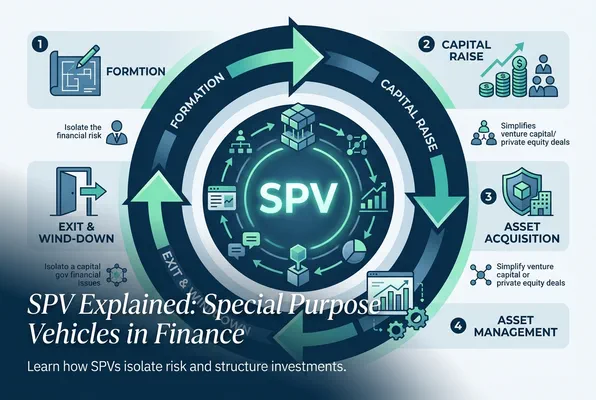
Step 1: Formation
A sponsor (also called the manager or general partner) identifies an investment opportunity, transaction, or asset that requires a dedicated legal entity. The sponsor incorporates the SPV — commonly in jurisdictions like Delaware (USA), the Cayman Islands, Luxembourg, or Ireland — and defines its purpose in the founding documents.
Step 2: Capital Raise
The SPV manager invites investors (limited partners or members) to commit capital to the vehicle. Each investor signs a subscription agreement and contributes funds. The SPV now holds this pooled capital on behalf of its investors.
Step 3: Asset Acquisition or Transaction
The SPV deploys the capital to fulfill its purpose — this could be purchasing equity in a startup, acquiring a real estate asset, issuing debt securities, or entering into a derivatives contract.
Step 4: Asset Management
During the holding period, the SPV manager oversees the asset, provides updates to investors, handles any distributions (such as dividends or interest payments), and ensures ongoing compliance.
Step 5: Exit and Wind-Down
When the SPV achieves its objective — for example, a portfolio company is acquired or goes public — proceeds are distributed to investors proportionally, and the SPV is formally dissolved.
Types of SPVs
SPVs are versatile instruments used across many sectors of finance. Understanding the different types helps clarify when and why each structure is appropriate.
Investment SPVs (Co-Investment Vehicles)
These are among the most common SPVs in private markets today. An investment SPV allows multiple investors to pool capital and invest in a single company, fund, or asset together. The SPV appears as a single shareholder on the target company’s cap table, simplifying corporate governance significantly.
This structure is widely used in: - Venture capital co-investments - Angel syndicate deals - Secondary market transactions
Real Estate SPVs
Real estate developers and investors frequently use SPVs to hold individual properties. Each property is isolated in its own entity, protecting other assets from liability and enabling clean exit strategies (such as selling the SPV rather than the property directly, which can have tax advantages).
Securitization SPVs
In structured finance, SPVs are the backbone of asset-backed securities (ABS), mortgage-backed securities (MBS), and collateralized loan obligations (CLOs). Banks and financial institutions transfer pools of loans to an SPV, which then issues securities to capital markets investors. This removes the assets from the bank’s balance sheet and transfers risk to investors.
Project Finance SPVs
Infrastructure projects — think toll roads, power plants, or pipelines — are routinely financed through SPVs. The project company itself is the SPV, which borrows money based solely on the project’s expected cash flows rather than the sponsor’s balance sheet.
Acquisition SPVs
Private equity firms often create an SPV to acquire a target company. This acquisition vehicle takes on the debt used to finance a leveraged buyout (LBO), keeping that liability separate from the PE firm’s other portfolio companies.
SPVs as an Investment Vehicle
SPVs are widely used as an investment vehicle for acquiring specific assets or financing a specific project. A dedicated SPV, also known as a special purpose limited company, is typically created as a separate company to isolate liabilities and protect the parent company from financial exposure. In venture capital and private equity funds, SPVs allow companies and investors to participate in a specific investment without affecting the broader company structure.
SPVs in Structured Finance and Joint Ventures
SPVs are often used in structured finance transactions, including asset securitization and large-scale finance deals. Banks, institutional investors, and joint ventures use SPVs to pool capital, manage risk, and improve financial reporting transparency. Because SPVs are commonly used for off-balance-sheet financing, regulators such as the Securities and Exchange Commission closely monitor compliance and disclosure obligations.
The Benefits of Using an SPV
SPVs have become a dominant structure in private markets for good reason. They offer a range of compelling advantages for both sponsors and investors.
Risk Isolation and Bankruptcy Remoteness
Perhaps the most fundamental benefit of an SPV is risk isolation. Because the SPV is legally separate from its sponsor, problems in one entity do not automatically contaminate another. If the asset held by an SPV fails, the parent company’s other assets are protected — and vice versa.
This bankruptcy remoteness is why SPVs are so popular in securitization: lenders to the SPV have a claim on the SPV’s assets, not the originating bank’s balance sheet.
Simplified Cap Table Management
For startup founders and venture investors, SPVs dramatically simplify cap table management. Instead of dozens of individual angel investors appearing as separate shareholders, a single SPV entity holds the combined investment. This reduces administrative burden, streamlines future fundraising rounds, and makes it easier to secure institutional investors who prefer clean, manageable cap tables.
Access to Specific Opportunities
SPVs enable investors who might not qualify for a main fund to participate in a specific deal. A lead investor with deal access can open an SPV, invite co-investors, and collectively participate in an investment that would otherwise be unavailable to smaller capital providers.
Off-Balance-Sheet Financing
Companies can use SPVs to raise capital or finance assets without affecting their own balance sheet ratios. While regulatory scrutiny (particularly post-Enron) has tightened the rules around off-balance-sheet treatment, legitimate uses remain common in project finance and structured products.
Tax Efficiency
SPVs are frequently structured to optimize tax outcomes. Pass-through entities like LLCs and LPs avoid double taxation — income flows through to investors who are taxed at their individual rates. Choosing the right jurisdiction (e.g., Luxembourg for European structures, Cayman Islands for offshore) can further reduce withholding taxes and comply with international treaty networks.
Flexibility and Speed
Compared to forming a full fund with its regulatory requirements, an SPV can often be set up relatively quickly for a specific transaction. This agility is critical in competitive deal environments where speed matters.
SPV vs. Traditional Fund: Key Differences
Understanding when to use an SPV versus a traditional investment fund is crucial for sponsors and investors.
| Dimension | SPV | Traditional Fund |
|---|---|---|
| Investment Scope | Single asset or transaction | Diversified portfolio |
| Lifespan | Limited to the deal | Multi-year, ongoing |
| Investor Selection | Deal-by-deal basis | Committed at fund close |
| Cap Table Impact | Single line item | Single line item |
| Regulatory Burden | Generally lower | Higher (fund registration) |
| Diversification | None (single asset) | Built-in |
| Carry & Economics | Negotiated per deal | Standardized (2/20 typical) |
| Setup Speed | Faster | Slower |
For emerging managers or established GPs looking to do a one-off deal outside their main fund strategy, an SPV is often the ideal solution. For investors seeking diversification and a long-term relationship with a manager, a traditional fund structure makes more sense.
SPV Structure: The Legal Architecture
Understanding the legal architecture of an SPV helps sponsors design vehicles that are robust, compliant, and investor-friendly.
Common Jurisdictions
Delaware LLC/LP (USA) Delaware remains the gold standard for domestic U.S. SPVs. Its well-developed legal framework, flexible LLC statute, and business-friendly courts make it the default choice for most U.S.-focused venture and private equity deals.
Cayman Islands The Cayman Islands is the dominant offshore jurisdiction for international funds and SPVs. Its neutral tax environment, sophisticated legal system, and widespread acceptance among institutional investors make it ideal for cross-border transactions.
Luxembourg For European structures, Luxembourg offers a range of sophisticated vehicles — including the Société en Commandite Spéciale (SCSp) and the Reserved Alternative Investment Fund (RAIF) — that are widely recognized across EU member states.
Ireland Ireland’s SPV framework under Section 110 of the Taxes Consolidation Act 1997 is extensively used for securitization, enabling efficient structures for ABS and CLO transactions.
Key Legal Documents
A well-structured SPV relies on a suite of legal documents:
- Limited Partnership Agreement (LPA) or Operating Agreement: The foundational document governing the relationship between the manager and investors, outlining rights, obligations, economics, and governance.
- Subscription Agreement: Signed by each investor to commit capital and make representations about their investor status (e.g., accredited investor).
- Side Letters: Individual agreements between the manager and specific investors that may grant preferential terms.
- Private Placement Memorandum (PPM): A disclosure document that describes the investment opportunity, risks, and terms in detail.
The Role of the General Partner and Limited Partners
In an LP structure:
- The General Partner (GP) manages the SPV, makes investment decisions, and bears unlimited liability (mitigated in practice through a GP entity).
- Limited Partners (LPs) contribute capital and receive economic returns but have limited liability capped at their investment and no management role.
In an LLC structure, the manager plays a similar role to the GP, while members correspond to LPs.
Advantages and Disadvantages of SPVs
While SPV investment structures provide flexibility and efficient investment strategies, there are also disadvantages of SPVs to consider. Legal setup costs, regulatory compliance, and ongoing administration can become complex, especially for smaller transactions. However, modern SPV services help simplify formation, investor onboarding, reporting, and governance, making SPVs an increasingly attractive solution for both private company investments and institutional transactions.
Risks and Considerations When Using an SPV
While SPVs offer substantial benefits, they are not without risks. Sponsors and investors should carefully consider the following.
Regulatory and Compliance Risk
SPVs must comply with securities laws in their jurisdiction. In the United States, for example, offering interests in an SPV to investors generally constitutes the sale of a security. Managers must either register the offering or qualify for an exemption — most commonly Regulation D (Rule 506(b) or 506(c)) for private placements to accredited investors.
Failure to comply with securities regulations can result in severe penalties, rescission rights for investors, and reputational damage.
Conflicts of Interest
When a manager operates multiple SPVs and/or a main fund simultaneously, conflicts of interest can arise — for example, when deciding which vehicle gets allocation to a hot deal. Proper disclosure and robust governance policies are essential.
Concentration Risk
By definition, an SPV holds a single asset. This means investors have zero diversification within the vehicle. If the underlying investment fails, investors lose their entire contribution to that SPV.
Complexity and Cost
While SPVs are simpler than full funds, they still involve legal, administrative, and compliance costs. Legal fees for forming an SPV, drafting documents, and ongoing compliance can be significant, particularly for smaller deal sizes where costs may be disproportionate to the economics.
Opacity and Governance Concerns
Historically, SPVs have been criticized for enabling opaque transactions that obscure risk from investors and regulators. The Enron scandal brought SPV misuse into sharp public focus, leading to significant regulatory reform. Today, accounting standards (particularly IFRS 10 and ASC 810) require consolidation of SPVs when the parent effectively controls the entity, limiting the scope for off-balance-sheet abuse.
How Technology Is Transforming SPV Formation
The traditional SPV formation process has historically been slow, expensive, and accessible only to well-resourced institutions and established managers. Technology platforms are changing that equation dramatically.
The Rise of SPV Platforms
Modern SPV platforms streamline the entire lifecycle of a special purpose vehicle — from formation and investor onboarding to administration, reporting, and eventual wind-down. Key features typically include:
- Automated document generation for LPAs, subscription agreements, and PPMs
- Digital investor onboarding with built-in KYC/AML verification
- Electronic signature capabilities for all legal documents
- Cap table management and ownership tracking
- Investor relations portals for reporting and distributions
- Compliance monitoring tools
Incentrium’s Approach to SPV Management
Incentrium is at the forefront of this transformation, providing fund managers, venture capitalists, and corporate sponsors with the infrastructure to launch and manage SPVs efficiently. By combining legal expertise with intuitive technology, Incentrium helps sponsors:
- Reduce time-to-launch from weeks to days
- Lower formation costs compared to traditional legal workflows
- Scale across multiple SPVs without proportional increases in administrative overhead
- Improve investor experience through transparent reporting and streamlined communication
For emerging managers looking to run their first SPV, or established GPs seeking to operationalize a high-volume deal-by-deal strategy, platforms like Incentrium represent a meaningful competitive advantage.
SPVs in Venture Capital: A Closer Look
Venture capital has embraced the SPV structure more enthusiastically than perhaps any other sector. Here’s why.
The Anatomy of a VC SPV
A typical VC SPV works as follows:
- A lead investor or deal syndicator identifies an investment opportunity in an early-stage company.
- The lead investor creates an SPV and invites co-investors — often sourced from their network, an angel platform, or a curated investor community.
- Each co-investor commits capital to the SPV, which pools the capital and invests as a single entity.
- The startup receives one wire and adds one name to its cap table.
- Upon exit (acquisition, IPO, or secondary sale), proceeds flow back through the SPV to individual co-investors.
Why Founders Love SPVs
Founders benefit enormously from SPVs:
- Cleaner cap tables: A single SPV entity replaces dozens of individual investors, reducing governance complexity.
- Faster future rounds: Institutional investors in Series A and beyond often require clean cap tables as a precondition of investment.
- Simpler voting: One entity means simplified shareholder consent processes for future corporate actions.
Why Investors Use SPVs for Co-Investment
For investors, participating in a VC SPV offers:
- Access to deals they wouldn’t otherwise see
- Lower minimums than direct LP commitments to a fund
- Transparency about exactly what they’re investing in
- Flexibility to pick and choose deals rather than committing to a blind pool
Carry and Economics in VC SPVs
The economics of a VC SPV typically include:
- Carried interest: The manager takes a percentage of profits (commonly 10–20% in SPVs, compared to 20% in traditional funds) as compensation for sourcing and managing the deal.
- Management fee: Some SPVs charge a small one-time or annual fee; many do not.
- Setup fees: Legal and platform costs may be passed through to the SPV or charged separately.
SPV Accounting and Reporting
Proper accounting and transparent reporting are critical for maintaining investor trust and regulatory compliance.
Consolidation Rules
Under US GAAP (ASC 810) and IFRS 10, a company must consolidate an SPV into its financial statements if it is determined to be the primary beneficiary — meaning it has the power to direct the SPV’s activities and absorbs the majority of its risks and rewards. This rule was significantly tightened after the Enron crisis to prevent off-balance-sheet abuse.
Investor Reporting
SPV managers should provide investors with regular reporting, including:
- Quarterly or annual financial statements
- Capital account statements showing each investor’s current value
- Portfolio updates on the underlying asset(s)
- Tax documents (K-1s in the U.S. for partnership structures)
Valuation Methodology
For private market SPVs, the underlying assets are often illiquid. Managers must apply consistent and defensible valuation methodologies — typically following guidelines from bodies like the IPEV (International Private Equity and Venture Capital Valuation Guidelines) — and disclose these to investors.
When Should You Use an SPV?
Not every situation calls for an SPV. Here are the scenarios where it makes the most sense:
✅ You’re syndicating a single deal and want to aggregate multiple investors cleanly
✅ A startup’s existing investors want to collectively participate in a follow-on round
✅ A PE firm is acquiring a company using leverage it doesn’t want on its fund’s balance sheet
✅ A real estate developer wants to isolate liability for a specific property
✅ A company is securitizing a pool of receivables or loans
✅ You want to offer a specific opportunity to LPs outside your main fund
Conversely, an SPV is probably not the right tool if:
❌ You want investors to get diversified exposure
❌ You’re building a long-term asset management franchise
❌ The deal size is too small to justify formation costs
❌ Your investors require a regulated fund structure
Regulatory Landscape for SPVs
United States
In the U.S., SPV managers must navigate the Securities Act of 1933, the Investment Advisers Act of 1940, and potentially the Investment Company Act of 1940. Most SPVs rely on exemptions:
- Section 3(c)(1) or Section 3(c)(7) of the Investment Company Act to avoid fund registration
- Rule 506(b) or 506(c) of Regulation D for private placement exemption
Managers with significant AUM (over $150M in the U.S.) must register as investment advisers with the SEC; smaller managers may register at the state level.
European Union
In the EU, managers of SPVs with assets above certain thresholds fall under the Alternative Investment Fund Managers Directive (AIFMD), which imposes significant regulatory obligations around authorization, reporting, leverage limits, and investor disclosure.
Smaller managers may qualify for the AIFMD sub-threshold regime, with lighter-touch national registration requirements.
Global Considerations
Cross-border SPVs must navigate multiple regulatory regimes simultaneously. The choice of jurisdiction affects not only regulatory obligations but also tax treatment, investor perception, and operational logistics. Engaging experienced legal counsel with cross-border expertise is essential for international structures.
Conclusion: The SPV as a Modern Financial Building Block
The SPV has evolved from an arcane financial engineering tool into a mainstream instrument that is reshaping how capital is raised, deployed, and managed across global markets. From venture capital syndicates in Silicon Valley to infrastructure project finance in emerging markets, SPVs provide an unmatched combination of flexibility, risk isolation, and structural efficiency.
As the private markets ecosystem continues to democratize — with more individual investors accessing deal flow previously reserved for institutions — the SPV will only grow in importance. Technology platforms like Incentrium are removing the friction from SPV formation and management, making it possible for more managers to run sophisticated investment operations with greater speed and less overhead.
Whether you’re a first-time deal syndicator or an experienced fund manager looking to expand your deal-by-deal capabilities, understanding the mechanics, benefits, and risks of SPVs is no longer optional. It’s a fundamental competency for anyone operating in today’s private capital markets.
Looking to launch your first SPV or streamline your existing deal-by-deal investment program? Explore how Incentrium can help you structure, launch, and manage SPVs efficiently.
FAQ
What is an SPV in simple terms?
What is the difference between an SPV and a fund?
How is an SPV used in venture capital?
Is setting up an SPV complicated?
Written by
Dominik KonoldCEO & Founder
Dominik Konold is the CEO and founder of Finidy GmbH, specializing in share-based compensation and treasury accounting. With a background in audit and investment banking, he is a certified Professional Risk Manager (PRMIA) and lectures for the Association of Public Banks and the Academy of International Accounting.
Related Posts
Dry Income: Meaning, Tax Impact & Management Tips
This article explains what dry income is, why it occurs, how it affects business owners and investors, and which tax strategies can help manage tax liabilities and maintain financial stability.
Accelerated Vesting: How to Accelerate Your Vesting Schedule for Stock Options & Restricted Stock
This guide explains accelerated vesting, including single- and double-trigger acceleration, vesting schedules, equity grants, and what happens to employee equity during major corporate events.
Good Leaver: Definition, Clauses & Equity Rules Explained
This article explains what a good leaver is and how good leaver clauses and provisions affect employees, founders, and shareholders when they leave a company.
Ready to simplify your equity programs?
See how Incentrium helps you manage share-based compensation with ease. Book a demo to learn more.
Book a Demo