Warrants vs Options: Key Differences Explained
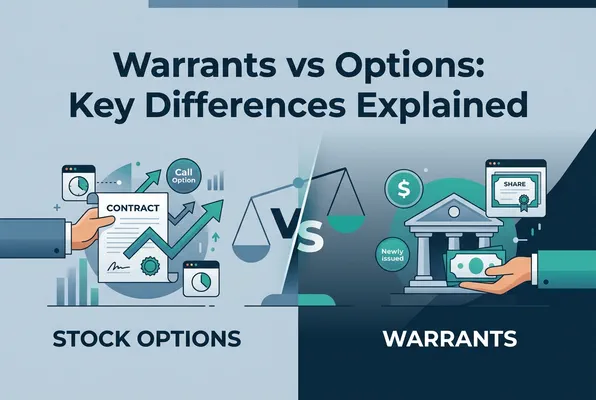

Equity instruments can be confusing — especially when two instruments look almost identical on the surface but serve very different purposes. Warrants vs options is one of the most common points of confusion for founders, investors, and finance professionals alike. Both give the holder the right to purchase shares at a predetermined price, yet the differences between them have significant implications for company capitalization, tax treatment, and investor strategy.
This guide breaks down everything you need to know: how each instrument works, when to use one over the other, and what the key structural and legal differences mean in practice.
What Are Stock Options?
A stock option is a contract that grants the holder the right — but not the obligation — to buy or sell shares of a company’s stock at a specific price (called the exercise price or strike price) within a defined time period.
Types of Stock Options
There are two primary categories of stock options:
1. Employee Stock Options (ESOs) These are issued by companies to employees, executives, and advisors as part of a compensation package. They are not traded on public exchanges. Instead, they follow a vesting schedule and are governed by an equity incentive plan.
- Incentive Stock Options (ISOs): Available only to employees in the United States, ISOs offer favorable tax treatment. Gains are not taxed at the time of exercise but may be subject to Alternative Minimum Tax (AMT). Long-term capital gains tax applies if shares are held for a qualifying period.
- Non-Qualified Stock Options (NSOs or NQSOs): Available to employees, contractors, and advisors. The spread between exercise price and market value is taxed as ordinary income at exercise.
2. Exchange-Traded Options These are standardized contracts traded on public exchanges like the Chicago Board Options Exchange (CBOE). They allow investors to buy (call options) or sell (put options) shares of publicly traded companies. These are completely separate instruments from employee stock options and are used for hedging, speculation, and income generation.
How Employee Stock Options Work
When a company grants stock options, the employee receives the right to purchase shares at the grant price — typically the fair market value (FMV) at the time of the grant. Options usually vest over time, commonly over a four-year period with a one-year cliff.
Example: - Grant date: January 1, 2024 - Options granted: 10,000 - Exercise price: $5.00 per share - Vesting: 4 years with 1-year cliff
After one year, 2,500 options vest. If the company’s share price rises to $15, the employee can exercise those options, paying $5 per share and receiving shares now worth $15 each — a $10 per-share gain.
What Are Warrants?
A stock warrant is also a contract that gives the holder the right to purchase company shares at a specified price before an expiration date. Unlike options, warrants are always issued directly by the company and are most commonly used as part of capital-raising transactions.
How Warrants Work
Warrants function similarly to call options but are primarily used in:
- Convertible note deals — investors receive warrants as additional incentive
- Equity fundraising rounds — warrants are offered as a “sweetener” to attract investors
- Bank loans and credit facilities — lenders receive warrants as part of their compensation for providing capital
- SPAC transactions — Special Purpose Acquisition Companies frequently issue warrants to investors
Example: A startup raises $500,000 in a convertible note. As part of the deal, the investor receives warrants to purchase 50,000 shares at $2.00 per share, exercisable for five years. If the company’s valuation rises significantly, the investor can exercise these warrants and acquire equity at the below-market price.
Types of Warrants
- Equity warrants: The most common type, allowing the holder to purchase common or preferred shares
- Covered warrants: Issued by financial institutions rather than the company itself, typically in public markets
- Naked warrants: Issued independently, not attached to a debt instrument
- Detachable warrants: Originally attached to bonds but can be separated and traded independently
- Call warrants vs put warrants: Call warrants give the right to buy; put warrants give the right to sell (less common for private companies)
Warrants vs Options: Side-by-Side Comparison
Understanding the structural differences between warrants and options is critical for anyone dealing with equity compensation or startup investing. Here’s a detailed comparison:
| Feature | Stock Options | Warrants |
|---|---|---|
| Issuer | Company (for ESOs) or exchange | Always the company directly |
| Primary use | Employee compensation | Capital raising, investor deals |
| Expiration | Typically 5–10 years (ESOs) | Often 5–10+ years, sometimes longer |
| Traded on exchange? | Exchange-traded options yes; ESOs no | Some publicly listed warrants; most not |
| Dilution | Yes, when exercised | Yes, when exercised |
| Tax treatment | ISOs and NSOs have distinct tax rules | Generally taxed as capital gain or income at exercise |
| Vesting schedule | Common for ESOs | Rare; usually immediately exercisable |
| Settlement | New shares issued or cash-settled | Almost always new shares issued |
| Regulatory framework | Well-established (especially in the US) | Less standardized |
| Typical recipient | Employees, advisors | Investors, lenders, strategic partners |
Equity Instruments in Practice
Stock warrants vs options are often discussed together, but they serve different financial purposes. A warrant allows an investor to acquire equity in a company at a predetermined valuation, usually as part of a financing structure, while an option is more commonly embedded in compensation systems or derivative markets. In both cases, the value is tied to the underlying stock price, yet the legal structure and intent differ significantly. Warrants are issued directly by the issuing company, whereas options typically arise through standardized agreements or employee stock option plans, making stock options and warrants functionally distinct despite surface similarities.
Rights, Pricing, and Exercise Structure
A stock option contract grants the right to acquire company equity under predefined conditions, often linked to vesting schedules or performance milestones. Warrants, on the other hand, are generally issued alongside investment arrangements and give the warrant holder the ability to buy shares at a specified price over a longer time horizon. While both instruments depend on the future stock price, warrants are usually more flexible in duration and are commonly used when companies issue stock warrants to attract capital. Options tend to be more structured and are frequently integrated into compensation systems rather than financing transactions.
Usage Context and Financial Purpose
The practical use of stock warrants and stock options differs based on strategic intent. Warrants are often associated with fundraising, where investors receive the right to buy shares of stock as an additional incentive, whereas options are primarily used in employee stock option plans to align long-term incentives with company performance. In this context, stock warrants vs options highlights how warrants are designed for external capital providers, while options are focused on internal stakeholders. Both instruments ultimately connect to ownership in the underlying stock, but they operate within different financial ecosystems and timeframes.
Key Differences Explained in Detail
1. Who Issues Them and Why
This is the most fundamental distinction in the warrants vs options debate.
Stock options can be issued either by the company (ESOs) or they exist as standardized contracts on public exchanges. Exchange-traded options do not involve the underlying company at all, they are contracts between two market participants.
Warrants are always issued directly by the company. When a warrant is exercised, the company issues new shares and receives the exercise price. This is a deliberate capital-raising mechanism.
2. Dilution Impact
Both instruments cause dilution when exercised because new shares are created. However, the scale of dilution typically differs:
- ESOs are managed through an option pool, usually representing 10–20% of a company’s fully diluted cap table at any given time
- Warrants issued during financing rounds can represent significant additional dilution on top of the equity already issued
Companies should carefully model the fully diluted share count — which includes outstanding options, warrants, convertible notes, and issued shares — to understand the true dilutive impact of each instrument.
3. Vesting and Exercise Conditions
Employee stock options almost always come with a vesting schedule, tying equity incentives to continued employment and performance. A standard structure is:
- 4-year vesting period
- 1-year cliff (no vesting before 12 months)
- Monthly or quarterly vesting thereafter
Warrants, on the other hand, are typically immediately exercisable or become exercisable shortly after issuance. There is no employment condition attached, since warrants are primarily held by investors rather than employees.
4. Expiration Periods
While exchange-traded options often expire within days, weeks, or months, employee stock options typically have a 10-year lifespan from the grant date. However, they usually expire within 90 days of leaving the company, which is a critical — and often overlooked — detail for employees.
Warrants commonly have expiration periods ranging from 3 to 10 years. In some private equity and venture deals, longer warrant periods may be negotiated.
5. Tax Implications
Tax treatment is one area where warrants and options diverge significantly, and getting it wrong can be costly.
Stock Options:
- ISOs: No ordinary income tax at exercise (for regular tax purposes). If the employee holds the shares for at least 2 years from grant and 1 year from exercise, gains are taxed at long-term capital gains rates. Beware of AMT.
- NSOs: The spread at exercise is taxed as ordinary income. Companies can deduct this as a business expense.
Warrants:
Warrants are generally not subject to the same favorable ISO treatment. In most cases:
- If a warrant is received as compensation, its fair market value may be taxable as ordinary income when granted or exercised
- If a warrant is purchased as part of an investment (e.g., a SAFE or convertible note), the tax treatment is more like a capital asset
- Exercising a warrant and then selling the shares will typically result in capital gains tax on the appreciation
Always consult a qualified tax advisor or attorney before structuring or exercising either type of instrument.
6. Regulatory and Legal Framework
Employee stock options in the United States are governed by a well-developed set of rules under the Internal Revenue Code (IRC) Section 422 (for ISOs) and company equity incentive plans. There are established best practices for 409A valuations, plan document requirements, and board approval processes.
Warrants have less standardization, especially in private market deals. The terms are typically negotiated individually and documented in a warrant agreement. This gives more flexibility but also introduces complexity, especially for international deals.
When Should a Company Issue Warrants?
Warrants are typically the right instrument when:
- Raising capital through convertible notes or SAFEs: Warrants provide additional upside to investors beyond the conversion right
- Securing debt financing: Lenders may require warrants as part of their compensation, reducing the cash interest rate
- Strategic partnerships: Issuing warrants to a strategic partner aligns their incentives with company growth
- SPAC or public market transactions: Warrants are commonly used to attract investors in blank check company offerings
- Bridge financing: Short-term capital needs can be bridged by offering warrants as an equity kicker
When Should a Company Issue Stock Options?
Stock options are typically the right instrument when:
- Compensating employees and key team members — options align employee incentives with company performance
- Building an equity incentive plan — a formal option pool is standard practice for venture-backed startups
- Attracting advisors or consultants — NSOs can be issued to non-employees for advisory services
- Retaining talent over time — vesting schedules create a “golden handcuff” that incentivizes long-term commitment
Platforms like Incentrium help startups and growth-stage companies manage equity incentive plans, model dilution, and generate cap table reports — making it easier to administer stock options professionally.
Warrants vs Options in Startup Financing
In the startup ecosystem, you’ll encounter both instruments frequently — but in very different contexts.
The Option Pool in Venture Deals
Before a venture capital round closes, investors typically require the company to establish or expand an employee option pool. This pool is dilutive to existing shareholders (including founders) but is necessary to attract top talent. A typical seed-stage option pool might represent 10–15% of the post-money fully diluted cap table.
Warrants in Venture Debt and Convertible Notes
Venture debt lenders — such as Silicon Valley Bank, Hercules Capital, and similar institutions — almost always receive warrants as part of their lending arrangement. The warrant coverage is typically expressed as a percentage of the loan amount.
Example: - Loan amount: $2,000,000 - Warrant coverage: 10% - Exercise price: Current preferred share price
This means the lender receives warrants to purchase $200,000 worth of shares at the current round price. If the company does well, these warrants become very valuable.
SAFE Notes and Warrant Kickers
Some SAFE (Simple Agreement for Future Equity) notes include warrant coverage as an additional investor incentive. This is more common in angel and early-stage deals where investors want extra upside for taking on more risk.
Cashless Exercise: A Feature of Both Instruments
Both warrants and stock options may include a cashless exercise (also called net exercise or “cashless settlement”) provision. Instead of paying the exercise price in cash, the holder surrenders a portion of their shares equal in value to the exercise price.
Example: - Warrants to purchase 10,000 shares at $2.00 each - Current share price: $10.00 - Total exercise cost: $20,000
With cashless exercise: - Value gained per share: $10.00 - $2.00 = $8.00 - Shares surrendered: $20,000 / $10.00 = 2,000 shares - Shares received: 10,000 - 2,000 = 8,000 shares
This is especially useful for investors who want to exercise without needing to commit additional cash.
Common Misconceptions About Warrants vs Options
Misconception 1: “Warrants and options are the same thing”
While they share structural similarities, warrants and options serve different purposes, have different issuers, different legal frameworks, and different tax treatments. Confusing them in deal documentation can have serious legal and financial consequences.
Misconception 2: “Only public companies issue warrants”
Private companies issue warrants frequently, particularly in connection with debt financing and early-stage investment rounds. In fact, warrants are one of the most common instruments in venture debt and angel investing.
Misconception 3: “Options don’t dilute shareholders”
Any option or warrant that is exercised results in new shares being created, which dilutes existing shareholders. The degree of dilution depends on the size of the option pool or warrant coverage relative to total shares outstanding.
Misconception 4: “Warrants can replace options for employee compensation”
While technically possible, using warrants for employee compensation is unusual and may not provide the tax advantages that ISOs or NSOs offer. Most equity compensation lawyers will recommend options over warrants for employees.
Practical Checklist: Warrants vs Options Decision Framework
Use this checklist when deciding which instrument is right for your situation:
Consider stock options if you are: - [ ] Compensating employees, advisors, or contractors - [ ] Building a formal equity incentive plan - [ ] A US company looking to offer favorable tax treatment (ISOs) - [ ] Seeking a standardized, board-approved process
Consider warrants if you are: - [ ] Closing a convertible note or venture debt deal - [ ] Offering equity kickers to investors or lenders - [ ] Structuring a strategic partnership with equity upside - [ ] Issuing equity instruments as part of a public offering or SPAC
Managing Equity: Why the Right Tools Matter
Whether you’re managing an option pool of 50 grants or tracking warrants issued across multiple financing rounds, the complexity grows quickly. Keeping your cap table accurate is critical for:
- Investor reporting
- 409A valuations
- M&A due diligence
- Employee equity education
Modern equity management platforms streamline the administration of both options and warrants, providing clear views of vesting schedules, dilution scenarios, and exercise activity. If you’re looking for a platform built for European and international startups, Incentrium offers tools designed to handle the nuances of equity compensation across multiple jurisdictions.
Summary: Warrants vs Options at a Glance
Both warrants and options are powerful equity instruments — but they are designed for different stakeholders, different transactions, and different strategic goals.
- Options are the go-to instrument for employee compensation, offering vesting schedules, established legal frameworks, and favorable tax treatment under the right structure
- Warrants are the preferred instrument for capital-raising transactions, used to reward investors and lenders with equity upside beyond their primary investment
Understanding the difference between warrants vs options isn’t just an academic exercise — it directly impacts your cap table, your tax obligations, and your ability to attract and retain both talent and capital.
When in doubt, work with an experienced equity attorney and use a reliable cap table management platform to keep your equity structure clean, compliant, and investor-ready.
FAQ
What is the main difference between warrants vs options?
Do warrants dilute shares like options do?
Are warrants or options better for employee compensation?
Can warrants be traded like options?
Written by
Dominik KonoldCEO & Founder
Dominik Konold is the CEO and founder of Finidy GmbH, specializing in share-based compensation and treasury accounting. With a background in audit and investment banking, he is a certified Professional Risk Manager (PRMIA) and lectures for the Association of Public Banks and the Academy of International Accounting.
Related Posts

Secondary Market: Stock Trade Across Private Companies, NASDAQ & Private Market vs Primary Markets
Discover how secondary markets shape the trading of existing securities, improve liquidity, and enable investors to buy and sell stocks, bonds, and private assets based on market dynamics.
Restricted stock units (RSU) vs Stock Options: Key Differences Explained
This guide explains stock options and RSUs as a form of equity compensation, highlighting RSUs vs stock options, key differences, tax implications, and how startups structure employee equity.

Accelerated Vesting: How to Accelerate Your Vesting Schedule for Stock Options & Restricted Stock
This guide explains accelerated vesting, including single- and double-trigger acceleration, vesting schedules, equity grants, and what happens to employee equity during major corporate events.
Ready to simplify your equity programs?
See how Incentrium helps you manage share-based compensation with ease. Book a demo to learn more.
Book a Demo