What Is a Stock Option? Types, How They Work & Tips
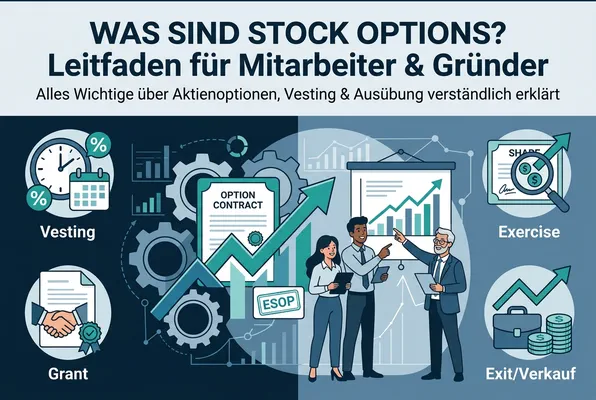

Stock options are one of the most powerful — and most misunderstood — forms of compensation in the modern workplace. Whether you’ve just received an equity offer from a startup, are trying to evaluate a job at a public company, or are an investor looking to understand derivatives, knowing exactly what a stock option is can have a meaningful impact on your financial future.
This guide breaks down everything you need to know: how stock options work, the different types, vesting schedules, tax treatment, and how to think strategically about your equity compensation.
What Is a Stock Option?
A stock option is a contractual right granted to an individual — typically an employee or contractor — that allows them to purchase a specific number of shares in a company at a predetermined price, known as the exercise price or strike price, within a defined time window.
Stock options give you the right to buy company stock at a specific price within a set time. You can choose to buy or sell a stock depending on whether the stock value rises above that level.
The critical word here is right, not obligation. You are never forced to buy the shares. You choose to exercise your options when — and if — doing so makes financial sense.
Stock options serve two broad purposes:
- As employee compensation tools — used by companies, especially startups, to attract and retain talent by aligning employees’ financial interests with company growth.
- As financial derivatives — traded on public markets, giving investors the ability to speculate on or hedge against movements in stock prices.
This article focuses primarily on employee stock options, though we’ll also touch on exchange-traded options where relevant.
How Do Stock Options Work?
Understanding the mechanics of stock options is essential before evaluating any equity compensation package.
An option allows you to either buy the underlying stock or not, depending on market conditions. If the stock is currently trading higher than the strike price, you may choose to exercise your stock options and buy the stock at a discount. If not, options will expire worthless. This flexibility is what makes options trading attractive.
The Strike Price
When a company grants you stock options, it sets a strike price — the price at which you can buy shares. For employee stock options, this is typically set at the fair market value (FMV) of the stock on the date the options are granted. For private companies in the US, this value is determined through a process called a 409A valuation.
The Vesting Schedule
You don’t receive all your options at once. Instead, they become available to you gradually through a vesting schedule. The most common structure is:
- 4-year vesting with a 1-year cliff: You receive nothing for the first year (the “cliff”). After 12 months, 25% of your options vest. The remaining 75% vest monthly or quarterly over the next three years.
This structure incentivizes employees to stay at the company long enough to earn their full equity grant.
The Exercise Window
Once your options vest, you have the right to exercise them — meaning you can pay the strike price to actually purchase the shares. This window varies by company but is typically valid until the option’s expiration date, which is often 10 years from the grant date for employee options.
However, if you leave the company, you usually have only 90 days to exercise your vested options before they expire — a detail that catches many employees off guard.
In-the-Money vs. Out-of-the-Money
- In-the-money (ITM): The current market price of the stock is above your strike price. Exercising would be profitable.
- At-the-money (ATM): The market price equals your strike price. No immediate gain.
- Out-of-the-money (OTM): The market price is below your strike price. Exercising would mean paying more than the stock is worth — so you wouldn’t.
Trading and Investment Use
Outside of employment, options are traded by investors to trade options, speculate, or hedge risk. Investors may buy a call, sell options, or buy an option depending on whether they believe the stock will rise or fall. These strategies depend on expectations of future stock value movements.
Types of Stock Options
Not all stock options are the same. For employees, the two most important types are Incentive Stock Options (ISOs) and Non-Qualified Stock Options (NSOs or NQSOs). Understanding the difference is crucial, particularly for tax purposes.
Incentive Stock Options (ISOs)
ISOs are a form of equity compensation available only to employees (not contractors or board members) and are governed by specific IRS rules in the United States.
Key features of ISOs:
- Tax-favored treatment: You don’t pay ordinary income tax when you exercise ISOs. Instead, the gain is subject to capital gains tax when you sell the shares — potentially at a lower rate.
- AMT risk: Exercising ISOs can trigger the Alternative Minimum Tax (AMT), as the “spread” (difference between strike price and FMV at exercise) is an AMT preference item.
- Holding period requirements: To receive full long-term capital gains treatment, you must hold the shares for at least two years from the grant date and one year from the exercise date.
- Annual limit: Only the first $100,000 worth of ISOs (based on strike price) that vest in any calendar year qualify for ISO tax treatment. Amounts above this threshold are automatically treated as NSOs.
ISOs are generally considered more tax-efficient for employees who can afford to hold the shares long enough.
Non-Qualified Stock Options (NSOs or NQSOs)
NSOs are more flexible than ISOs and can be granted to employees, contractors, advisors, and board members.
Key features of NSOs:
- Ordinary income tax at exercise: When you exercise NSOs, the spread between the strike price and the FMV at the time of exercise is treated as ordinary income and is subject to income tax and payroll taxes (Social Security and Medicare).
- Employer deduction: Companies can take a tax deduction equal to the ordinary income recognized by the employee at exercise.
- Simpler tax treatment: While less favorable than ISOs, NSOs carry no AMT risk and no complex holding period requirements.
Exchange-Traded Options (Calls and Puts)
Beyond employee compensation, options are also traded on financial markets:
- Call options give the holder the right to buy shares at the strike price before expiration.
- Put options give the holder the right to sell shares at the strike price before expiration.
These are financial instruments used by investors for speculation, income generation (e.g., covered calls), and hedging strategies. While the fundamental concept of “right to buy or sell at a fixed price” is the same, exchange-traded options differ significantly in mechanics, expiration, and purpose from employee stock options.
Stock Options vs. Other Equity Compensation
Stock options are just one type of equity compensation. Here’s how they compare to other common instruments:
Stock Options vs. RSUs (Restricted Stock Units)
| Feature | Stock Options | RSUs |
|---|---|---|
| Ownership upon vesting | No — you must pay to exercise | Yes — shares are delivered automatically |
| Value if stock stays flat | Could be worthless (OTM) | Always has value if the stock price > $0 |
| Upside potential | Higher, due to leverage effect | More predictable |
| Tax event | At exercise (NSO) or sale (ISO) | At vesting (ordinary income) |
| Common at | Early-stage startups | Later-stage startups, public companies |
RSUs tend to be more straightforward and are increasingly popular at larger tech companies. Stock options, by contrast, carry more upside potential — and more risk.
Stock Options vs. Employee Stock Purchase Plans (ESPPs)
An ESPP allows employees to purchase company stock at a discount (often 10–15%) through payroll deductions. Unlike stock options, ESPPs don’t require a separate exercise decision — the purchase happens automatically during designated offering periods.
Stock Options vs. Phantom Stock / SARs
Stock Appreciation Rights (SARs) and phantom stock provide the economic benefit of stock ownership without requiring the employee to actually purchase shares. They’re often used by private companies looking to avoid administrative complexity.
Stock Option Vesting: A Deeper Look
Vesting is the process by which you earn the right to exercise your options over time. It’s a retention mechanism — the longer you stay, the more equity you earn.
Cliff Vesting
In a cliff vesting arrangement, no options vest until you’ve worked for the company for a set period (typically one year). After the cliff, a portion vests all at once. This protects companies from immediately having to honor equity for employees who leave within months of joining.
Graded (Graduated) Vesting
With graded vesting, options vest incrementally over time — for example, 1/48th of your grant each month over four years. This provides a smoother, continuous incentive to stay.
Acceleration Clauses
Some option agreements include acceleration provisions that allow unvested options to vest early under specific circumstances:
- Single-trigger acceleration: Unvested options vest automatically upon a company acquisition or merger.
- Double-trigger acceleration: Vesting accelerates only if both an acquisition occurs and the employee is terminated or demoted without cause. This is more common in practice.
Tax Implications of Stock Options
The tax treatment of stock options is one of the most complex — and financially significant — aspects of equity compensation. Getting it wrong can cost thousands of dollars.
When Are You Taxed?
| Event | ISO | NSO |
|---|---|---|
| Grant | No tax | No tax |
| Vesting | No tax | No tax |
| Exercise | Possible AMT | Ordinary income on spread |
| Sale of shares | Capital gains tax | Capital gains tax on post-exercise appreciation |
Capital Gains Tax Considerations
When you eventually sell your shares, the holding period determines whether gains are taxed as:
- Short-term capital gains (held less than one year): taxed at ordinary income rates
- Long-term capital gains (held more than one year): taxed at preferential rates (0%, 15%, or 20% in the US, depending on income)
For ISO holders, meeting the qualifying disposition requirements (2 years from grant, 1 year from exercise) is key to achieving long-term capital gains treatment on the entire gain.
The AMT Trap
One of the most common pitfalls for ISO holders is the Alternative Minimum Tax. When you exercise ISOs and hold the shares (rather than selling immediately), the spread is included in your AMT income. If the stock price subsequently falls, you could owe AMT on gains you never actually realized.
Always model out your AMT exposure before exercising a large ISO grant, or consult a tax advisor experienced in equity compensation.
Section 83(b) Election
If you exercise unvested options (sometimes called “early exercise”), you can file a Section 83(b) election within 30 days of exercise. This allows you to report the income at the current (lower) FMV rather than at the value when the shares vest — potentially saving significant taxes if the company grows. Missing the 30-day window is an irreversible mistake.
How to Evaluate a Stock Option Grant
If you’ve received a stock option offer, here’s a framework for evaluating its potential value:
1. Understand the Strike Price and Current Valuation
Ask what the company’s current 409A valuation is and what the most recent preferred stock price was in the last funding round. The ratio between these two can give you a rough sense of how “in the money” your options already are.
2. Calculate Ownership Percentage
Don’t just focus on the raw number of options. Find out the fully diluted share count and calculate what percentage of the company you’d own if you exercised all your options. Even 100,000 options can be nearly meaningless if the company has 10 billion shares outstanding.
3. Assess the Liquidation Preferences
In venture-backed companies, preferred shareholders (investors) typically get paid back first in an acquisition before common shareholders (employees with options) receive anything. Multiple liquidation preferences can significantly reduce the actual payout to option holders even in a seemingly successful exit.
4. Consider the Exercise Cost and Tax Bill
Calculate your total out-of-pocket cost to exercise your options (strike price × number of shares). Then factor in the tax liability. For NSOs especially, this can be a substantial sum.
5. Think About Exit Scenarios
Model several outcomes: what happens to your options in a modest acquisition, a large IPO, or if the company fails? Understanding the range of outcomes helps you make a more grounded decision.
Common Mistakes to Avoid with Stock Options
Even sophisticated employees make costly errors with their equity. Here are the most important pitfalls to avoid:
- Letting options expire: Vested options that are in-the-money and left to expire are pure lost value. Track your expiration dates closely.
- Forgetting the post-termination exercise window: Leaving a company without exercising vested in-the-money options (within the 90-day window) is one of the most common and painful mistakes.
- Ignoring the AMT: For ISO holders, failing to model AMT liability before a large exercise event can result in a tax bill you can’t pay if the stock price drops.
- Overconcentration: Holding too much of your net worth in a single company’s stock — even a good one — is a significant financial risk. Diversification matters.
- Not reading your option agreement: The specifics of your vesting schedule, exercise window, acceleration clauses, and repurchase rights all live in your option grant agreement and plan documents. Read them.
Tools and Resources for Managing Stock Options
Managing equity compensation across multiple grants, companies, and tax years can be complex. Platforms like Incentrium are designed to help employees and plan administrators track vesting schedules, model exercise scenarios, calculate tax exposure, and manage equity compensation in one place.
For tax guidance, always work with a CPA or financial advisor who specializes in equity compensation — the complexity of ISOs, AMT, and 83(b) elections makes generalist advice risky.
Key Takeaways
Understanding what a stock option is — and how to make the most of it — requires grasping several interconnected concepts: the strike price, vesting mechanics, option types, tax treatment, and exit scenarios. Here’s a quick summary:
- A stock option gives you the right to buy shares at a fixed price within a defined period.
- ISOs offer tax advantages but come with AMT risk and holding requirements. NSOs are more flexible but taxed as ordinary income at exercise.
- Vesting schedules — typically 4 years with a 1-year cliff — determine when your options become exercisable.
- Tax planning is critical: the timing of your exercise decision can significantly affect your overall tax liability.
- Always evaluate your options in the context of ownership percentage, liquidation stack, and realistic exit scenarios.
Stock options can be a life-changing form of compensation — but only if you understand them well enough to make informed decisions about when and how to exercise them.
FAQ
What is a stock option in simple terms?
What happens to stock options when you leave a company?
What is the difference between a stock option and a stock grant?
Are stock options worth anything if the company is private?
Written by
Dominik KonoldCEO & Founder
Dominik Konold is the CEO and founder of Finidy GmbH, specializing in share-based compensation and treasury accounting. With a background in audit and investment banking, he is a certified Professional Risk Manager (PRMIA) and lectures for the Association of Public Banks and the Academy of International Accounting.
Related Posts
Accelerated Vesting: How to Accelerate Your Vesting Schedule for Stock Options & Restricted Stock
This guide explains accelerated vesting, including single- and double-trigger acceleration, vesting schedules, equity grants, and what happens to employee equity during major corporate events.
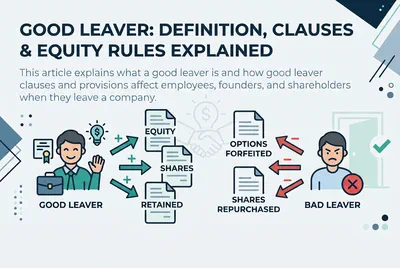
Good Leaver: Definition, Clauses & Equity Rules Explained
This article explains what a good leaver is and how good leaver clauses and provisions affect employees, founders, and shareholders when they leave a company.
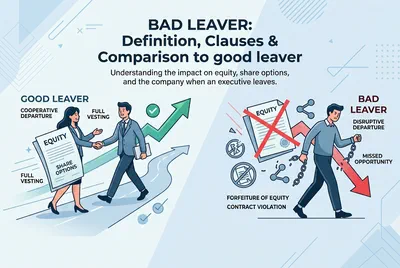
Bad Leaver: Definition, Clauses & Comparison to good leaver
This article explains the differences between good leavers and bad leavers and how their departure can affect equity, share options, and the company.
Ready to simplify your equity programs?
See how Incentrium helps you manage share-based compensation with ease. Book a demo to learn more.
Book a Demo