Devest Definition: What Does It Mean to Divest Equity and How Does Devesting Work?
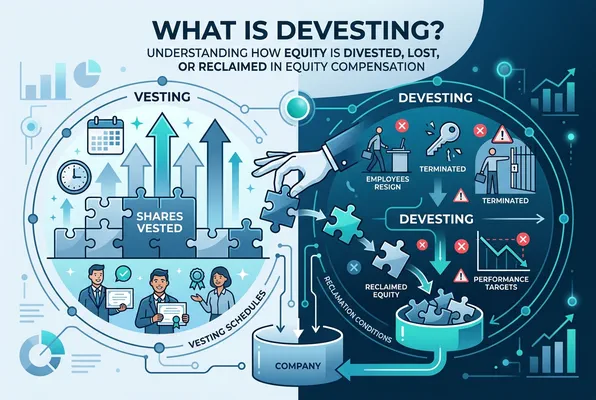

Equity compensation has become one of the most powerful tools companies use to attract and retain talent — but the rules governing how that equity is earned, and how it can be lost, are not always straightforward. If you’ve ever come across the term devesting and wondered what it means, you’re not alone. It’s a concept that sits at the heart of employee equity programs, yet it often goes unexplained in offer letters and employment contracts.
This guide breaks down everything you need to know about what devesting is, how it works in practice, and why understanding it is essential for employees, founders, and HR professionals alike.
Understanding Equity Vesting: The Foundation
Before diving into devesting, it’s important to have a solid grasp of how equity vesting works — because devesting is, by definition, the other side of that coin.
What Is Equity Vesting?
Vesting is the process by which an employee gradually earns ownership rights to company equity over time. Rather than receiving shares or stock options outright on their first day, an employee “earns” their equity incrementally according to a predefined schedule. This mechanism aligns the interests of employees with the long-term success of the company — rewarding loyalty and sustained contribution.
Common types of equity subject to vesting include:
- Stock options (ISOs and NSOs in the US, EMI options in the UK)
- Restricted Stock Units (RSUs)
- Restricted Stock Awards (RSAs)
- Phantom shares or virtual stock
- Profit participation rights (Genussrechte in Germany and Austria)
How Vesting Schedules Work
The most common vesting structure in the startup world is a 4-year vesting schedule with a 1-year cliff. This means:
- No equity vests during the first 12 months (the cliff period).
- After 12 months, 25% of the total equity vests all at once (the cliff vest).
- The remaining 75% vests monthly or quarterly over the following 3 years.
Some companies use time-based vesting, while others incorporate performance-based vesting, where equity is earned upon hitting specific milestones. Hybrid models combining both are also increasingly common.
What Is Devesting?
Devesting, sometimes written as “de-vesting”, refers to the forfeiture or reversal of equity rights that an employee has accrued or was entitled to receive. In simple terms, it is what happens when a person loses their right to vested or unvested equity, typically because they leave the company or breach a contractual obligation.
While the term is less commonly used than “vesting,” devesting is a critically important concept in equity compensation. It defines the boundaries of what you keep, and what you lose, when circumstances change.
Devesting vs. Forfeiture: Is There a Difference?
The terms devesting and forfeiture are often used interchangeably, and in most practical contexts they describe the same outcome: equity that was expected or earned is returned to the company. However, there is a subtle distinction worth noting:
- Forfeiture typically refers to the loss of unvested equity when an employee leaves before completing the full vesting schedule.
- Devesting can refer more broadly to the loss of both unvested equity and, in some cases, previously vested equity, particularly when clawback provisions are involved.
For the purposes of this article, we’ll use devesting to describe both scenarios.
Divestiture in Corporate Strategy
A divestiture is a strategic transaction in which a company chooses to sell an asset, subsidiary, or business unit. The decision to divest is often made to focus resources on core businesses, improve operational efficiency, or strengthen the firm as a whole. In many cases, a company may withdraw from an existing business that no longer aligns with its long-term objectives.
The Meaning of Divest and Devest
The meaning of divest generally refers to the act of disposing of ownership or reducing involvement in an investment. A common synonym is “dispose of,” although the exact legal definition can vary by context. By contrast, the devest definition relates to situations where rights or ownership are removed or forfeited. In certain circumstances, contractual provisions may deprive an individual of benefits that would otherwise vest, effectively taking away future ownership rights.
Why Companies Divest Assets
A firm may choose to divest a division or profitable subsidiary for several reasons. Some organizations seek to generate cash, obtain funds for expansion, or rebalance a corporate portfolio. Others pursue a carve-out strategy, where part of a business is separated while the parent company retains a partial stake. The process of divesting can also support a larger restructuring effort following a merger or corporate breakup.
Divestment and Shareholder Value
Many executives view invest divestment decisions as an important tool for creating value. When a company focuses on its strongest business activities, it can often optimize performance and improve returns for each shareholder. In some situations, a company selling non-core assets may increase its ability to pay a dividend or invest more heavily in growth opportunities across its remaining different business units.
Ethical and Social Motivations for Divestment
Not every divestment decision is driven by financial goals. Some investors choose to sever ties with certain industries for ethical or social reasons. Concerns about sustainability, governance, or environmental concerns may encourage organizations to withdraw capital from specific sectors. This form of divestment has become increasingly common among institutions seeking to align investment strategies with broader social objectives.
The Process of Selling a Business Unit
The process of selling a business often involves extensive planning, valuation, and negotiations. Whether the transaction concerns a small business unit or a large subsidiary, management must evaluate how the sale will affect the firm as a whole. A well-executed divestiture can streamline operations, strengthen strategic focus, and position the organization for future growth.
How Devesting Works in Practice
Understanding devesting in theory is one thing, seeing how it plays out in real employment scenarios is another. Below are the most common situations in which devesting occurs.
1. Leaving Before the Vesting Cliff
This is the most straightforward and most common form of devesting. If an employee leaves a company before reaching the cliff date (typically 12 months), they forfeit all of their unvested equity. The cliff exists precisely to prevent this equity from vesting, ensuring the company is protected from early departures.
Example: An engineer joins a startup with a grant of 10,000 stock options on a standard 4-year/1-year cliff schedule. If they leave after 10 months, they receive zero options — all 10,000 are devested back to the company’s option pool.
2. Voluntary Resignation Before Full Vesting
If an employee resigns after passing the cliff but before their equity fully vests, they keep the portion that has already vested and forfeit the remainder.
Example: The same engineer leaves after 2 years. They’ve vested 50% (5,000 options) and forfeit the remaining 5,000 unvested options — those unvested options are devested.
3. Termination “For Cause”
When an employee is terminated for cause, for example, due to gross misconduct, fraud, or serious breach of contract, many equity agreements allow the company to devest all equity, including shares or options that have already vested. This is a critical clause that employees often overlook.
4. Clawback Provisions
Some companies, particularly publicly traded ones or those with aggressive retention strategies, include clawback clauses in equity agreements. These allow the company to reclaim vested equity under defined circumstances, such as:
- Financial restatements resulting from misconduct
- Violation of non-compete or non-solicitation agreements
- Breach of confidentiality obligations
Clawback-driven devesting is increasingly regulated — in the US, for instance, the SEC has expanded clawback requirements for executive compensation under Dodd-Frank rules.
5. Change of Control Events
Mergers, acquisitions, and other change-of-control events can trigger complex devesting scenarios. Depending on the equity agreement:
- Unvested equity may be assumed by the acquiring company
- Unvested equity may be accelerated (single or double trigger acceleration)
- Unvested equity may be cancelled entirely, a form of devesting
Understanding what happens to your equity in a change-of-control situation is one of the most important (and most neglected) aspects of equity planning.
Key Terms Related to Devesting
To fully understand devesting, you need to be familiar with the broader equity compensation vocabulary.
Good Leaver vs. Bad Leaver
One of the most significant factors determining how much equity you keep, or lose, when you leave a company is whether you are classified as a good leaver or a bad leaver.
| Classification | Typical Equity Outcome |
|---|---|
| Good Leaver (e.g., redundancy, illness) | Keeps vested equity; unvested equity is devested |
| Bad Leaver (e.g., resignation, misconduct) | May lose some or all equity, including vested shares |
| Intermediate/Neutral Leaver | Outcome depends on specific agreement terms |
Good leaver / bad leaver provisions are especially common in European startup equity agreements, particularly in the UK, Germany, and the Netherlands. In some jurisdictions, being classified as a bad leaver can result in vested shares being bought back at a nominal or reduced price — which is effectively a form of devesting even after full vesting has occurred.
Reverse Vesting
Reverse vesting is a mechanism often used for founders rather than employees. A founder receives shares immediately but is subject to a buyback right by the company: if the founder leaves early, the company can repurchase the unvested portion at the original (typically very low) price. This is functionally identical to devesting — the founder loses economic exposure to the shares they haven’t yet “earned.”
Acceleration
Acceleration is the opposite of devesting, it’s when vesting is sped up, allowing equity to vest earlier than the original schedule. This can be single-trigger (triggered by one event, like a sale of the company) or double-trigger (requiring two events, such as a sale plus termination of employment).
Post-Termination Exercise Window
When an employee with stock options leaves a company, they typically have a limited window in which to exercise their vested options before they expire. This is known as the post-termination exercise window (PTEW). Standard windows range from 30 to 90 days, though some progressive companies have extended this to 10 years. Failing to exercise within this window results in the options expiring, a form of effective devesting.
Why Devesting Matters: The Stakeholder Perspective
Devesting isn’t a neutral administrative process, it has real financial, legal, and psychological consequences for everyone involved.
For Employees and Team Members
For employees, understanding devesting is fundamentally about financial literacy and self-protection. When you accept a job offer that includes equity compensation, the vesting schedule and devesting conditions are just as important as the headline number of shares or options.
Key questions to ask before signing:
- What is the vesting schedule and cliff period?
- What are the good leaver / bad leaver definitions?
- Are there any clawback provisions?
- What happens to my equity in a change-of-control scenario?
- How long is my post-termination exercise window?
Failing to understand these terms means you might overestimate the value of your equity package significantly.
For Startups and Founders
For founders and companies offering equity, devesting mechanisms are essential tools for:
- Retaining talent over the long term
- Protecting the cap table from former employees holding large stakes without ongoing contribution
- Maintaining alignment between equity ownership and company value creation
Well-designed devesting provisions also help companies avoid the messy situation of having disengaged or departed employees own significant equity stakes, which can complicate fundraising rounds and M&A processes.
For HR and Legal Professionals
HR teams and legal counsel need to ensure that devesting provisions are:
- Clearly drafted in employment and equity agreements
- Legally compliant with local employment and securities law
- Consistently applied to avoid discrimination claims
- Communicated transparently to employees during onboarding
In jurisdictions like Germany, Austria, and Switzerland, there are additional legal complexities around equity compensation that make professional guidance especially important.
Devesting in Different Equity Structures
Devesting operates slightly differently depending on the type of equity instrument in use.
Stock Options (ISOs, NSOs, EMI)
With stock options, devesting is typically clean: unvested options are simply cancelled and returned to the option pool. Vested but unexercised options may expire after the post-termination exercise window. Vested and exercised options (now actual shares) are generally kept, unless clawback provisions apply.
Restricted Stock Units (RSUs)
RSUs that haven’t vested are forfeited entirely upon departure — this is the most straightforward form of devesting. Since RSUs deliver actual shares only upon vesting, there is no exercise step to worry about.
Restricted Stock Awards (RSAs)
RSAs are trickier. Because shares are issued upfront (often at a nominal price), unvested shares are typically subject to a company buyback right at the original purchase price. When an employee leaves early, the company exercises this buyback — which is effectively devesting the unvested portion.
Virtual Equity and Phantom Shares
For virtual equity schemes (common in Germany and other European markets as virtual stock option programs or VSOPs), devesting works similarly to standard options: unvested phantom shares are cancelled, and any payout rights associated with them are lost.
How to Protect Yourself Against Unfair Devesting
Not all devesting provisions are fair, and it’s worth knowing your rights and negotiating levers.
Negotiate Your Cliff and Vesting Schedule
If you’re joining a company and have leverage, consider negotiating:
- A shorter cliff (e.g., 6 months instead of 12)
- Accelerated vesting for tenure already served at similar companies
- Credit for prior employment if you’ve been with a related entity
Request Acceleration Clauses
Push for double-trigger acceleration in your equity agreement, particularly if you’re joining a high-growth startup that is a likely acquisition target. This protects your unvested equity if the company is acquired and you’re subsequently let go.
Understand Your Leaver Classification
Ask specifically how “good leaver” and “bad leaver” are defined in your agreement. Vague language can work against you. Ideally, voluntary resignation should be treated as a good leaver event — though this isn’t standard.
Extend Your Exercise Window
If you’re receiving stock options, negotiate for a longer post-termination exercise window. Many employees lose significant value simply because they couldn’t afford to exercise options within 90 days of leaving. A window of 2–5 years is increasingly common at employee-friendly companies.
Devesting and Cap Table Management
From a company perspective, devesting plays a central role in cap table hygiene. A well-managed cap table should reflect actual economic contributors and avoid becoming cluttered with equity held by individuals who are no longer involved with the business.
When devesting occurs — whether through forfeiture of unvested options or buyback of unvested restricted shares — the equity typically returns to:
- The option pool, where it can be re-granted to new hires
- The company’s treasury, in the case of bought-back shares
This recycling of equity is an important feature of a healthy equity program and allows companies to continue offering competitive equity packages to new team members without continuous dilution of existing shareholders.
Modern equity management platforms like Incentrium make it much easier to track vesting schedules, model devesting scenarios, and maintain an accurate, real-time cap table — reducing the administrative burden on HR and legal teams while improving transparency for employees.
Common Misconceptions About Devesting
Let’s clear up a few myths that commonly circulate around devesting and equity forfeiture.
Myth 1: “Once equity is vested, it can never be taken away”
This is largely true for most standard employment arrangements, but not universally so. Clawback clauses, bad leaver provisions allowing below-market buybacks, and non-compete violations can all result in the effective loss of vested equity in certain circumstances.
Myth 2: “Devesting only happens if I get fired”
In reality, the most common trigger for devesting is simply voluntary resignation before the vesting schedule completes. Employees who leave to pursue other opportunities forfeit all unvested equity, regardless of how well they performed.
Myth 3: “The equity in my offer letter is guaranteed”
The headline equity number in an offer letter represents a maximum potential grant, not a guaranteed outcome. The amount you actually receive depends entirely on how much vests before you leave — and whether any devesting conditions are triggered.
Myth 4: “All companies treat devesting the same way”
Equity agreements vary enormously between companies, sectors, and jurisdictions. What’s standard in a Silicon Valley startup may be completely different from what’s typical at a German GmbH or a UK limited company. Always read your specific agreement carefully.
Conclusion: Why Understanding Devesting Is Non-Negotiable
Whether you’re an employee evaluating a job offer, a founder designing your company’s first equity program, or an HR professional managing a growing team, understanding devesting is non-negotiable. It defines the real-world value of equity compensation and shapes the incentives that keep teams aligned and motivated.
At its core, devesting is a risk-management tool — for companies to protect against short-term hires and for employees to understand the true conditions under which they’ll benefit from equity ownership. When both sides of the employment relationship understand devesting clearly, equity compensation can do exactly what it’s designed to do: create shared ownership, long-term commitment, and aligned incentives.
If you’re building or managing an equity program and want to simplify vesting schedules, automate devesting calculations, and maintain a clean cap table in real time, Incentrium offers the tools and expertise to help you do it right.
Want to learn more about equity compensation, vesting, and cap table management? Explore the Incentrium blog for expert guides tailored to startups and growing companies.
FAQ
What is devesting in simple terms?
What is the difference between vesting and devesting?
Can devesting happen after equity has fully vested?
How does devesting affect startup employees?
Written by
Dominik KonoldCEO & Founder
Dominik Konold is the CEO and founder of Finidy GmbH, specializing in share-based compensation and treasury accounting. With a background in audit and investment banking, he is a certified Professional Risk Manager (PRMIA) and lectures for the Association of Public Banks and the Academy of International Accounting.
Related Posts

Best Equity Management Software for Startups 2026
Discover the best equity management software for startups. Compare top platforms, key features, cap table tools, and compliance capabilities to manage equity.
Vesting Explained: Meaning, Schedules & Examples Guide
Understand what vesting means in ESOP and VSOP contracts: how vesting schedules work, why they matter for employees and startups, and what to watch out for before signing.

Cap Table Guide: What It Is & How It Works | Incentrium
All you need to about Cap Table as a Startup Founder
Ready to simplify your equity programs?
See how Incentrium helps you manage share-based compensation with ease. Book a demo to learn more.
Book a Demo