Future Financing Act: changes offer new opportunities for startups


The Future Financing Act changes how startups in Germany can structure employee shareholdings for tax and legal purposes. For a long time, shareholdings were considered complicated because employees had to pay tax on the value of their shares even though no money had yet been paid out. With the current changes, such as higher tax-free allowances, extended tax deferrals and new regulations for founders and shareholders, shareholdings are becoming more predictable and attractive. Anyone introducing or planning shareholdings today is making decisions with long-term effects on team loyalty and company valuation.
The difficulties of initial shareholdings
A startup is growing. The first customers have been won, the product is developing, and the team is working closely together. Salaries are below market level, but the vision is compelling. In order to retain employees in the long term, the idea of a stake in the company arises. But as soon as it becomes concrete, questions arise: Does the employee have to pay tax immediately? How is the value of the shares determined? What happens if there is no exit? Until now, many startups had to stop their plans at this point for fear of tax burdens and legal risks. However, this has changed with the Future Financing Act.
Higher tax-free allowances make shareholdings more attractive
One key change concerns the tax-free allowances for employee shareholdings under Section 3 No. 39 of the Income Tax Act. The annual allowance has been increased from 1,440 euros to 2,000 euros. This means that a larger portion of the monetary benefit remains tax-free. This is particularly relevant for startups, because investments in early stages often have moderate values. The increased allowance ensures that these investments do not immediately trigger tax consequences and thus become more attractive for employees.
Dry income problem and extended tax deferral
A central element of the Future Financing Act concerns the tax deferral for employee shareholdings, regulated in Section 19a of the Income Tax Act. The aim is to alleviate the dry income problem mentioned above. The most important changes at a glance:
- The duration of the tax deferral has been extended from 12 to 15 years (cf. Section 19a (1) sentence 2 EStG).
- The deferral continues to end prematurely in the event of an exit, other realisation of the participation or termination (see Section 19a (2) EStG).
- After 15 years without an exit or termination, a possible dry income event is mitigated by an additional deferral until the actual sale if the employer irrevocably assumes liability for income tax on the sale (see Section 19a (3) EStG). These changes make shareholdings predictable again and significantly reduce the risk for employees.
New size and age limits for beneficiary companies
Further changes in the Future Financing Act concern the conditions under which a company can benefit from tax deferral:
- The company may employ up to 1,000 employees.
- In addition, it may have either a maximum annual balance sheet total of €86 million or a maximum annual turnover of €100 million.
- Furthermore, the time requirements for these size thresholds must be met (see Section 19a (4) ff. EStG). In addition, the maximum age of a company granting an ESOP at the time of granting has been raised from 12 to 20 years, which also includes slightly older startups.
Participations by shareholders and investors
Another new feature is that shareholdings can no longer be granted by the company itself. Founders, shareholders or investors may also grant employees a direct stake in the company. This is more in line with the usual structures in venture capital and private equity, makes shareholdings more practical and gives startups more flexibility in implementation.
Legal and tax assessment remains central
Despite the simplifications, the valuation of shares remains a key issue, both for tax purposes and for management and communication. The tax advantage continues to depend on how the value of the shares is determined (see Section 3 (9) EStG). This is often a challenge for startups without external financing rounds. Valuation models must be comprehensible, consistent and documented. Software solutions such as Incentrium offer a way to design share ownership programmes in a legally sound and transparent manner, thereby building trust and reducing potential points of contention later on.
Practical implications for startups
These changes make employee share ownership plans predictable, tax-fair and usable in the long term:
- Employees are no longer subject to short-term tax burdens.
- Shareholdings can be built up over many years.
- Flexibility through the granting of shareholdings by third parties.
- Larger startups up to 20 years old can participate. This makes share ownership a strategic tool that expresses motivation, loyalty and appreciation without putting employees at a tax disadvantage.
The Future Financing Act creates a new framework for employee share ownership in startups. Higher allowances, extended tax deferrals and the easing of the dry income problem make share ownership more predictable and practicable. New size and age limits, as well as the possibility of shareholders and investors granting share ownership, expand the scope for action for young companies. For startups, this means not only tax relief, but also a solid basis for using shareholdings as a genuine strategic option for retention and motivation.
FAQ
What is the German Future Financing Act?
How does the Future Financing Act affect startups?
What is the dry income problem in employee share ownership?
Written by
Dominik KonoldCEO & Founder
Dominik Konold is the CEO and founder of Finidy GmbH, specializing in share-based compensation and treasury accounting. With a background in audit and investment banking, he is a certified Professional Risk Manager (PRMIA) and lectures for the Association of Public Banks and the Academy of International Accounting.
Related Posts
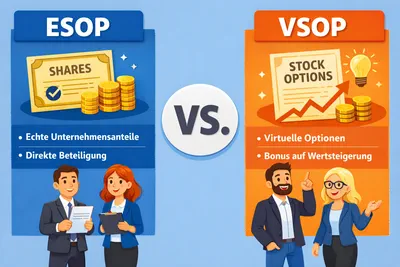
Employee participation in startups: Everything you need to know about ESOP, VSOP, vesting and more
A complete guide to employee participation in startups — covering ESOP, VSOP, vesting schedules, leaver provisions, and equity strategy for founders.
ESOP or VSOP? The crucial comparison for founders
ESOP or VSOP? Compare the crucial differences between real and virtual stock option plans to find the right fit for your startup.

Equity Evolution: Transforming the Future of Work
ESOPs and VSOPs are transforming the way that employees are compensated and incentivized for their work. Learn more about the benefits of share-based compensation and how it can benefit your company.
Ready to simplify your equity programs?
See how Incentrium helps you manage share-based compensation with ease. Book a demo to learn more.
Book a Demo