Secondaries: How employees can realise real value before the exit

Dominik Konold CEO/founder of Findiy GmbH, specializes in banking and corporate finance. With a background in audit and investment banking, he's a certified Professional Risk Manager and also serves as a lecturer in banking and accounting.
- Knowlwedge
- February 16, 2026
Sooner or later, start-ups face the challenge of not only allocating company shares but also making them truly usable. Employee participation is becoming strategically more important, but loses its impact if liquidity only materialises years later. Secondaries open a way to convert shares into capital even before an exit. The growing importance of such models is currently changing how young companies think about participation, motivation and retention.
Why secondaries are becoming so important for start-ups
Many young companies plan for the long term and remain private for much longer than they did a few years ago. IPOs are being postponed, strategic sales are more difficult to predict and exit dates are difficult to plan. For employees, this means that shareholdings may be growing on paper, but they are not financially usable.
Employee participation only has its full effect when there are real prospects for value realisation. Liquidity prior to an exit therefore becomes a decisive factor for motivation, loyalty and trust. Secondaries create precisely this access to capital without the company itself having to issue new shares or raise additional growth capital.
What exactly are secondary sales?
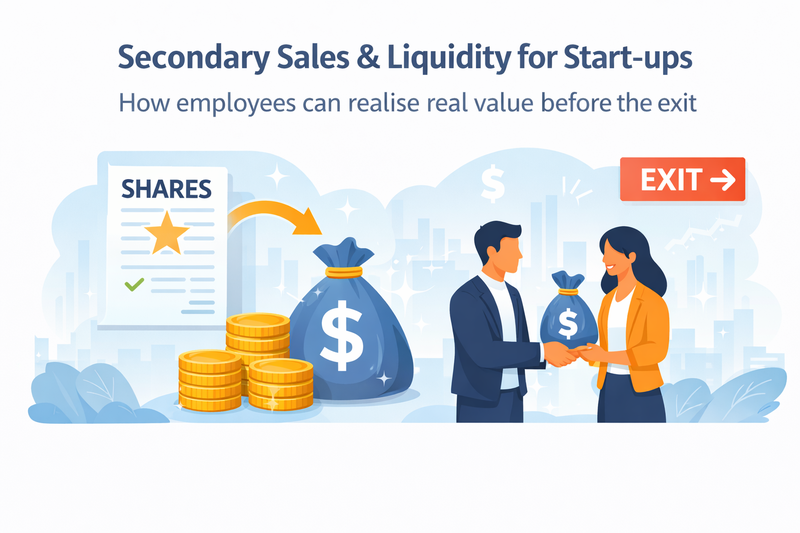
Secondary sales are transactions in which existing shares or stakes in private companies are sold to external buyers. Unlike a new round of financing, this money does not flow into the company, but directly to those who hold shares, i.e. employees, founders or early investors.
In practice, this is often handled via specialised platforms or institutional investors. Such secondary markets make it possible to sell shares even before an IPO, which was almost unthinkable in the past.
Companies remain private for longer
Many high-growth start-ups deliberately decide against an early IPO. Instead, they focus on sustainable growth, international scaling and stable business models. This significantly extends the time frame until a classic exit, which necessitates new ways of generating liquidity.
Employee participation is used more strategically
Participation programmes have long been more than just an incentive. They are used specifically to retain key personnel in the long term and promote entrepreneurial thinking. To maintain this effect, there is a growing demand for realistic opportunities to realise value during the life of the company.
Secondaries become part of the capital strategy
Secondary sales are increasingly becoming an integral part of corporate planning in later growth phases. They make it possible to create liquidity without issuing additional shares or changing control of the company. For founders and investors, secondaries are therefore a tool for ensuring stability in the shareholder structure.
Professionalisation of processes
As start-ups mature, the requirements for transparency and structure also increase. Equity models, cap table management and clear rules on sales options are becoming increasingly important. Secondaries require clean processes and a common understanding among all parties involved.
Advantages of secondary sales for start-ups and employees
- Motivation through real value realisation: Equity becomes tangible when employees can monetise at least part of their shares. This significantly increases loyalty and motivation.
- No dilution for the company: Since no new shares are issued, the participation ratio of existing shareholders remains unchanged. This is a key advantage for founders.
- Financial flexibility for employees: Liquidity prior to exit allows for personal financial decisions and reduces individual risks. This is particularly relevant in times of economic uncertainty.
Risks and decision-making issues:
- Balancing early liquidity and potential added value: An early sale can provide security but often means a lower price than a later exit. This decision requires basic financial knowledge and realistic expectations.
Legal and tax complexity: Secondary sales are legally challenging. Articles of association, vesting arrangements, tax treatment and approval requirements must be carefully examined. A clear structure is crucial, especially for young companies, in order to avoid conflicts later on.
How start-ups can successfully use secondary sales
- Early communication within the team: Transparency is crucial. Employees should understand how equity, ESOPs and potential secondary sales work. Only then can they make informed decisions. After all, clarity breeds trust.
- Professional cap table management: A digital system for managing complex equity programmes is essential. Solutions such as Incentrium help start-ups to efficiently manage equity plans and prepare relevant reports for secondary strategies.
- Strategic planning with investors: Founders and leadership teams need to discuss secondary sales with investors at an early stage. Such sales can often be combined with a new financing round to send positive market signals and facilitate pricing.
Practical examples from the market
International fintechs and technology companies use secondary sales in a targeted manner to provide liquidity to employees while securing growth.
Revolut, Monzo and Moneybox have implemented structured secondary programmes in late stages of their development, setting new standards for employee participation.
Summary
Secondaries are more than just a financial tool. They are an expression of a modern corporate culture that takes participation seriously and offers employees real prospects. They open new ways to realise value, strengthen motivation and create financial flexibility without having to wait for an exit. For start-ups that want to retain talent in the long term and build trust, structured secondary models are increasingly becoming a competitive advantage. Those who get to grips with the basics early on and make informed decisions lay the foundation for sustainable corporate success.