ESOP or VSOP? The crucial comparison for founders

Dominik Konold CEO/founder of Findiy GmbH, specializes in banking and corporate finance. With a background in audit and investment banking, he's a certified Professional Risk Manager and also serves as a lecturer in banking and accounting.
- Knowledge
- December 29, 2025
ESOP or VSOP? The crucial comparison for founders
Have you already asked yourself which employee participation model is right for your start-up, but are still unsure? You are not alone. The decision between ESOP and VSOP is not easy and requires background knowledge. It affects employee motivation and also influences how well the company can be managed and developed.
Young companies in particular face the challenge of attracting talented employees despite limited financial resources. Employee participation models can be a solution. However, the models differ significantly in their organisation and impact. Only a closer look at ESOP and VSOP will reveal which model is better suited to you in the long term.
ESOP: Participation through real company shares
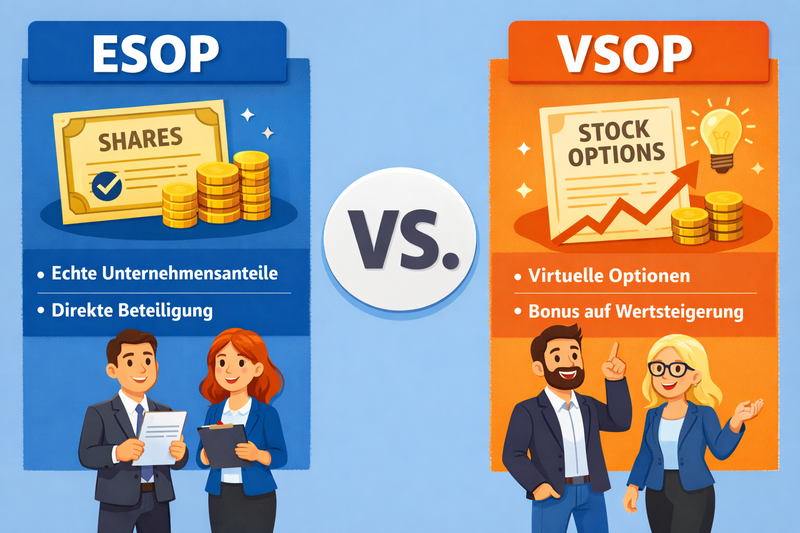
In an ESOP, employees receive real company shares and officially become shareholders. This form of participation is clearly regulated and subject to fixed conditions.
Real shares are usually accompanied by voting rights. Employees can participate in shareholder decisions and are entitled to certain information rights. For companies that value maximum transparency and long-term co-entrepreneurship, this can send a strong signal. Employees feel not only economically but also structurally involved.
With each additional shareholder, the organisational and legal complexity increases. Changes to company law must be notarised, and share transfers involve costs and administrative effort. At the same time, decision-making processes are prolonged as more parties must be involved.
An ESOP is therefore particularly suitable for companies with stable structures, clearly defined roles and a manageable number of participants.
VSOP: Participation in the company’s success without actual company shares
A VSOP takes a fundamentally different approach. Employees do not receive real shares, but rather contractually regulated claims that correspond economically to a shareholding. They participate in the success of the company without owning shares.
Payment is typically made upon exit or comparable events. The amount is based on the company valuation and the agreed scope of participation. This does not give rise to voting rights or co-determination rights.
For many start-ups, this is precisely the biggest advantage. The founders retain full control over strategic decisions. The corporate structure remains unchanged. There is no requirement for a notary to be involved in the allocation of virtual shareholdings. Adjustments can be implemented flexibly and quickly.
The administrative effort is also significantly lower. Virtual shareholdings can be allocated in a standardised manner and are easily scalable. This is a decisive factor, especially for fast-growing teams or international employees.
If you want to learn more about the differences between the two models, you will find a clear overview
here
.
Voting rights: trust or control?
The question of voting rights is not a legal one, but a cultural one. Do you want to actively involve employees in business decisions, or should responsibility clearly remain with the founders? An ESOP can strengthen the sense of belonging and turn employees into co-creators. At the same time, it increases the need for coordination. Strategic decisions require more coordination and often take longer. A VSOP deliberately dispenses with co-determination. Participation is purely economic. For many start-ups, this is the more pragmatic approach, especially when quick decisions and clear responsibilities are crucial.
Notarial requirements and organisational flexibility
Notarisation requirement is one of the key differences in practical implementation. Notarisation is mandatory for real shares. This applies to both the initial allocation and subsequent adjustments. Virtual shareholdings do not have these formal hurdles. Contracts can be adjusted without triggering corporate law processes. This saves time, money and stress, especially in phases of rapid growth.
Administration and scaling in everyday life
As the number of employees grows, the administrative burden increases exponentially. An ESOP requires clean shareholder management, regular formal processes and clear documentation. A VSOP is much easier to manage. Incentrium supports start-ups in clearly presenting vesting periods, participation levels and potential payouts, thereby significantly reducing the administrative burden. For start-ups with ambitious growth plans, this scalability is a decisive argument.
Which choice is the right one?
The decision between ESOP and VSOP depends on several factors. The company’s phase, team structure, investor interests and corporate culture play a central role.
An ESOP makes sense if long-term co-ownership is a priority and the organisation is prepared to take on additional complexity. A VSOP offers maximum flexibility, clear decision-making structures and easy scaling.
There is no universally correct model. There is only the model that fits your vision and your growth path.
Conclusion
Employee participation is a strategic tool with far-reaching consequences. Anyone who takes a differentiated view of ESOPs and VSOPs will quickly realise that it is not a question of better or worse, but of suitable or unsuitable.
Start-ups that address the legal, tax and organisational implications at an early stage create a stable foundation for sustainable growth. A well-informed decision today saves complicated corrections tomorrow.